Blast at Gaza rally kills 10

A truck carrying masked militants and two home-made rockets blew up at a Hamas rally in Jebaliya, Gaza, today, killing at least 10 Palestinians and wounding 85, hospital doctors said.

Blast at Gaza rally kills 10

A truck carrying masked militants and two home-made rockets blew up at a Hamas rally in Jebaliya, Gaza, today, killing at least 10 Palestinians and wounding 85, hospital doctors said.

Hamas blamed Israel, but the Israeli military denied involvement and the Palestinian Interior Ministry said the blast was set off by the mishandling of explosives.

Ten of the wounded were in serious condition, hospital doctors said.

The rally was held in the Jebaliya refugee camp, one of the last military-style parades before a ban on flaunting weapons in public – agreed to by all militant groups – is to go in effect tomorrow evening.

Witnesses said participants, including many children, crowded around the truck when the explosion went off. The witnesses said the truck carried two home-made rockets.

One man, who only gave his first name, Hussam, said he helped pull three men out of the pickup, two of them dead and one who was still alive, but had a leg severed. The side of the truck was charred.

The witness said he saw five dead children nearby. However, it was difficult to count torn up bodies.

Dozens of children were wounded in the blast. The Hamas military wing, Izzedine al Qassam, is popular with youngsters and when the pickup with the gunmen arrived at the rally, many crowded around the vehicle.

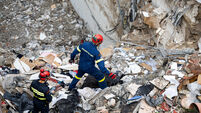
After the blast, men carried bloody body parts and lifeless bodies wrapped in blankets to nearby cars. The dead and wounded were taken to nearby hospitals.

At Shifa Hospital in Gaza, doctors had to treat patients on the floor of the emergency room because they ran out of beds. Masked Hamas men wheeled in casualties, including children.

The truck was not heavily damaged by the blast.

One witness, Hazem Abu Rashad, 18, said the truck had two rockets in its bed. Three militants rode in the back and three or four others were inside, he said.

“There was smoke all over, and then we saw people in pieces, but we couldn’t make out what really happened,” he said.

Also today, Palestinians temporarily opened the crossing between Gaza and Egypt, taking control of a border for the first time in their history. Palestinians hoped the two-day opening would set a precedent and pressure Israel to reach a permanent border agreement with them.

Earlier, Israeli forces killed three Palestinian gunmen in a West Bank raid.

Israel shut down Rafah, Gaza’s main gateway to the outside world, before leaving the coastal strip last week after 38 years of occupation. Israel wants Rafah to remain sealed for six months, for a technological upgrade and to test the Palestinians’ ability to take control in Gaza. In the meantime, Palestinians are to use an alternative, crossing in Israel, which is to be opened next week.

Israel, however, did not object to the Palestinians plan to open Rafah for two days starting today, intended mainly to allow the passage of people seeking medical treatment, or studying or residing abroad.

Several thousand travellers arrived at Rafah this morning, turning over travel documents to Palestinian border police at the gates of the once heavily guarded crossing, waiting for border officials to call them to board buses that would take them to the Rafah terminal, and from there, to Egypt. Some of the travellers sat on suitcases, napping as they waited.

Inside the gate, new X-ray equipment was in place, and plastic still covered the new chairs in the air-conditioned waiting area.

“This is the first time we cross without the Israelis standing over our heads, and that indeed is a blessing,” said Manal Hatem, 36, who arrived with her 11-month-old baby and a sister-in-law, en route to a religious pilgrimage to Mecca, Saudi Arabia.

Thousands of Palestinians busted through the Gaza-Egypt border last week after Israel withdrew, before the frontier was again sealed.

Mark Regev, an Israeli Foreign Ministry spokesman, said Israel was concerned by the border chaos last week, and doesn’t want the crossing permanently reopened until security is upgraded.

“If that crossing doesn’t function in a positive way, that has very negative security consequences,” Regev said, without clarifying why Israel allowed the two-day opening.

Rafah is important to the economic recovery of Gaza, which was devastated by nearly five years of Israeli-Palestinian fighting. Stable border arrangements there would encourage foreign investment in Gaza, and ensure the free flow of people, long cooped up under Israeli travel restrictions.

Yesterday, Israeli Defence Minister Shaul Mofaz indicated Israel would speed up its plans to reopen Rafah, probably by January.

x

More in this section

Cookie Policy Privacy Policy Brand Safety FAQ Help Contact Us Terms and Conditions

© Examiner Echo Group Limited