Hurricane body count less than expected

Alarming predictions of as many as 10,000 dead in New Orleans may have been greatly exaggerated, with authorities saying that the first street-by-street sweep of the swamped city revealed far fewer corpses than feared.

Hurricane body count less than expected

Alarming predictions of as many as 10,000 dead in New Orleans may have been greatly exaggerated, with authorities saying that the first street-by-street sweep of the swamped city revealed far fewer corpses than feared.

“Some of the catastrophic deaths that some people predicted may not have occurred,” said Col Terry Ebbert, the city’s homeland security chief.

He declined to give a revised estimate, but added: “Numbers so far are relatively minor as compared to the dire projections of 10,000.”

The encouraging news came as workers repairing New Orleans’ system of levees and water pumps predicted that it would take a month to dry out the city ravaged by Hurricane Katrina.

Authorities officially shifted most of their attention to counting and removing the dead after spending days cajoling, persuading and all but strong-arming the living into leaving the city because of the danger of fires and disease from the fetid floodwaters.

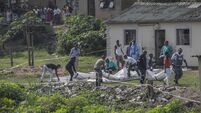
Ever since the hurricane struck on August 29, residents, rescuers and cadaver-sniffing dogs have found bodies floating in the waters, trapped in attics or deft lying on broken highways. Some were dropped off at hospital doorsteps or left slumped in wheelchairs out in the open.

Mayor Ray Nagin suggested last weekend that “it wouldn’t be unreasonable to have 10,000” dead, and authorities ordered 25,000 body bags. But soldiers who had been brought in over the past few days to help in the search were not seeing that kind of toll.

“There’s nothing at all in the magnitude we anticipated,” said Maj Gen Bill Caldwell, commander of the Army’s 82nd Airborne Division.

Ebbert said the search for the dead would be done systematically, block-by-block, with dignity and with no news media allowed to follow along.

The US Army Corps of Engineers said most of the city could be drained by October 2, but some of the eastern areas of New Orleans and the hard-hit community of Chalmette, across the Mississippi River, could be under water until October 8. Plaquemines Parish, which suffered a storm surge from the coast, could take another 10 days to drain.

The effort to get water out of the city, which had been 80% covered following the storm and levee breaches, was helped by dry weather and gaps blown in the levees to allow floodwaters to drain out.

Over the past few days, police and soldiers trying to rescue the living marked houses where corpses were found, or noted their location with global positioning devices, so that the bodies could be collected later.

State officials could not provide an exact count of the dead recovered so far. Corpses from New Orleans were taken to a mortuary in nearby St Gabriel, where medical examiners worked to identify the remains.

Still, thousands of stubborn holdouts were believed to staying put in the city, and authorities continued trying to clear them out.

Police fearing deadly confrontations with jittery residents enforced a new order that barred homeowners from owning guns. The order does not apply to the hundreds of M-16-toting private security guards hired to protect businesses and wealthy property owners.

But there were still no reports of anyone being taken out by force under the three-day-old order from the mayor, and there were growing indications that that was little more than an empty threat.

:: Former US vice president Al Gore helped airlift 270 evacuees from Hurricane Katrina on two private charters from New Orleans, after a plea from a doctor who saved the life of the Gore’s son after a 1989 car accident.

Gore, a Democrat who served as President Bill Clinton’s deputy and lost the presidential race in 2000 to George Bush, criticised the Bush administration’s slow response to Katrina in a speech in San Francisco, but refused to talk about the mercy missions he financed and flew on September 3 and 4.

However, Dr Anderson Spickard, who is Gore’s personal physician and accompanied him on the flights, said: “Gore told me he wanted to do this because like all of us he wanted to seize the opportunity to do what one guy can do, given the assets that he has.”

An account of the flights was posted this week on a Democratic Party web page. It was written by Greg Simon, president of the Washington-based activist group FasterCures. Simon, who helped put together the mission, also declined to be interviewed.

On September 1, three days after Katrina slammed into the Gulf Coast, Simon learned that Dr David Kline, a neurosurgeon who operated on Gore’s son, Albert, after a life-threatening car crash in 1989, was trying to get in touch with Gore. Kline was stranded with patients at Charity Hospital in New Orleans.

“The situation was dire and becoming worse by the minute – food and water running out, no power, four feet of water surrounding the hospital and … corpses outside,” Simon wrote.

Gore responded immediately, telephoning Kline and agreeing to underwrite the £28,000 (€41,500) each for the two flights, although Larry Flax, founder of California Pizza Kitchens, later pledged to pay for one of them.

More in this section

Cookie Policy Privacy Policy Brand Safety FAQ Help Contact Us Terms and Conditions

© Examiner Echo Group Limited