Tycoon Khodorkovsky jailed for nine years
A court declared oil tycoon Mikhail Khodorkovsky guilty of an array of charges today in a trial widely criticised as politically motivated, sentencing him to nine years in prison minus time served.
The declaration of guilt and sentence came in the 12th day of the laborious verdict-reading process in the most closely watched trial of post-Soviet Russia.
Khodorkovsky, the former head of the Yukos oil company and once estimated to be Russia’s richest man, has already spent 583 days in jail, meaning he would serve about another seven-and-a-half years in prison.
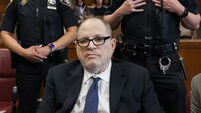
Khodorkovsky, pale and his lips pursed, looked straight ahead as the sentence was pronounced. In a statement later read outside the court by defence lawyer Anton Drel, Khodorkovsky said he would not harshly criticise the judge, noting “the pressure she has come under from the initiators of the case when preparing the verdict.”
“Judicial power has been turned into a blunt weapon of the authorities,” he said in the statement. The statement also said Khodorkovsky would try to devote his efforts in prison to an array of charitable and social works, including a proposed fund for aiding inmates.
His co-defendant Platon Lebedev, found guilty of the same charges and given the same sentence, said: “There’s not a sane person who can understand what you have said.” The judge then read his sentence again.
Khodorkovsky and Lebedev also were ordered to pay more than 17 billion rubles (about €500m) in taxes and penalties.
Supporters have claimed that Khodokovsky’s trial was part of a Kremlin-driven campaign to punish him for funding opposition parties and to stifle his own political ambitions. The sentence would keep him in prison well past the 2008 presidential elections, when a successor to Vladimir Putin is to be chosen, and potentially during the 2012 elections as well.
Asked if she had expected the tough sentence, Khodorkovsky’s mother Marina said “Of course, I live in this country. ... I lost my son the day we elected Putin.”
A third defendant in the case, Andrei Krainov, was given a five-and-a-half year suspended sentence.
The court did not sentence them on a charge regarding Apatit, a fertiliser component company in which Khodorkovsky and Lebedev allegedly acquired a large stake by rigging a privatisation auction. Although the court considered them guilty, the statue of limitations on the 1994 matter had expired, according to prosecutors.
Khodorkovsky’s lawyers plan to appeal within the 10-day period allotted under Russian law. The Prosecutor-General’s office, meanwhile, reiterated today that new criminal charges against Khodorkovsky are being prepared.
Khodorkovsky is one of the so-called oligarchs who became enormously wealthy during the murky post-Soviet privatisation of state industries in the 1990s. Such tycoons are widely resented by ordinary Russians and demonstrators denouncing Khodorkovsky have been a daily fixture outside the courthouse during the weeks of verdict-reading.
But there have also been gatherings of Khodorkovsky supporters – who say the trial was revenge for his funding of opposition parties and who say the proceedings raised substantial doubt about Russia’s commitment to rule of law.
The verdict “shows that in Russia there is no independent court, in Russia there is only the all-powerful Prosecutor-General,” liberal politician Irina Khakamada said.
Demonstrators’ chants of “Shame, shame!” could be heard even inside the courtroom as the proceedings continued after the sentencing.
Concerns about Russia’s observance of legal propriety and respect for shareholders’ rights have spooked many foreign investors.
“It does make people concerned, leery about an environment they don’t understand,” US Commerce Secretary Carlos Gutierrez told Russian and US business representatives in Moscow today. “Any time the business community sees something that impacts business and doesn’t really understand why, then that’s a setback because then businesses will not wnt to invest.”
Khodorkovsky, whose fortune was once estimated as high as £8.2bn, has been in jail since his October 2003 arrest when special forces stormed his private plane as it sat on the tarmac at a Siberian airport.
A liberal member of parliament, Vladimir Ryzhkov, suggested yesterday that Khodorkovsky’s team consider filing an appeal with the European Court of Human Rights, “which will make a decision on the basis of common sense and law,” the Interfax news agency reported.
“This verdict is a tragic example of the authorities turning a legal system against an individual for political ends,” said Yukos spokesman Alexander Shadrin.
Parallel to Khodorkovsky’s trial, Yukos has been battered by some £15bn in back taxes claims. The company’s main production unit was sold off by the state to meet some of the tax arrears, in a murky auction in which the unit was bought by a shell company and then acquired by a state-controlled oil company.
Yukos announced shortly after the verdict and sentencing of Khodorkovsky that it had filed a court challenge to the production unit’s sale and would seek 324 billion rubles in damages.
Khodorkovsky and Lebedev are to serve their sentences at medium-security prison camps – which, because inmates sleep in dormitories and can move about outside, are seen as somewhat more tolerable than Russia’s deteriorating and overcrowded jails.
CONNECT WITH US TODAY



Be the first to know the latest news and updates