US forces bombard Fallujah
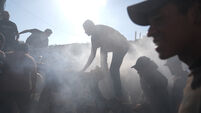
US warplanes and artillery attacked Sunni insurgents in a thunderous show of force that rocked Fallujah, sending huge plumes of black smoke into the night sky.
The assault came after US troops killed 64 gunmen near the southern city of Najaf.
A US soldier died yesterday in Baghdad, raising the US death toll for April to 115 – the same number killed during the invasion of Iraq that toppled Saddam Hussein last year. Up to 1,200 Iraqis also have been killed this month.
The second straight night of battles in Fallujah came as the extension of a fragile cease-fire ended yesterday in the turbulent city west of Baghdad. US Marines have been preparing to begin patrols in the city later this week.
Yesterday’s battle appeared far heavier than the previous night’s clashes, in which eight insurgents and a US Marine were killed – suggesting that US forces were trying to wear down gunmen in the Jolan neighbourhood, a district of narrow alleyways and ramshackle houses.
An AC-130, a powerful gunship that can unleash a deluge of ordnance, joined 105mm howitzers fired by the US military on insurgent targets in the neighbourhood. Gunfire and explosions reverberated for nearly two hours, and an orange glow shone over the area while showers of sparks descended like fireworks.
Fires were visible in the Jolan neighbourhood, and mosque loudspeakers elsewhere in the city called for firefighters. US aircraft dropped white leaflets over Fallujah before nightfall, calling on insurgents to give up.
“Surrender, you are surrounded,” the leaflets said. “If you are a terrorist, beware, because your last day was yesterday. In order to spare your life end your actions and surrender to coalition forces now. We are coming to arrest you.”
Fighting also broke out yesterday in Baghdad and in the south, where US forces are in a stand-off with militiamen loyal to radical Shiite cleric Muqtada al-Sadr, who is wanted on murder charges for allegedly killing a fellow cleric.
US forces killed 64 Iraqis on Monday and yesterday in battles with militiamen outside the Shiite holy city of Najaf, US Brigadier General Mark Kimmitt said.
Washington is trying to avoid a resurgence of the intense fighting ahead of June 30 – the date for installation of a new Iraqi government.
In New York, UN envoy to Iraq Lakhdar Brahimi briefed the Security Council on plans for a caretaker government that would take over from the US-picked Governing Council. He also warned that there would be a ”very bloody confrontation” unless an agreement is reached to end fighting in Fallujah.
John Negroponte, who has been nominated as US ambassador to Iraq, acknowledged that the caretaker government would have limited powers because the Iraqi security forces were not yet strong enough. The US would keep control of security forces, and the new government may not have the authority to pass laws, he told lawmakers in Washington.
Several US-allied Iraqi leaders demanded that the government receive full sovereignty.
Mohsen Abdel-Hamid, a Sunni Arab on the Governing Council, said the prospect of the US retaining some sovereignty is “not acceptable, this is totally rejected”.
If the Americans do not respect agreements on giving complete sovereignty, “then the Iraqi people know what route to take”, he said.
Two nights of battles in Fallujah have strained US attempts to find a political way out of the siege of the city to avoid a resumption of full-fledged fighting.
US Defence Secretary Donald Rumsfeld told reporters at the Pentagon yesterday that continuing negotiations in Fallujah was “worth the try”.
He said: “I think that realistically if you’ve got some very tough people in a city that are terrorists … that you have to expect that they’re not going to be terribly cooperative.
“Now, does that mean that something can’t be worked out? No.”
US General Richard Myers, chairman of the Joint Chiefs of Staff, also said that the coalition hasn’t completely given up on a cease-fire. But he said in a speech to a group of disabled veterans in New York that “we don’t have unlimited patience”.
Joint patrols by US Marines and Iraqis are a key part of the political effort, aiming to restore a semblance of control in Fallujah. Marines began training Iraqi security forces yesterday for the patrols, practicing in an industrial zone on the southern side of the city held by US forces.
South of Baghdad, US troops battled militiamen loyal to al-Sadr on the east side of the Euphrates River, outside the cities of Najaf and Kufa.
The first fight came yesterday afternoon when Shiite militiamen fired on a US patrol. In the ensuing firefight, seven insurgents were killed. Hours later, an M1 tank was attacked with rocket-propelled grenades. A heavy battle erupted, during which warplanes destroyed an anti-aircraft gun belonging to the militia and 57 gunmen were killed, Kimmitt said.
Najaf hospitals listed 37 dead, all young men of fighting age, suggesting they may have been militiamen. Al-Sadr aides said civilians also died, but could not say how many.
The fighting came as US troops are trying to up the pressure on al-Sadr. A force of 200 US troops moved into a base in Najaf to replace Spanish troops. The Americans have said they will avoid the Shiite holy shrines about three miles away in the heart of Najaf.
Fewer al-Sadr fighters were seen yesterday on the streets of Najaf and nearby Kufa, where they have been digging in over the past week against a possible American attack.
Some 2,000 US troops are deployed outside Najaf, the holiest Shiite city in Iraq. Any action that brings the possibility of harm to the Imam Ali Shrine in Najaf could turn the limited al-Sadr revolt into a widespread uprising by Iraq’s Shiite majority.