Police arrest key Serb war crimes suspect
Police in Serbia-Montenegro have arrested a former army officer and war crimes suspect hiding in an apartment building after fierce battles with a violent crowd trying to protect him.
The arrest of Veselin Sljivancanin was made hours after special police raided his apartment but failed to locate him there, a senior Serbian government official said.
Sljivancanin, who was indicted by the UN war crimes tribunal in The Hague, Netherlands, was ultimately found after police broke through a steel-reinforced door near his apartment. Other details of his arrest were not immediately known.
Sljivancanin was arrested after a 10-hour police siege of his apartment building, B-92 radio reported later.
Witnesses at the scene saw Sljivancanin being led out of the building, the radio said. A convoy of armored police vehicles sped away as Sljivancanin was taken to Belgrade’s central prison.
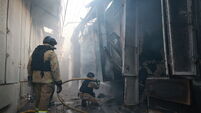
The police action to retrieve the hiding war crimes suspect was preceded by hours of battles in which police threw stun grenades and lots of teargas to disperse the crowd after their initially unsuccessful raid on his apartment.
Some rubber bullets were also fired into the surging protesters, and at least seven of them were injured. The number of police suffering injuries in the clash was not immediately known.
The confrontation between several dozen police and a few hundred protesters supporting Sljivancanin escalated when the crowd threw a burning tire and stones, bricks, beer bottles and other missiles to attack the officers inside the building.
In the meantime, police were apparently combing the apartment building to find Sljivancanin amid persistent rumors he was inside.
As the crowd swelled to at least 1,000, police received scores of reinforcements charging into the protesters and preventing them from entering the building.
After police managed to push the protesters away, some of them set a nearby grass field ablaze, but it was not known whether anyone was hurt by the fire. The crowd was later dispersed.
Hours earlier, black-clad crack units with machine guns stormed the five-storey apartment building in a Belgrade suburb, moving into Sljivancanin’s home on the fourth floor. But they found only his daughter and a relative inside, witnesses and other tenants said.
A group of Sljivancanin’s backers and other hard-line nationalists gathered at the scene, waving a Serbian flag, and began throwing rocks and beer bottles at the police.
Police initially refrained from responding, but as the crowd grew increasingly hostile, officers in riot gear used batons to disperse the protesters.
Police first were searching through various documents and pictures found in Sljivancanin’s home, his daughter, Aleksandra, said.
Sljivancanin has been indicted by the Netherlands-based UN war crimes tribunal for the killing of more than 200 people in eastern Croatia in 1991.
After being indicted by the court in 1995, Sljivancanin managed for years to evade arrest because he was protected by the authorities of former President Slobodan Milosevic until that regime fell in 2000. He has since been in hiding from the new democratic government that has been under Western pressure to arrest and hand over all war crimes suspects.
But right-wing nationalists regard Sljivancanin as a hero of the 1991 rebellion by ethnic Serbs in Croatia, who took up arms that year against the republic’s secession from former Yugoslavia and fought alongside federal forces of the then crumbling Yugoslavia.

CONNECT WITH US TODAY



Be the first to know the latest news and updates