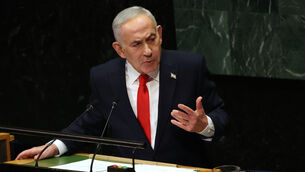
Sharon accepts peace road map to Palestinian state
Israeli Prime Minister Ariel Sharon announced today that he is prepared to “accept the steps prescribed” in the road map peace plan that will lead to a Palestinian state and he would present it to his Cabinet for approval.
Sharon said in a statement that he has informed President George Bush of his decision.
The statement followed weeks of hesitation, and came just hours after the Bush administration assured Israel that its concerns regarding the plan would be taken into account.
The Israeli Cabinet will discuss the peace plan on Sunday or Monday, said a Sharon adviser, Raanan Gissin.
“In light of the fact that the United States will address Israel’s concern, Israel accepts the road map,” Gissin said. “This has provided an assurance that the prime minister will submit it and get is passed.”
A statement released by Sharon’s office said: “Prime Minister Ariel Sharon has informed the United States that the state of Israel is prepared to accept the steps prescribed in the road map and that the matter will be brought before the Cabinet for approval.”
Earlier, the White House appeared to open the way for changes to be made to the peace plan as Israel had demanded.
But within minutes of the Bush administration releasing a statement implying the plan might be flexible, Secretary of State Colin Powell said: “We not planning on making any changes to the road map.”
Israeli Prime Minister Ariel Sharon has indicted wants more than a dozen changes to the plan, jointly formulated by the US, EU, UN and Russia, which envisages a state of Palestine by 2005.
The Palestinians have accepted the plan and insisted again today that there should be no changes to the wording.
Today’s confusion over the flexibility of the plan began shortly after the White House released a joint statement from Powell and National Security Adviser Condoleezza Rice.
It said: “The United States shares the view of the government of Israel that these are real concerns.”
It said the White House would “fully and seriously” consider Israel’s “significant concerns” and added that the concerns will be addressed “in the implementation” of the road map.
But a short while later in Paris, Powell emphasised: “With respect to the road map, we’re not planning on making any changes to the road map.”
“We have told the Israeli government that we would take their comments and address them seriously and fully as we went forward in the implementation of the road map.
“This does not require us to change the road map. It is a good document that leads to the president’s vision of two states living in peace side by side,” Powell said.
In the Gaza Strip today a pipe bomb went off near an armoured bus carrying Israelis. Hamas claimed responsibility for the attack, which wounded eight people.
A key part of the first phase of the road map is for the new Palestinian Prime Minister Mahmoud Abbas to stop militant attacks.
A wave of terror attacks caused Sharon to postpone a trip to Washington this week. But the two leaders seemed likely to meet soon: Bush is considering a three-way meeting in Egypt with Sharon and Abbas, US officials said.
Israeli Foreign Minister Silvan Shalom said Bush and Sharon might also meet at the end of next week in Europe, where Bush will be attending the G-8 summit of the world’s leading industrial nations.
One of Sharon’s main worries is that the road map requires the dismantling of recently built Israeli settlements in the West Bank and Gaza.
The Palestinians said they had been assured by Washington that there would be no changes to the plan, and that they had accepted it based on this promise.
“We are ready to implement the road map as one package and without any changes,” Palestinian Information Minister Nabil Amr said today.
The road map is a bid to end 32 months of fighting, freeze Israeli settlement construction and establish a Palestinian state by 2005 on land Israel has held for 36 years.
Bush is hoping he can do what his predecessors have failed to do and help bring about a dramatic breakthrough in the Israeli-Palestinian conflict.