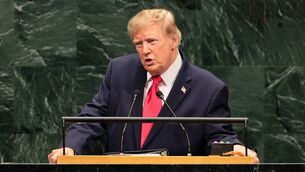
Bush appeals to former Iron Curtain states
President Bush compared Osama bin Laden’s al-Qaida terrorist network and Afghanistan’s Taliban rulers to communist Iron Curtain-era regimes in an appeal today to Eastern Europe, former Soviet republics and Balkan nations for help fighting terrorism.
‘‘For more than 50 years, the peoples of your region suffered under repressive ideologies that tried to trample human dignity,’’ Bush was to tell officials from about 20 nations gathered in Warsaw, Poland, to discuss combating terrorism.
‘‘Today our freedom is threatened once again,’’ he was to say via satellite, according to aides. ‘‘Like the Fascist totalitarians before them, these terrorists al-Qaida, the Taliban regime that supports them and other terror groups across the world try to impose their radical views through threats and violence.’’
Bush is stepping up his contacts with world leaders at a time when some of them, and their citizens, are expressing doubts and impatience about the military campaign in Afghanistan. He was to meet French President Jacques Chirac and Serbian Prime Minister Zoran Djindjic today.
He received fresh words of caution last night from Algerian President Abdelaziz Bouteflika, who pledged support but warned that the military operation in Afghanistan must minimise civilian deaths.
Bush was seeking to allay such concerns today, saying, ‘‘Our efforts are directed at terrorists and military targets, because unlike our enemies, we value human life.’’
By invoking the ghosts of communism in his speech, Bush was walking a fine line between stirring listeners to his cause and inflaming officials from countries, such as Russia and the former Soviet satellites, where communists still enjoy some support.
The leaders gathered at the invitation of Polish President Aleksander Kwasniewski to discuss ways they can cooperate in fighting terrorism.
Heads of state from Albania, Bosnia, Croatia, Estonia, Latvia, Lithuania, Moldova, Romania, Slovakia, Ukraine and Macedonia have confirmed participation.
Bulgaria, the Czech Republic, Slovenia and Yugoslavia planned to send senior government representatives, he said. Hungary also was expected to participate, but had not decided whom to send.
Observers were expected from Russia, Belarus, Turkey, the European Union, Nato and the Organisation for Security and Cooperation in Europe.
White House spokesman Ari Fleischer called it ‘‘a rather unusual gathering.’’
‘‘These nations used to be part of a bloc that opposed us. Now they’re working shoulder-to-shoulder with us,’’ he said.
Many of the nations represented have a powerful incentive to cooperate: They are seeking Nato admission. But administration officials said Bush was not promising to promote their membership in exchange for cooperation.
Asked how Bush would persuade the nations that it is in their interest to help, Fleischer said, ‘‘If they didn’t think it was in their interest, they wouldn’t be meeting.’’
CONNECT WITH US TODAY



Be the first to know the latest news and updates