Nasa's Scott Kelly back down to Earth after 340 days spent in space
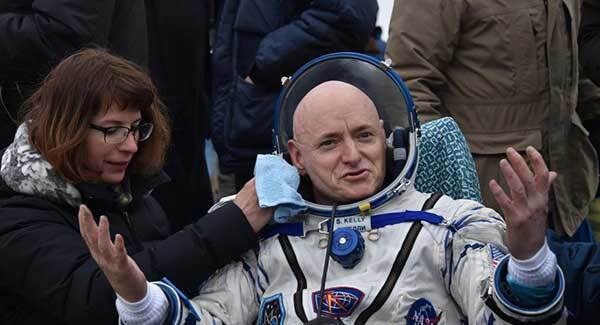
Throughout their nearly year-long stay in space, Kelly, 52, and Mikhail Kornienko, 55, were the subjects of dozens of medical experiments and science studies into weightlessness, and into how the high-radiation environment of space affects the human body.
The research will help the US space agency, and its partners, to send humans to Mars for at least two years.
Their Soyuz capsule parachuted onto the central Asian steppes.
That ended a science-rich mission at the International Space Station, which had begun last March and was deemed a stepping stone to Mars.
It was a triumphant homecoming for Kelly and Kornienko, after 340 days in space.
Kelly pumped his fist as he emerged from the capsule, then gave a thumbs-up.
He smiled, and chatted with his doctors and others, as photographers crushed around him in the freezing cold.
“The air feels great out here,” Nasa spokesman at the scene, Rob Navias, quoted Kelly as saying. “I have no idea why you guys are all bundled up.”
In total, they travelled 144m miles through space, circled the world 5,440 times, and experienced 10,880 orbital sunrises and sunsets, during the longest, single spaceflight by an American.
The two spacemen faced a series of medical tests following touchdown.
Before committing to even longer Mars missions, Nasa wants to know the limits of the human body for a year, minus gravity.
“A year now seems longer than I thought it would be,” Kelly confided a couple of weeks ago.
Not quite a year — 340 days, based on the Russian launch and landing schedule.
But still record-smashing for Nasa.
Kelly’s closest US contender trails him by 125 days. Russia continues to rule, however, when it comes to long-duration spaceflight. The world record, of 438 days, was set by a Russian doctor during the mid-1990s.
Scientists are hoping for more one-year subjects, as Nasa gears up for human expeditions to Mars in the 2030s.
Radiation will be a top challenge, along with the body and mind’s durability on what will be a two-and-a-half year journey, round trip.
With his one-year mission, Kelly has “helped us take one giant leap toward to putting boots on Mars,” Nasa administrator, Charles Bolden, said in a statement.
Welcome home @StationCDRKelly! Your #YearInSpace helps ensure humans are “go” for our #JourneyToMarshttps://t.co/5TkCH23Hwy
— NASA (@NASA) March 2, 2016