Donald Trump could be a blessing in disguise for the Republicans

OW that Donald Trump has pledged not to run as an independent in the US presidential race, he could yet confound his critics and turn out to be a blessing in disguise for the Republican party.
The conventional wisdom had been that if his volatile candidacy was derailed by the Republican establishment, he would run as an independent and split the party’s vote, handing the presidency to presumptive Democratic nominee Hillary Clinton.
But since he’s taken that threat off the table — at least for now — the party no longer has to grapple with this nightmare scenario.
Instead, they may begin to see that Trump has carved out a potential path to election victory — if not for himself, at least for his party.
With no political experience but with large doses of brashness, ruthlessness, and demagoguery, Trump has single-handedly managed to focus the election on what is a traditional winning formula for Republicans — national security and defence.
Polls show that Trump’s stance against immigrants, refugees, and Muslims is a winner. A CNN poll among Republican voters in Iowa earlier in December found that 40% listed either terrorism or foreign policy as the top issue they would consider as they choose a candidate for president. Only 29% named the economy.
So even if Trump is not the party’s candidate — and the party establishment is still hoping he won’t be — his reframing of the election makes it much easier for the party’s eventual candidate to run with the security issue in the general election.
In other words, Trump has made certain this election is no longer going to be exclusively about “the economy, stupid” — the memorable slogan that propelled Democrat Bill Clinton to victory in 1992.
Now Trump has successfully reframed it so that it’s no longer going to be fought on the Democrats’ natural territory of the domestic economy but instead will be about national security, or at least the Republican candidates’ version of it.
It was telling that Trump’s close rival Senator Ted Cruz said earlier this month that Trump had “framed the central narrative” of the primary season.
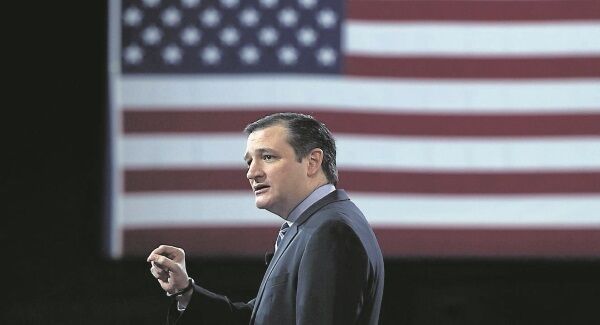
Indeed he has — and one of the immediate beneficiaries could be Cruz himself who, like most of the other candidates in the 14-strong Republican field, have seen it work for Trump and have now jumped aboard the bandwagon.
Of course Hillary Clinton is no slouch when it comes to national security, but Democrats tend to see this in more personal terms as it relates to investment in healthcare, education, better jobs and tax breaks for the struggling middle class.
But, fired up by Trump’s apocalyptic language about war and the need to beef up the military to fight the IS threat at home and abroad, voters are now being drawn away from domestic issues and towards angry soundbites about bombing their enemies.
It was Bill Clinton who once pointed out that when people are insecure “they prefer to have someone who’s strong and wrong than someone who’s weak and right.” And, after the Paris attacks and the California massacre, Americans certainly feel insecure.
Enter Trump. And the more his rivals out-Trump him the more they rise in polls because they know very well that Trump has paved the way for them.
Cruz is especially benefiting but the rest of the Republican field can also now run with the security issue — if not more successfully, certainly more subtly than Trump, especially in the general election, thereby appealing to a wider voter base.
And that’s the key for the party. Its White House hopefuls can now afford to be less bellicose than Trump because he has already done the legwork for them.
Indeed, if Trump begins to falter in the coming primaries to choose the party’s candidate, it’ll probably only be a matter of time before another less volatile candidate steps into the breach. The messenger might be different but, thanks to Trump, the message will be very much the same and a more establishment Republican would sell it even better.
In such a climate Clinton faces a more delicate challenge because if she moves too far to the right she loses some Democrats, but she’s probably sufficiently politically astute to find the right balance. However, it will not be easy because the battle lines have already shifted on to the Republican agenda and away from pocketbook issues.
And, come the general election, if it’s not about the economy and improving life for the struggling middle class, the Democrats could be in a far weaker position.
In effect, they will have allowed the Republicans to define the race and be left playing catch up.
It wouldn’t be the first time that Republicans have successfully defined a presidential election and went on to win it once national security dominated an election.
It happened in the 1988 election when they made security the issue and the first President Bush successfully portrayed the relatively unknown Democratic candidate Michael Dukakis as soft on crime and national defence.
In the 2004 election, his son, George W, painted Democrat John Kerry as weak on security.
So it’s entirely possible that the same could happen again and that a third Bush — with Trump’s preparatory work — could do the same in a race dominated once again by the issue of national security and terrorism fears.
Then again, it would be wrong to underestimate Clinton, who’s shown herself to be tough, hawkish, and resilient. A YouGov survey in November after the attacks in Paris but before the California massacre found Clinton stood apart from Trump, Cruz, Marco Rubio, Ben Carson and Carly Fiorina as the only candidate a majority of voters believe is ready to be commander-in-chief.
All of which suggest Clinton may have managed to overturn voters’ traditional attitude to the party and that it can now own the national security issue as much as Republican have in previous elections.
Still, the Clinton camp might be wise not to start celebrating just yet.


CONNECT WITH US TODAY



Be the first to know the latest news and updates