Ex-Kerry star Seán O'Sullivan: 'We have to live forever', raising a son with autism
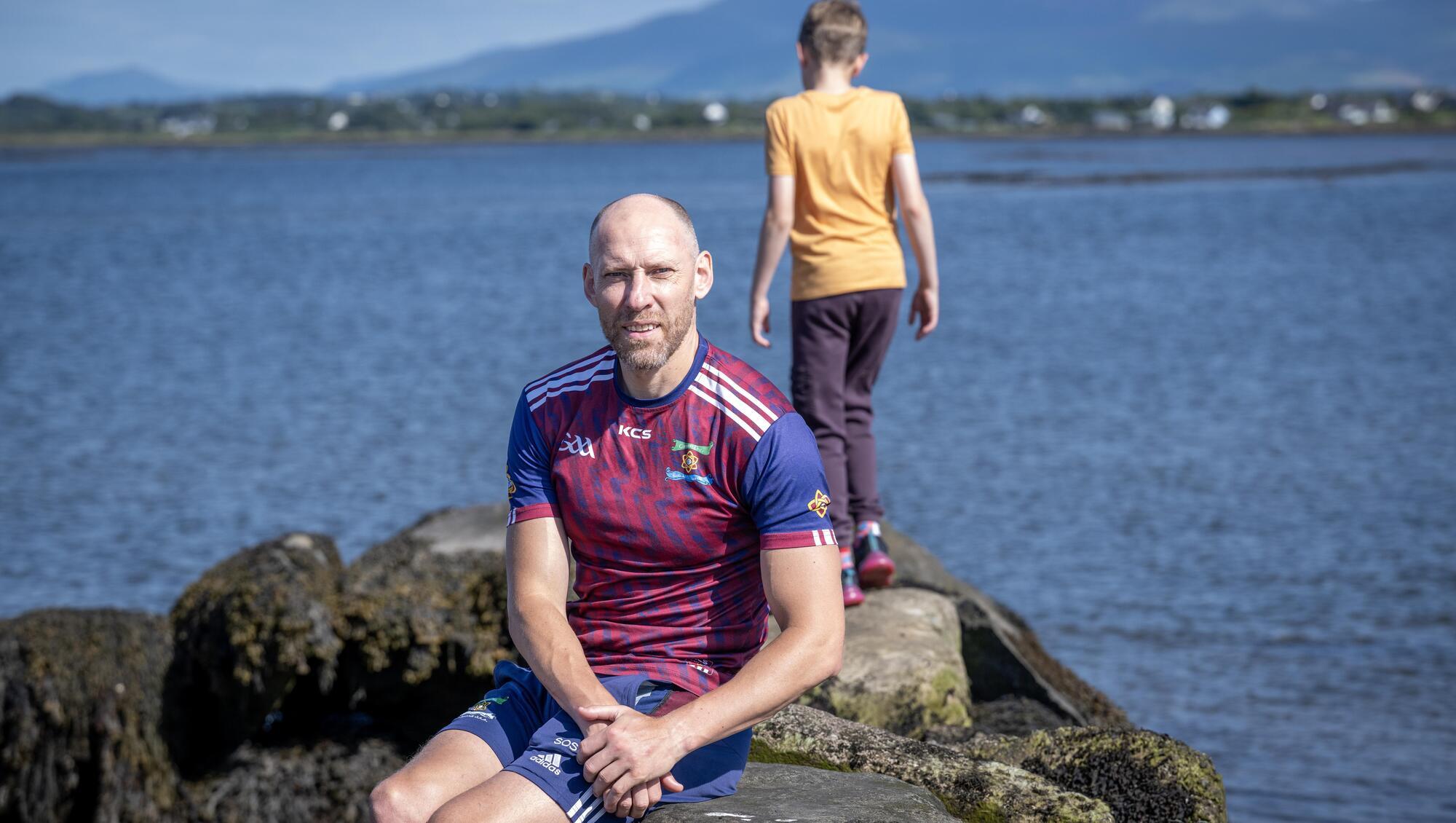
Former Kerry footballer Sean O'Sullivan from Cromane with his 11-year-old son Dylan walking on Cromane beach in South Kerry. Photo: Domnick Walsh
It was a song of Seán and Mary O’Sullivan’s youth. Released in 1998. The year Seán 'Bán' won a Munster minor with Kerry.
Now it’s his 11-year-old son’s mantra. Dylan is autistic and has a learning disability. “Praise You” he absolutely must listen to on loop “about 20 times” in his garden swing after school before he goes on his daily walk in Cromane Lower.
Come rain or this recent bout of shine, Dylan’s needs require a walk.
Seán usually takes Dylan as he is a flight risk. “If he does try something on a walk, he tends not to try it with Dad,” says Seán. “Dylan knows he's faster than Mary.” So out to 'The Spit' the pair go. Dylan will climb the rocks, then walk a long ditch before he sits on a perch where he will pick up a few blades of grass, which he chews for oral sensory regulation. They then return to the road and on the way home Dylan will climb all the neighbours’ walls.
He’ll hit the swings before going into his grandparents’ house beside theirs where he’ll have a sweet or a biscuit and read a Peppa Pig story. “Well, I read it to him,” smiles Seán. “It's the same Peppa Pig story. I could recite it for you at this stage. That gives him brilliant joy altogether.”
Every child is worthy of praise; Dylan an extraordinary amount. And compassion. When the Wi-Fi went down in the house last Monday and he couldn’t watch his YouTube or Mickey Mouse shows, he had to be calmed.
“To people that don’t understand autism, they might be thinking, ‘Oh for goodness’ sake, what’s the big deal?’” says Mary. “They might not realise that being autistic he thrives in routine, which brings comfort. Any unexpected changes or disruptions can be quite upsetting and unsettling. So, perception doesn’t always tally with reality.”
Dylan’s is a home of love. He has an older brother Ryan, 13, and younger one Aaron, 9. At the end of each afternoon, Dylan goes from his ASD class to join Aaron’s mainstream one in Scoil Réalt Na Mara, a school which the O’Sullivans say have been hugely supportive to Dylan.
Recently, Seán noticed Aaron was quiet having come back from school.
“I said, ‘Are you okay, Aaron, what's wrong?’ And he said, ‘Oh, Dylan was over to our class today.’ “When Dylan gets excited or upset, he can make flicking sounds with his fingers and can get quite high-pitched. They are squeaks, which are a self-stimulatory behaviour he does to regulate himself.
“But he was happy this one particular day, down the back of the class, and he was making the noises, and Aaron said, ‘Some of the kids were laughing at Dylan.’
“It was the first time it really hit us because the two lads are so used to him at home. It’s second nature. But we tried to explain to Aaron that, ‘This is the way Dylan expresses himself, that he's happy. Those children would have never been in the class with Dylan, so they wouldn't really know that.’
“Of course, now that they're used to him, they're very welcoming to him and they're delighted to see him coming in. But it was a little insight into how the brothers see him as well, and they don't want him laughed at or judged. Ryan is very protective of him too.
“It was nice from Aaron in a way, but it can pull at your heartstrings. You feel for all the children but at the same time living a life with a child with special needs can be very enriching.”

Read More
At the age of six, Dylan was diagnosed as autistic with a moderate learning disability. He met all his milestones but sought a lot of sensory activities, spun in circles and preferred his own company.
Sleep was a difficulty, words began to disappear as did his interest in a varied diet, which became more restricted. He began to gag on foods he once loved and started putting order on toys. “The preschool would send us little videos of him and he'd be away from the group, lining up the little toy cars, about 20 of them,” Seán recalls.
For reasons such as limited communication, Mary and Seán strenuously tried to keep him in his preschool an extra year but were told he would then be too old leaving primary school.
Dylan was three when Mary raised her son’s case and the public health nurse referred him for further assessments. It wasn’t until he started national school that his diagnosis was made. There, he was able to avail of one-to-one support, which was vital because of Dylan’s lack of danger awareness and how he found some experiences overwhelming.
In a rare stroke of luck, Dylan’s enrolment meant the school had enough pupils to open an ASD class. He’s content there. Takes the odd liberty, as Seán would admit. He sees his father as a jungle gym seeking sensory stimulation and thinks other adults should follow suit, which has led to some challenging moments.
Services provided from the HSE have been scant. After his diagnosis, Mary says there was little support. “I feel their services, the workshops for the parents, it’s ‘We'll tell you how, what you should be doing, but off you go now.’”
“I was on one workshop the other day,” mentions Seán. “About two hours long about the anxiety of the child. But they don’t do anything with the child. They'll give you all this information and these pamphlets. They don’t get to know the child.”
Recently, the O’Sullivans met with Dylan’s new HSE team as he was moving up a level because of his age. “We went to meet him – they didn’t actually lay eyes on Dylan,” Mary states. “It doesn’t make sense. We’re not the experts. We need to work with them. They may see patterns of behaviour which we aren’t aware of.
“We understand there may be a huge strain on resources, but we feel it would be beneficial for the team to meet with the children. More funding needs to be allocated for the promotion of staffing. I will say this, though: if we have a concern, the team are approachable and they will work with you and come to observe the child.”
Scoil Réalt na Mara, which Seán himself attended, is a haven. The school has been approved for two new ASD classes on top of the two they have. “They too need more funding,” Seán insists.
Mary adds: “We’re lucky Dylan has a school placement. We hear of parents who have none for their children. There is a great need for more teachers with specialised training and SNA (special needs assistants) are vital.
“The recent proposed cuts in allocations of SNAs was a step backwards and we are glad that this was paused. The Government talks about early intervention, and these suggestions would take away from the resources which allow our children to flourish.
“Dylan is very settled in school. All we kind of want for Dylan is that he’s happy and safe. We're not overly interested in academics. Just do the best that he can do. And we get pleasantly surprised by the academic stuff then because we don't have any demanding expectations.”
For the sake of Dylan, Seán and Mary don’t spend much time together on their own. When they do, it’s obviously precious, usually spent walking the dog Taffy to 'The Point'.
“About an hour before the kids come home,” says Mary. “That's our alone time, isn't it? It's very much separate lives. Like, if Seán's away with Ryan at a concert like last weekend, I'm here with the boys or vice-versa.
“First of all, who do you trust, who will understand his needs, protect his dignity and ensure his safety? Then it's also, ‘They won't know who he is as a person and how he communicates.’ So, you're going to be leaving him in a situation where he might not be happy or it's just very hard.”
Seán chimes in. “We got to a point where we just felt maybe from the outside looking in, people mightn't understand. And it is tough. So, we got to a stage where it's just easier now for the other person, if they want to go and do something, say it's me going up to Dublin for a match, or Mary's going on holidays with friends there in September, it's nearly peace of mind for the other person knowing that the other person is with Dylan.
“If there was a wedding in the local, Jack's, we just about might get away with this because we know we're only up the road and we can scoot down in the car.
“We take it in turns to sleep in with Dylan. It's not that I don't want to be in the same bed as my wife. It's just, it's easier. The flight risk thing too – you lock your house up the best you can, but you might say, ‘That window's broken. We need to get that fixed.’ And it's a peace of mind to know that he's safe. He senses it when there's somebody in the room and he's a bit more relaxed and wakens less.”
What the O’Sullivans are telling you is the story of most couples who have children with additional needs. “You have to put other people before you,” says Mary. “We work well as a team, just try to anyway.”
An Antrim woman, Mary wasn’t aware who Seán was when they first met in Australia. Life in Cromane has taught her plenty about football and bringing three sons into the mid-Kerry parish that she was blessed.
Seán didn’t push them to follow in his footsteps, though. He didn’t have aspirations for all of them to don the maroon and white. “When you realise and you're told that Dylan has a disability and probably will never go down that road, of course you feel, “God, it would have been nice.’
“I never would have insisted they do. Ryan is artistic, very good at drawing and making prosthetics and doesn’t have an interest in football. Aaron loves sports including football. I get as much buzz out of them enjoying what they do, Ryan’s art, Aaron kicking a goal for the U10s, as Dylan horse-riding or swimming. The last day at the pool, he actually swam a length all by himself and he’s really just learned on his own.”
***
The O’Sullivans plan not day by day but hour by hour. And still there are the nagging thoughts about the future. “At the back of your mind, I think you do have that, ‘God forbid if anything happened to the two of us’,” says Mary.
“Who is going to take on this responsibility? Who would I think is qualified enough to mind Dylan? Who would I trust? You think, ‘God, we have to live forever. We have to live into our hundreds.’
“Sometimes, it does sneak up on you,” Seán nods, his voice quivering. “We always go for McDonald's after our swimming. And I was just driving away and a young boy and girl passed the car, a young couple, I'd say, in their early teens, in love, maybe their first love. And I just looked in the backseat and I talked to myself, ‘Will he ever… will he ever experience that?’ But then you are grateful for the experiences he does have.
“Moments like that raise difficult questions about what Dylan may miss and about his long-term care when we are no longer here. Day to day, we focus on the next immediate need, but those concerns can surface unexpectedly.”
Mary remembers her late father Artie telling her a story about seeing an older man with Down Syndrome caring for his elderly mother. “My dad was just so touched because the role had reversed. The mom had minded him all his life and now he was able to look after his mom. I grew up with that, a real compassion for other people.”

Seán was at Liverpool’s final game of the season against Brentford in May, grabbing a sandwich in Subway, when he noticed a father and son entering.
“I knew the little fella was in the same boat as Dylan and the dad going through the same routine, getting him exactly what he wanted in Subway, probably there at two or three o’clock every Saturday afternoon. I was crying and I called Mary because I knew what they were going through every day. You feel part of a bigger family.”
By the time Dylan becomes an adult, the hope is a purpose-built building for respite in Kerry will be restored. It’s a noble campaign. Ending the practice of vulnerable people being sent to facilities away from their families to other places in the country is a must.
Among them, the O’Sullivans know there are those going through more arduous times but their fears, the financial demands of raising a child with greater needs than most, are the same.
Of course, in the years ahead they want Ryan and Aaron to love and care for their brother but not to be his keepers. “It is definitely tough at times for them,” Mary concedes. “Not knowing what's wrong with him all the time, constantly on high alert, watching out for him, the flight risk, the sleepless nights, the putting Dylan to bed at 11 o'clock, Dylan awake at 11.15pm, thinking the day is beginning, things like that.
“And if you were to assume that your children would take on that role when you're gone, it's just not fair because their own lives would just be totally stalled. We couldn't lie, if the boys decide to live near us and they help out a bit, lovely.”
Seán knows they have good-hearted sons. Three of them. “It can be stressful at times but there's something beautiful about it as well, because there's the pure innocence in Dylan, and it's lovely to witness and the joy that he gets. That really softens your heart. He is fun and mischievous and gentle. Yes, there are times then you feel you're constantly swimming against the tide, but then, out of nowhere, he'll do something that'll just blow you away.”
Praising a child like he should.


CONNECT WITH US TODAY



Be the first to know the latest news and updates