PARIS ATTACKS: Love and liberty a powerful message from the people of Paris in Place de la Republic
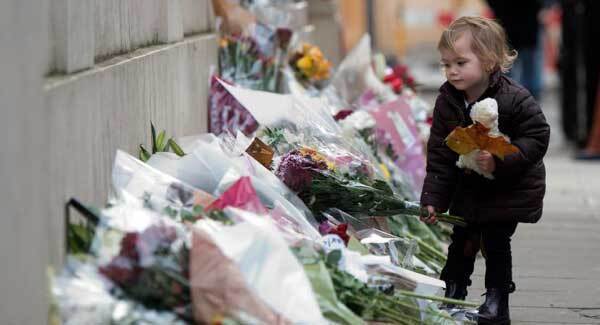
The square is a memorial to the murdered and where the French give one another hope and courage.
Galvanised by a minuteâs silence that hushed the capital at 12pm, the city tentatively returned to its normal routine.
But something had changed. The chalked pink hearts, Eiffel towers, and multicoloured loving sentiments over much of the Place are just as much a call to arms as the Presidentâs address in Versailles.
For them this is their requiem for peace, their battle-cry for unity, as they face an enemy.

âFrance will live a long time with this threat. There is no zero risk. Prepare for a ânew meâ,â warned prime minister Manuel Valls.
Paris resident Ahmed Chabbi believes France must put troops on the ground to counter IS. âBombardment from the sky is not enough,â and those providing IS with their arms and money must also to be tackled, says Chabbi.
And yes, he is prepared to fight. âLike my grandfather in the Second World War against the Nazis with France. I will do it because even I can be a victim, my son, my family,â he says.

Ethnically Tunisian and a Muslim, he says he found it impossible to explain to his six-year-old boy what had happened so close to where they live.
âWhen a child asks why do people kill people, I have not been able to tell him.â
He had just finished work and came to Place de la Republic to explain to others. âAll of us are human before we are Muslim,â says Chabbi.
âThese people cannot be human because they kill like this. The Koran says you do not have to right to kill anyone.â

Raphael Pegol, a 21-year- old media student, like many others is feeling the tension around the city. His father is Moroccan who has lived in Paris for 43 years.
âI am just French, not Moroccan, just French,â says Pegol. âBut going into a disco or a bar or just going home people see you as an Arab. It is not good.â
His father, Abdel, said Muslims have had nothing to do with the murderous attacks. âMuslims have to respect people. In France, societies do not mix, that is a problem.â
His brother-in-law, Hammadi, a sociologist visiting from the Netherlands believes the Dutch have dealt better with radicalisation. But he does not disagree with the French going to war now. âI am not against bombarding Syria,â he says.

Nearby, Anissa picks up a piece of pink chalk and writes, âJe suis Arabe. Je suis Paris,â adding a heart. âI want to tell people I am not a terrorist,â says the young nanny.
Her friend Hajare adds: âThey look at us and think we are. But it is not our fault. We had a friend who was injured in the attacks.â
They are willing to accept the cost, the shutting of borders, effectively ending the Schengen free zone, one of the EUâs much vaunted freedoms.
And extending the emergency for perhaps three months giving the police unchecked powers to search and detain.

There are not too many people on the Place as darkness falls and France goes home for the evening.
The place has become a TV studio, lined with white plastic gazebos, electric wires trailing from the lamps lighting the place like a football pitch.
Paster William Devlin is getting some attention from a few Chinese tourists who want a selfie with him. âYou are dressed very fancy,â they tell him.
He flew in from New York as soon as he heard of the killings. âMy family came from Cork three generations agoâ, he says, and now he runs an Evangelical church. He is in Paris to offer support.
But it seems like the French have found their raison dâĂȘtre, determined to support one another, united against IS.