Drowned toddler the latest in migrant crisis horror
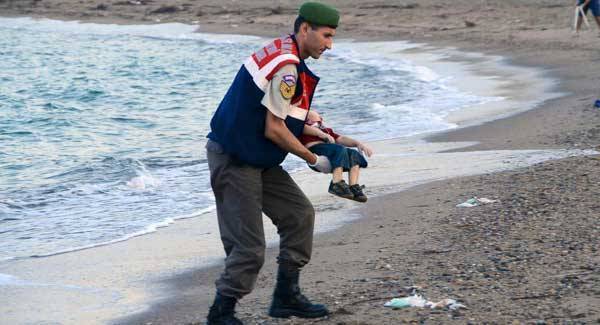
The picture showed a little boy, named in reports as three-year-old Aylan Kurdi, wearing a bright red T-shirt and shorts lying face-down in the surf on a beach near the resort town of Bodrum.
In a second image, a grim-faced policeman carries the tiny body away.
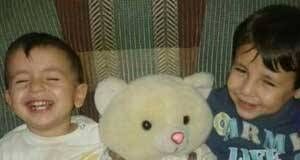
Aylan’s five-year-old brother, Galip, also drowned together with the boys’ mother.
Their father survived.
The hashtag “KiyiyaVuranInsanlik”, “humanity washed ashore”, became the top trending topic on Twitter after the picture was retweeted heavily.
The two boats, carrying 23 people, had set off separately from the Akyarlar area of the Bodrum peninsula, a senior Turkish naval official said.
The confirmed dead included five children and one woman.
Seven people were rescued and two reached the shore in lifejackets.
The official said hopes were fading of saving the two people still missing.
Senior United Nations official, Philippe Douste-Blazy, who has witnessed the harrowing scenes in the Mediterranean first hand, warned Europe’s leaders to take urgent action.
‘The talk from politicians is of invasion, mass migration.
The mood that has been created is one of xenophobia, of nationalism, of fear,’ he told The Independent.
“But, you know, these populists should be careful; the people of Europe are more decent and humane than they think, and they will not like being used for political ends,” he said.
Douste-Blazy said it is important people see the full horror of what is happening.
“People need to see the full horror of what’s going on, and how desperate these refugees and migrants are. Then I am sure they will want to help,” he said.
Television images showed the lifeless body of the small boy dressed in a red T-shirt and blue shorts lying face-down on the sand in Bodrum.
He had been on an overcrowded dinghy filled with refugees fleeing the war in Syria.
Tens of thousands of Syrians fleeing the war in their country have descended on Turkey’s Aegean coast this summer to board boats to Greece, their gateway to the EU.
The official said almost 100 people had been rescued by Turkish vessels overnight as they tried to reach Kos.
Aid agencies estimate that, over the past month, about 2,000 people a day have been making the short crossing to Greece’s eastern islands on rubber dinghies.
A ship bringing about 1,800 migrants and refugees from one of the islands arrived at the port of Piraeus near Athens on Tuesday night, the Greek coastguard said.
Thousands of people, mainly Africans, have also been trying to reach Europe via boat from Libya to Italy.
The United Nations refugee agency UNHCR said four bodies had been pulled from the central Mediterranean on Tuesday and 781 migrants rescued, mostly from Nigeria, Ivory Coast and Senegal.
So far this year, more than 2,500 people have died trying to cross the Mediterranean, the UNHCR said.
In Hungary, hundreds of migrants protested in front of Budapest’s Keleti Railway Terminus for a second straight day, shouting “freedom, freedom” and demanding to be let onto trains bound for Germany from a station that has been closed to them.
Chaos this week at the station in the Hungarian capital has become a symbol of Europe’s migration crisis, the continent’s worst since the Balkan wars of the 1990s.
More than 2,000 migrants, including families with children, were waiting in the square at the station while Hungarians with IDs and foreigners with valid passports could board the trains.
Hundreds of thousands of refugees fleeing war and economic migrants escaping poverty have been arriving in Europe, on rickety boats across the Mediterranean and overland across the Balkan peninsula.
Nearly all reach the EU on its southern or eastern outskirts and then press on for the richer and more generous countries further north and west, ignoring EU rules which require them to wait for processing in the country where they first arrive.
Germany, which is prepared to take by far the greatest number, has begun accepting asylum claims from Syrian refugees regardless of where they entered the EU, even though undocumented migrants are theoretically barred from travel across the bloc.
That has caused confusion for its neighbours, which have alternated this week between letting them through and blocking them.
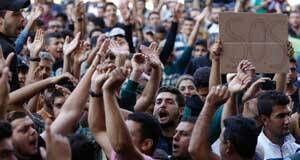
Many have come overland across the Balkans through Hungary, which allowed thousands to board trains for Germany on Monday but has since called a halt to the travel, leaving migrants camped in the summer heat in central Budapest.
Meanwhile, British prime minister David Cameron must allow more refugees into the country or Britain risks becoming a pariah state that will be ashamed of its inaction in Europe’s migration crisis, his opponents have said.
Earlier, Mr Cameron insisted that taking in more refugees would not solve the migration crisis, but Labour and the Liberal Democrats rounded on him, saying Britain must act and that “enough is enough”.
Shadow home secretary Yvette Cooper, who has called for the UK to take in 10,000 extra refugees, said the government cannot keep turning its back on the heartbreak unfolding across Europe.
The Labour leadership candidate said: “When mothers are desperately trying to stop their babies from drowning when their boat has capsized, when people are being left to suffocate in the backs of lorries by evil gangs of traffickers and when children’s bodies are being washed to shore, Britain needs to act.”
Migrants desperately trying to reach Britain have started targeting Eurostar trains because of increased security measures at the Channel Tunnel.
Passengers stranded in northern France overnight described being “surrounded by migrants” who blocked tracks and climbed on to train carriages in their efforts to enter the UK.

CONNECT WITH US TODAY



Be the first to know the latest news and updates