Funky gibbons studied for language clues
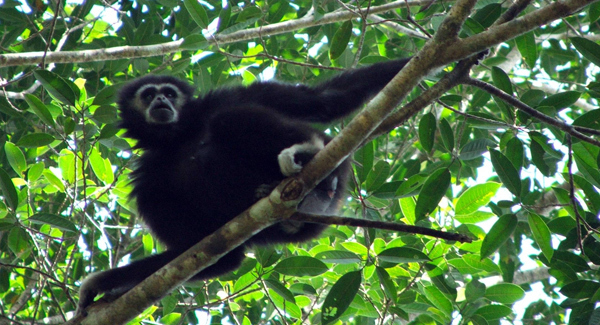
Research has shown they use these whispers to communicate specific information about events such as foraging, meeting neighbours, or types of predator. Scientists believe they could provide valuable clues to the evolution of human speech.
Lead researcher Dr Esther Clarke, from the University of Durham, said: “These animals are extraordinarily vocal creatures and give us the rare opportunity to study the evolution of complex vocal communication in a non-human primate.
“Gibbon vocalisations may reveal much about the processes that shape vocal communication, and because they are an ape species, they may be one of our best hopes at tracing the evolution of human communication.”
The scientists spent almost four months tracking gibbon groups around the forests of north-east Thailand. The apes were usually followed from the first morning encounter until they had located their evening sleeping tree. During this time, the researchers recorded their hoos and noted the event that elicited the response.
From the recordings, they extracted more than 450 hoo sounds which were subjected to computer analysis.
Gibbons reliably produced individual hoo calls in different communication contexts, including foraging, predator detection, encountering neighbours, and “duet” songs performed by mated pairs. Subtle hoo variations also occurred within a particular situation, for instance to distinguish between different types of predator, the scientists found.
Responses to a range of predators including leopards, tigers, pythons and raptors — birds of prey — were investigated. As well as observing the apes’ reactions to real predators, the researchers also presented them with fake model predators in realistic poses.
Raptor hoos were less intense, shorter, and lower in pitch than other calls. They were also below the frequency range where eagles and other raptors hear best.
Tiger and leopard hoos were similar, indicating that both animals were perceived as belonging to the same “big cat” class.

CONNECT WITH US TODAY



Be the first to know the latest news and updates