Survivor recalls Auschwitz horror 70 years on
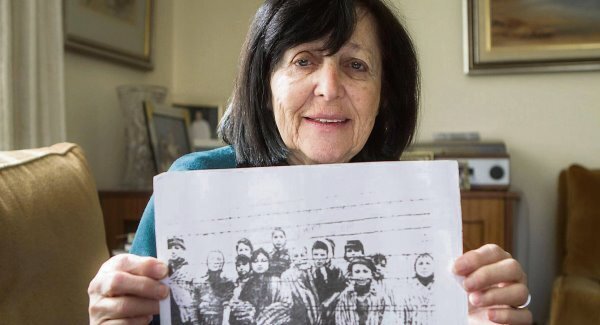
Marta Wise was ill and emaciated when she heard the distant sound of soldiers marching toward Auschwitz.

Survivor recalls Auschwitz horror 70 years on

The 10-year-old Slovakian Jew assumed it was German troops coming to get her, but once she saw the red stars on their uniforms she realised they were Russian.

Her nightmare was over. She was liberated.

More than a million Jews died in the infamous Nazi death camp, but on January 27, 1945 only a few thousand sickly inmates remained at the most vivid symbol of Nazi cruelty after most were marched off to die elsewhere.

Now, 70 years later, as the world marks International Holocaust Remembrance Day, Wise is one of the few remaining survivors who were actually there when the terror in Auschwitz finally ended.

A famous black-and-white photo of about a dozen children in rags standing behind barbed wire, taken by the Russian liberators, has become one of the most iconic images of the Holocaust. Among the children featured are Wise, who weighed just 17kg (37lb) when the Russians arrived, and her older sister Eva, whose sunken cheeks gave her a deathly gaze.

“That I survived and my sister survived is beyond me. I’ve never been able to work it out,” said Wise, now 80 and living in Jerusalem.

“To me, as far as I am concerned, the 27th of January is my second birthday ... because that’s when we got another lease at life.”

Along with 1.1m Jews, more than 100,000 prisoners of war, Poles, gypsies and other minorities also died in Auschwitz and the adjacent Birkenau death camp in gas chambers, crematoria, or from starvation, disease and forced labour.

Wise and her sister arrived at the camp in November 1944, when it was already in its waning days. Wise, who was blond, lived under an assumed Aryan identity with false papers throughout the war until she was finally caught on her 10th birthday and taken to the Sered labour camp in Slovakia. A few weeks later she was sent to Auschwitz and had the number A-27202 tattooed on her arm.

There, Wise and her sister were put in the medical experiment block of brutal Nazi doctor Josef Mengele and subjected to his torture, alongside twins and dwarfs.

She said they received various injections that either made them pass out or left them writhing in pain.

Because Wise had green eyes, she was spared one of his more sinister tests — an attempt to transform the dark eyes of Jews and gypsies into a more blue, or Aryan, complexion.

The lucky ones died immediately, she said, while others went blind and suffered in agony.

“We don’t know exactly what kind of injections he gave to us because when he escaped, before the Russians came, he took all his so-called medical experimentation notes,” she said, pausing. “He was a monster.”

With the Russians rapidly closing in, she said Auschwitz became a scene of absolute chaos in its final 10 days. The Nazis came and went and ultimately abandoned the camp, marching westward in the dead of winter with all the able-bodied prisoners they could take. Anyone who collapsed in the snow or even stopped to relieve themselves was shot dead on the spot.

With her sister stricken by tuberculosis, typhoid and dysentery, and confined to the Auschwitz infirmary, Wise stayed behind with the rest of the ailing — a decision that may have saved her life.

“It is a bizarre irony,” said David Silberklang, a senior historian at Israel’s Yad Vashem Holocaust memorial. “In general, if you went to the infirmary in Auschwitz, if you didn’t get out of there pretty quickly you were finished... but yet at that moment in time, being there meant you had a higher chance of survival.”

More in this section

Cookie Policy Privacy Policy Brand Safety FAQ Help Contact Us Terms and Conditions

© Examiner Echo Group Limited










