Severed spinal cord regrown with nose cells
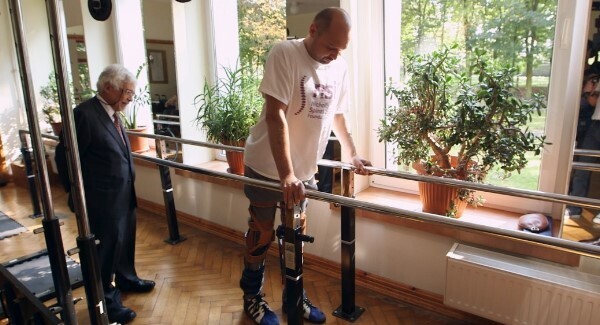
Darek Fidyka, who suffered the injury in 2010, is believed to be the first person in the world to recover from complete severing of the spinal nerves.
The 40-year-old Pole can now walk with a frame and has been able to resume an independent life, even to the extent of driving a car. Sensation has returned to his lower limbs.
Surgeons used nerve-supporting cells from Mr Fidyka’s nose to provide pathways along which the broken tissue was able to grow.
Despite laboratory success, it is the first time the procedure has worked in a human patient.
Geoffrey Raisman, whose team at University College London’s Institute of Neurology discovered the technique, said: “We believe that this procedure is the breakthrough which, as it is further developed, will result in a historic change in the currently hopeless outlook for people disabled by spinal cord injury.”
The research, funded by the Nicholls Spinal Injury Foundation and the UK Stem Cell Foundation, will be featured in a special Panorama programme on BBC One tonight.
A Polish team led by one of the world’s top spinal repair experts, Pawel Tabakow, from Wroclaw Medical University, performed the surgery.
The procedure involved transplanting olfactory ensheathing cells (OECs) from the nose to the spinal cord.
OECs assist the repair of damaged nerves that transmit smell messages by opening up pathways for them to the olfactory bulbs in the forebrain.
Re-located to the spinal cord, they appear to enable the ends of severed nerve fibres to grow and join together — something that was previously thought to be impossible. While some patients with partial spinal injury have made remarkable recoveries, a complete break is generally assumed to be unrepairable.
Prof Raisman said: “The observed wisdom is that the central nervous system cannot regenerate damaged connections. I’ve never believed that.
“Nerve fibres are trying to regenerate all the time. But there are two problems — crash barriers, which are scars, and a great big hole in the road. In order for the nerve fibres to express that ability they’ve always had to repair themselves, first the scar has to be opened up, and then you have to provide a channel that will lead them where they need to go.”
Prof Raisman stressed that what had been achieved was a leap forward beyond promoting ‘plasticity’ — the rewiring of remaining connections.
“He can get around with a walker and he’s been able to resume much of his original life, including driving a car,” said Prof Raisman. “He’s not dancing, but he’s absolutely delighted.”
Before his treatment two years ago, Mr Fidyka, a fireman, had shown no sign of recovery, despite extensive physiotherapy.
Mr Fidyka told the BBC: “I think it’s realistic that one day I will become independent. What I have learned is that you must never give up but keep fighting, because some door will open in life.”