Obama vows to dismantle ‘network of death’
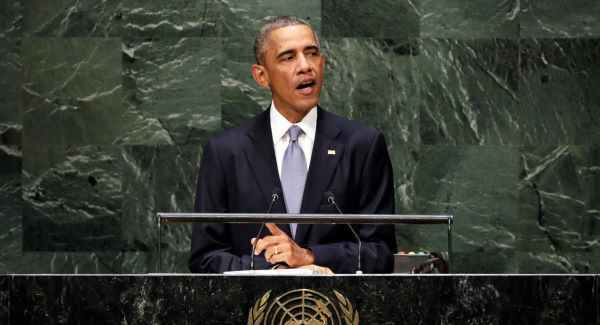
Speaking to the annual gathering of the UN General Assembly, Obama said the US would be a “respectful and constructive partner” in confronting the militants through force. But he also implored Muslims in the Middle East to reject the ideology that has spawned groups like the Islamic State and to cut off funding that has allowed that terror group and others to thrive.
“Ultimately, the task of rejecting sectarianism and extremism is a generational task — a task for the people of the Middle East themselves,” Obama said in a 38-minute address.
“No external power can bring about a transformation of hearts and minds.”
His remarks came against the backdrop of an expanded US military campaign against the Islamic State, with air strikes now hitting targets in both Iraq and Syria. A coalition of five Arab nations joined the US this week in the strikes in Syria: Bahrain, Jordan, Saudi Arabia, United Arab Emirates, and Qatar.
The US also opened another military front with air strikes this week against an al Qaeda cell the Pentagon said was “nearing the execution phase” of a direct attack on the US or Europe.
The threats have drawn Obama back into conflicts in the Middle East that he has long sought to avoid, particularly in Syria. Just months ago, he appeared to be on track to fulfil his pledge to end the US-led wars he inherited in Iraq and Afghanistan.
Obama sought to distinguish this current military campaign from those lengthy wars, declaring that he has no intention of sending US troops to occupy foreign lands. “We will neither tolerate terrorist safe havens nor act as an occupying power,” he said.
The militant threat in the Middle East is just one in a series of crises that have tested Obama this year. Russia has repeatedly flouted warning from the US and Europe to stop its threatening moves in Ukraine. And leaders in West Africa have criticised Obama for not doing more to help combat an ebola outbreak that is believed to have infected more than 5,800 people.
Obama took on Russia directly in his remarks, accusing Moscow of sending arms to pro-Kremlin separatists, refusing to allow access to the site of a downed civilian airliner, and then moving its own troops across the border with Ukraine.
“This is a vision of the world in which might makes right, a world in which one nation’s borders can be redrawn by another, and civilised people are not allowed to recover the remains of their loved ones because of the truth that might be revealed,” Obama said. “America stands for something different.”
Still, Obama held open the prospect of a resolution to the months-long conflict between Russia and Ukraine. While he has previously expressed scepticism about a fragile ceasefire signed earlier this month, he said the agreement “offers an opening” for peace.
If Russia follows through on the agreement, Obama said the US will lift economic sanctions that have damaged Russia’s economy but so far done little to shift President Vladimir Putin’s approach.
As Obama spoke, Russian foreign minister Sergei Lavrov sat in the audience, staring down at a stack of papers.
The chaotic global landscape Obama described stood in contrast to his remarks at the UN one year ago, when he spoke of diplomatic openings on multiple fronts. At the time, the US was embarking on another attempt to forge an elusive peace between Israelis and Palestinians and there were signs of a thaw in the decades-old tensions between the US and Iran.
The Middle East peace talks have since collapsed, though Obama said yesterday that “as bleak as the landscape appears, America will never give up the pursuit of peace”.
Later last night, Obama held his first one-on-one meeting with new Iraqi Prime Minister Haider al-Abadi, who took office this month.
The US has blamed the former Iraqi leadership’s lack of inclusiveness for giving the Islamic State a recruiting tool and had made the formation of a new government a condition for deeper military action to stop the group.
Obama was also convening an unusual meeting of the UN Security Council, during which members were expected to adopt a resolution that would require all countries to prevent the recruitment and transport of would-be foreign fighters preparing to join terrorist groups such as the Islamic State.
Even as the president cast the US as the main driver of peace and security around the world, he acknowledged that his country has not always lived up to its own ideals. He singled out the recent clashes between police and protesters in Ferguson, Missouri, that followed the shooting death of a black teenager.
“Yes, we have our own racial and ethnic tensions,” Obama said. “But we welcome the scrutiny of the world. Because what you see in America is a country that has steadily worked to address our problems and make our union more perfect.”

CONNECT WITH US TODAY



Be the first to know the latest news and updates