UN warns of ‘murder of all kinds’ in Iraq

US president Barack Obama said he is weighing options for countering the insurgency, but warned Iraqi leaders that he would not take military action unless they moved to address the country’s political divisions.
Fighters from the al Qaeda-inspired Islamic State of Iraq and the Levant made gains, driving government forces at least temporarily from two towns in an ethnically mixed province northeast of Baghdad. The assault threatens to embroil Iraq more deeply in a wider regional conflict feeding off the chaos caused by the civil war in neighbouring Syria.
The rebellion, which also draws support from former Saddam Hussein-era figures and other disaffected Sunnis, has emerged as the biggest threat to Iraq’s stability since the US withdrawal in 2011. It has pushed the nation closer to a precipice that could partition it into Sunni, Shi’ite, and Kurdish zones.
Prime minister Nouri al-Maliki, whose Shi’ite-led government is struggling to form a coherent response to the crisis, travelled to the city of Samarra to meet with military commanders last night, state TV reported.
Militants earlier in the week overran military bases and several communities including the second-largest city of Mosul and Saddam’s hometown of Tikrit.
Samarra, the site of a prominent Shi’ite shrine 95km north of Baghdad, sits between Tikrit and the capital.
A representative for Grand Ayatollah Ali al-Sistani, the most revered Shi’ite spiritual leader in Iraq, told worshippers yesterday it was their civic duty to confront the threat. “Citizens who can carry weapons and fight the terrorists in defence of their country, its people and its holy sites should volunteer and join the security forces,” said Sheik Abdul-Mahdi al- Karbalaie, whose comments are thought to reflect al-Sistani’s thinking.
He warned that Iraq faced “great danger”, and that fighting the militants “is everybody’s responsibility, and is not limited to one specific sect or group”.
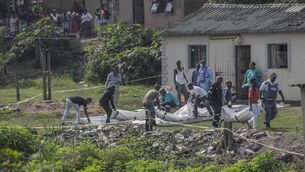
In Geneva, UN human rights chief Navi Pillay warned of “murder of all kinds” and other war crimes in Iraq, and said the number killed in recent days may run into the hundreds, while the wounded could approach 1,000. Pillay said her office has received reports that militants rounded up and killed Iraqi army soldiers as well as 17 civilians in a single street in Mosul.
Her office heard of “summary executions and extrajudicial killings” as ISIL militants overran Iraqi cities and towns this week.
Obama did not specify what options he was considering, but ruled out sending American troops back into combat in Iraq.
“We’re not going to allow ourselves to be dragged back into a situation in which, while we’re there we’re keeping a lid on things, and after enormous sacrifices by us, after we’re not there, people start acting in ways that are not conducive to the long-term stability and prosperity of the country,” he said.
Administration officials said Obama is weighing airstrikes using drones or manned aircraft. Other short-term options include an increase in surveillance and intelligence-gathering. The US also is likely to increase aid.
Iran has signalled its willingness to confront the growing threat from the militant blitz. But officials denied forces were actively operating in Iraq.
CONNECT WITH US TODAY



Be the first to know the latest news and updates