Scientists discover ‘mega-Earth’ 17 times bigger than our planet
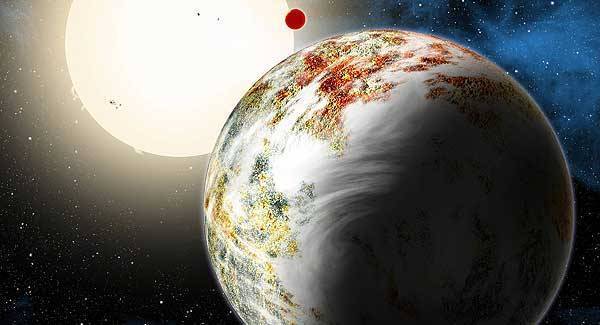
A new kind of rocky planet — dubbed a mega-Earth — has been discovered in a distant star system.

Scientists discover ‘mega-Earth’ 17 times bigger than our planet

The heavyweight world is up to 17 times more massive than the Earth and, according to theory, should have evolved over time into a gaseous mini-Neptune.

Instead the planet, known as Kepler-10c, has managed to remain solid despite being more than twice as old as the Earth.

The discovery suggests that potentially life-bearing rocky planets may be far more abundant than was thought, and some could be immensely ancient.

The Kepler-10 star system is an estimated 11bn years old, meaning it formed less than 3bn years after the Big Bang that gave birth to the universe. Earth is only around 4.5bn years old.

Dimitar Sasselov, from the Harvard Smithsonian Centre for Astrophysics, a member of the team that announced the find, said: “This is the Godzilla of Earths. But, unlike the movie monster, Kepler-10c has positive implications for life.

“Finding Kepler-10c tells us that rocky planets could form much earlier than we thought. And if you can make rocks, you can make life.”

The planet circles its sun-like parent star, located in the constellation Draco, every 45 days. It has at least one unusual neighbour, Kepler-10b — a scorching hot “lava world” three times heavier than Earth that whips around the star once every 20 hours.

Kepler-10c, which has a diameter more than twice that of the Earth, was previously thought to fall into the category of “mini-Neptune” planets that have an icy core surrounded by a thick gassy envelope.

However, observations from the Italian Galileo National Telescope in the Canary Islands confirmed that it has 17 times the mass of the Earth — far heavier than expected. This proved it must be made from dense rocks, like the Earth.

“We were very surprised when we realised what we had found,” said astronomer Xavier Dumusque, who led the research.

“Kepler-10c didn’t lose its atmosphere over time. It’s massive enough to have held onto one if it ever had it — it must have formed the way we see it now.”

x

More in this section

Cookie Policy Privacy Policy Brand Safety FAQ Help Contact Us Terms and Conditions

© Examiner Echo Group Limited