Kiev’s pro-EU protests escalate
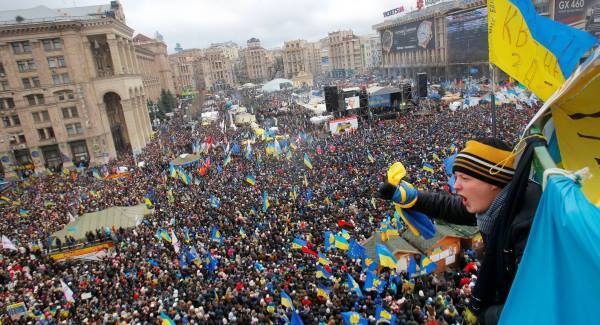
The biggest demonstration in the former Soviet republic since Ukraine’s pro-democracy Orange Revolution in 2004 led the government to fire back.
It announced an investigation of opposition leaders for an alleged attempt to seize power and warned the demonstrators they could face criminal charges.
The West pressed for a peaceful settlement.
Hundreds of thousands of Ukrainians flooded the centre of Kiev, the capital, to demand President Viktor Yanukovych’s ousting after he ditched ties with the EU in favour of Russia and sent police to break up an earlier protest in the nearly three-week stand-off.
“Ukraine is tired of Yanukovych. We need new rules. We need to completely change those in power,” said protester Kostyantyn Meselyuk, 42. “Europe can help us.”
Packing Independence Square as far as the eye could see, Ukrainians waving EU flags sang the national anthem and shouted “Resignation!” and “Down with the gang!” in a reference to Mr Yanukovych’s regime.
“I am convinced that after these events, dictatorship will never survive in our country,” world boxing champion and top opposition leader Vitali Klitschko told reporters.
“People will not tolerate when they are beaten, when their mouths are shut, when their principles and values are ignored.”
As darkness fell, the conflict escalated further with protesters blockading key government buildings in Kiev with cars, barricades and tents.
The protests have had an anti-Russian component because Russia had worked aggressively to derail the EU deal with threats of trade retaliation against Ukraine.
About half a mile from the main square, one group of anti-government protesters toppled the city’s landmark statue of Lenin and decapitated it this evening.
Protesters then took turns beating on the torso of the fallen statue, while others lined up to collect a piece of the stone. The crowd chanted “Glory to Ukraine!”
“Goodbye, Communist legacy,” Andriy Shevchenko, an opposition politician, wrote on Twitter.
The demonstrations erupted last month after Mr Yanukovych shelved a long-planned treaty with the 28-nation EU to focus on ties with Russia.
They were also galvanised by police violence and fears that Mr Yanukovych was on the verge of bringing his country into a Russian-led economic alliance.
Thai prime minister Yingluck Shinawatra proposed a referendum on her future and promised to resign if that was what the people wanted, as anti-government protesters prepared for a final push to try to force her from power.
Protesters have been on the streets of the capital for weeks, clashing with police and vowing to oust Yingluck and eradicate the influence of her self-exiled brother, former prime minister Thaksin Shinawatra.
The demonstrations are the latest eruption in nearly a decade of rivalry between forces aligned with the Bangkok-based establishment and those who support Thaksin, a former telecommunications tycoon who won huge support in the countryside with pro-poor policies.
CONNECT WITH US TODAY



Be the first to know the latest news and updates