Pistorius not considered flight risk, granted bail
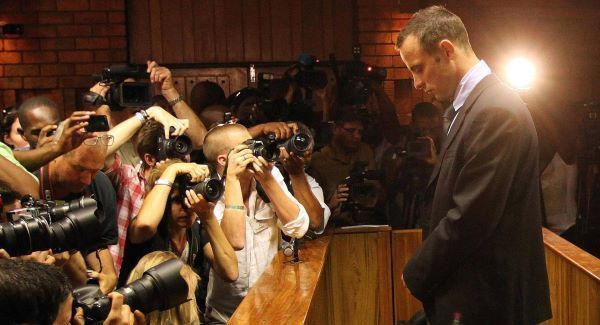
Pretoria magistrate Desmond Nair ruled Pistorius was not a flight risk and does not pose a danger to society after an emotional four-day bail hearing.
“I come to the conclusion that the accused has made a case to be released on bail,” Nair said to cries of “Yes!” from Pistorius’s family and supporters.
“The issue is not guilt, but where the interests of justice lie,” Nair said.
As the lengthy ruling was read, the 26-year-old stood in the dock weeping. He was escorted to the holding area sobbing uncontrollably.
His arrest on Feb 14 shocked the world and gripped South Africa, where he is considered a national hero after becoming the first double amputee to compete in the Olympics.
Pistorius has since spent more than a week at a Pretoria police station charged with the premeditated Valentine’s Day killing of Steenkamp, a model and law graduate.
If found guilty, he faces a possible life sentence.
He denies the charge, saying that he shot 29-year-old Steenkamp repeatedly through a locked bathroom door in the dead of night by accident, having mistaken her for a burglar.
Medics found Steenkamp early on Thursday morning last week at Pistorius’s luxury Pretoria home covered in bloodied towels, with bullet wounds to her head, elbow, and hip. She was pronounced dead at the scene.
Pistorius’s family was overjoyed at the magistrate’s ruling, which his lawyer praised.
“I think it’s a fair decision to grant bail,” said chief defence counsel Barry Roux.
Experts said the case would now be fast-tracked through the courts.
“This is probably going to get priority and will probably take about six months to go to trial,” said Stephen Tuson, a professor of criminal law at the University of the Witwatersrand, Johannesburg. “It’s a high-profile matter.”
It was not immediately clear where Pistorius would go, but he will not return to the Pretoria estate where Steenkamp was killed.
Pistorius was ordered to hand over firearms and passports, avoid his home and all witnesses in the case, report to a police station twice a week and not to drink alcohol.
“He doesn’t want to go back to the house,” said Roux.
Pistorius often cut a sorry figure sitting alone in the dock, having lost weight and often breaking into sobs.
The bail proceedings offered more than a glimmer of what is to come, with so many details about Steenkamp’s last hours that it sometimes appeared to be a mini-trial. The prosecution saw its evidence repeatedly picked apart.
Serious doubt was cast on the work of Hilton Botha, the detective who initially investigated the case.
Botha bumbled through his testimony, admitted he may have contaminated the crime scene, and appeared to undermine the police’s own witnesses.
Botha was forced to admit that Pistorius’s claims were “consistent” with the crime scene and that his police work was not adequate.
“I’m sure it could have been handled better,” he told the court.
The magistrate said: “Botha indeed made several errors and concessions during cross-examination.”
In a dramatic twist, police unceremoniously turfed Botha off the case after it emerged he faces seven attempted murder charges for having opened fire on a minibus in 2011.
The prosecution will now have a few short months to regroup and try and put the case back on track.
Embarrassed by proceedings that sometimes seemed to put the South African authorities in the dock, the country’s most senior detective Lieutenant General Vineshkumar Moonoo will now lead the case.
However, the prosecution will be buoyed by apparent gaps in Pistorius’s account of events.
“He fired four shots, not one. He meant to kill. On his own version, he’s bound to be convicted,” said prosecutor Gerrie Nel.
“He hasn’t said so, but he must think that conviction is likely. He must realise that a long term of imprisonment is almost guaranteed,” Nel told the court.
Arguing against bail, Nel said Pistorius had the money, means, and motive to flee his native South Africa.
“Lots of people have escaped bail. Lots of famous people,” he said.
Just hours before the magistrate’s decision, Pistorius’s lawyer appeared to admit the star sprinter could be convicted on charges of homicide.
“We can never say that he acted in self-defence,” Roux told the court “He is exposed to be convicted of culpable homicide.”
That charge, which entails negligence rather than murderous intent, could carry a sentence of up to 15 years in prison, or in some instances release and a warning.
Prosecutors had portrayed Pistorius as a cold-blooded killer.
“You cannot put yourself in the deceased’s position. It must have been terrifying. It was not one shot. It was four shots,” said Nel.
In an affidavit read in court, Pistorius said he had been “deeply in love” with Steenkamp, and Roux said his client had no motive for the killing.
Pistorius contends he was acting in self-defence after mistaking Steenkamp for an intruder, and feeling vulnerable because he was unable to attach his prosthetic limbs in time to confront the perceived threat.
He said he grabbed a pistol from under his bed and went into the bathroom. He said he fired into the locked door of the toilet, which adjoined the bathroom, in the mistaken belief the intruder was lurking inside.
Witnesses said they heard gunshots and screams from the athlete’s home in an upscale gated community near Pretoria. The community is surrounded by 3m-high stone walls and topped with an electric fence.
In a magazine interview a week before her death and published on Friday, Steenkamp, a law graduate and model, spoke about her three-month-old relationship with Pistorius.
“I absolutely adore Oscar. I respect and admire him so much,” she told gossip magazine Heat. “I don’t want anything to come in the way of his career.”
Oscar Pistorius is just one of several OIympians who found themselves in a courtroom for various accusations. Here are three of the most famous:
One of track and field’s biggest stars at the 2000 Olympics, she won three gold medals and two bronzes in Sydney. Eight years later, Jones was serving time in a federal prison in Texas.
The former world’s fastest woman was forced to return the medals to the International Olympic Committee after pleading guilty to lying to federal investigators about taking performance-enhancing drugs and her involvement in a cheque fraud scam. Jones served a six-month sentence from March to Sept 2008.
In 2002, Montgomery was the world’s fastest man, dating Marion Jones, and was an Olympic gold medallist with the US 4x100-meter relay team at the 2000 Sydney Games. The Bay Area Laboratory Co-Operative scandal exposed his doping and subsequently led to his 9.78 seconds record being dropped from the books.
Montgomery was later sentenced to almost 10 years in jail for his part in a $5m (€3.8m) cheque-fraud conspiracy — which also ensnared Jones and his former coach Steve Riddick — and a conviction for dealing heroin in Virginia.
Harding competed for the US in figure skating at the 1994 Winter Olympics while under suspicion following an assault on teammate and medal rival Nancy Kerrigan weeks before the games in Lillehammer, Norway.
Harding was placed on probation after pleading guilty to helping cover up a conspiracy, involving her former husband, tied to an assault on Kerrigan.
At the Olympics, Kerrigan won silver after recovering from her injuries; Harding finished eighth and was soon banned from the sport.