War of words erupts over peace award
But today the presidents of the three main institutions, together with the leaders of most of the EU states that make up the union including the Taoiseach, will be in the city’s grand town hall to accept the award, together with the close to €1m prize.
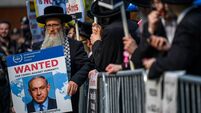
The choice of Nobel Laureate each year is quite often controversial but none more than this year when, according to locals, for the first time street protests have been organised.
They carry with them a letter from former winners of the prize — with the North’s Mairead Maguire and South Africa’s Desmond Tutu among them — criticising the decision.
“The EU is clearly not ‘the champion of peace’ that Alfred Nobel had in mind when he wrote his will,” the letter says, and accuses the jury of redefining and remodelling the prize in a way that is not consistent with the law.
Among the protesters was Norwegian Poul Olerud, a politics graduate from UCD. He says the prize goes to those who have done something for peace in the past year, but believes the EU has not.
“Look at Greece, they have forced the Greek government to cut wages and pensions but not the defence budget that is the biggest per capita in the Union — maybe because they buy their tanks from Germany,” he says.
The EU is a project to promote the markets and trade, not peace says Eva Heir of the Norwegian, ‘No to the EU’ movement. “It’s not about peace”, she insists and when asked what the EU should have done over the past year she said, “Some good for its youth.”
Norway has voted against EU entry in the past and the eurosceptics are stronger than ever at the moment. But Trione Eklund believes her country is just as guilty as the EU for failing to do what Alfred Nobel most wanted — to reduce the availability of arms.
The 77-year-old belongs to a group, Grandmothers for Peace, that meets outside the parliament every Wednesday for an hour for the past 30 years, listening to invited speakers and handing out leaflets.
“Norway is the number one per capita producer of weapons, and the EU countries are also big producers — this has to change”, she says.
Those who awarded the prize to the EU this year insist they are looking at the bigger picture. “The stabilising part played by the EU has helped to transform most of Europe from a continent of war to a continent of peace,” they said when explaining their decision.
The theme was picked up by the three men who will collect the award today — the presidents of the European Parliament Martin Schulz, the Council, Herman Van Rompuy, and the Commission, Jose Manuel Barroso.
Schulz, acknowledging the criticisms, said the award was also a warning to the EU and quoted the writer Thomas Mann that the third generation tends to gamble with the heritage left them by their parents and grandparents. “I don’t want us to be like the third generation,” he said.
Van Rompuy produced one of his famous Japanese-style Haiku poems for the occasion, “After war come peace, fulfilling the oldest wish, Nobel’s peace come true.”
Meantime the Nobel Peace Centre opens its exhibition, Europe from War to Peace, listing some of the more famous battles across Europe over the past 1,000 years and looking at the countries now lined up to gain admittance to the EU club — the Balkans.
It quotes the Copenhagen criteria — the principles that must be met by countries before they can become members, including a functioning democracy, rule of law, human rights and protection of minorities.