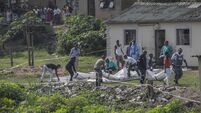
Gun battles in Lebanon as Syrian war spreads
The clashes have heightened fears that Syria’s civil war with its sectarian dimensions is now spreading into Lebanon, pitting local allies and opponents of Syrian president Bashar al-Assad against each other.
The Lebanese army promised decisive action to quell the violence, which was sparked by the assassination of a senior intelligence officer last week.
That killing has plunged Lebanon into a political crisis and the army command urged party leaders to be cautious in their public statements so as not to inflame passions further.
It issued the warning after troops and gunmen exchanged fire in Beirut’s southern suburbs overnight and yesterday while protesters blocked roads with burning tires.
Many politicians have accused Syria of being behind the killing of Brigadier General Wissam al-Hassan, an intelligence chief opposed to the Syrian leadership, who was blown up by a car bomb in central Beirut on Friday.
Opposition leaders want prime minister Najib Mikati to resign, saying he is too close to Assad and his Lebanese militant ally Hezbollah, which is part of Mikati’s government.
The worst of the clashes took place in the northern city of Tripoli, the scene of previous fighting between Sunni Muslims backing the Syrian insurgents and Alawites sympathetic to Assad.
Six people were killed and about 50 wounded in fighting between the Sunni neighbourhood of Tabbaneh and the Alawite Jebel Mohsen. The two sides exchanged rocket and gunfire, residents said.
Among the victims were a 9-year-old girl shot by a sniper.
Fighting in Beirut occurred on the edge of Tariq al-Jadida, a Sunni Muslim district that abuts Shi’ite Muslim suburbs in the south of the capital.
Residents had earlier reported heavy overnight gunfire around Tariq al-Jadida between gunmen armed with rifles and rocket-propelled grenades.
Soldiers killed one gunman, the army said, a Palestinian from a refugee camp who had shot at them.
The violence escalated on Sunday after thousands of people turned out in Beirut’s Martyrs’ Square for the funeral of Hassan, who was buried with full state honours in an emotionally charged ceremony. As the funeral ended, hundreds of opposition supporters broke away and tried to storm the nearby government offices, prompting security forces to fire teargas and shots in the air to repulse them.
The army command said that Lebanon was going through a critical time.
“We will take decisive measures, especially in areas with rising religious and sectarian tensions, to prevent Lebanon being transformed again into a place for regional settling of scores, and to prevent the assassination of the martyr Wissam al-Hassan being used to assassinate a whole country,” it said.
Troops stood guard at traffic intersections and government offices, with barbed wire and concrete blocks protecting buildings.
Beirut was noticeably quiet as people stayed at home because they feared being caught in more violence. Many shops, offices, restaurants were shut or empty and the area was free of its normal traffic chaos.
Lebanon is still haunted by its 1975-1990 civil war, which wrecked large parts of Beirut. Since then it has undergone an ambitious reconstruction programme and enjoyed periods of economic prosperity due to its role as a trading, financial and tourist centre.
The crisis underscores local and international concern that the 19-month-old, Sunni-led uprising against Assad, an Alawite, is dragging in Syria’s neighbours, which include Turkey and Jordan as well as Lebanon.
The slain Hassan was a senior intelligence official who had helped uncover a bomb plot that led to the arrest and indictment in August of a pro-Assad former Lebanese minister.
He also led an investigation that implicated Syria and the Shi’ite Hezbollah in the 2005 assassination of Rafik al-Hariri, a former prime minister of Lebanon.
Mikati offered to resign at the weekend to make way for a government of national unity, but President Michel Suleiman persuaded him to stay in office to allow time for talks.
Mikati, a Sunni, had personal ties to the Assad family before he became prime minister in January last year, two months before the anti-Assad uprising erupted. His cabinet includes Assad’s Shi’ite ally Hezbollah as well as Christian and other Shi’ite politicians close to Damascus. If he was to stand down before an alternative was worked out, it would mean the collapse of the political compromise that has kept the peace in Lebanon and leave a perilous power vacuum.