15 killed in protests on Muslim ‘day of love’
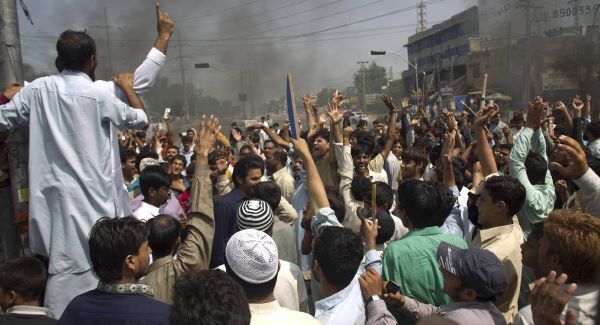
Muslim protests against insults to the Prophet Mohammed turned violent in Pakistan, where at least 15 people were killed yesterday, the Muslim day of prayer, but remained mostly peaceful in other Islamic countries.

15 killed in protests on Muslim ‘day of love’

Pakistan declared yesterday a “day of love” for the Prophet and Prime Minister Raja Pervez Ashraf said an attack on Islam’s founder was “an attack on the whole 1.5 billion Muslims”.

In France, where the publication of cartoons denigrating the Prophet stoked anger over an anti-Islam video made in California, the authorities banned all protests over the issue.

“There will be strictly no exceptions. Demonstrations will be banned and broken up,” said interior minister Manuel Valls.

Tunisia’s Islamist-led government also banned protests against the images published by French satirical weekly Charlie Hebdo. Four people were killed and almost 30 wounded last week when the US embassy was stormed in a protest over the film.

Many Western and Muslim politicians and clerics have appealed for calm, denouncing those behind the mockery of the Prophet, but also condemning violent reactions to it.

At street level, Muslims enraged by attacks on their faith spoke of a culture war with those in the West who put rights to freedom of expression above any religious offence caused.

“They hate him [the Prophet Mohammed] and show this through their continued works in the West, through their writings, cartoons, films and the way they launch war against him in schools,” said Abdessalam Abdullah, a preacher at a mosque in Beirut’s Palestinian refugee camp of Bourj al-Barajneh.

Muslims consider any depiction of the Prophet to be blasphemous.

Western diplomatic missions in Muslim nations tightened security ahead of Friday prayers yesterday. France ordered its embassies, schools and cultural centres to shut in a score of countries.

In Pakistan, tens of thousands of people joined protests encouraged by the government in several cities including Islamabad, Karachi, Peshawar, Lahore, Multan and Muzaffarabad.

The bloodiest unrest erupted in the southern city of Karachi, where 10 people were killed, including three policemen, and more than 100 wounded.

Crowds set two cinemas ablaze and ransacked shops in the northwestern city of Peshawar, clashing with riot police who fired tear gas. At least five people were killed.

In Mardan in the northwest, police said a Christian church was set on fire and several people hurt.

Mohammed Tariq Khan, a protester in Islamabad, said: “Our demand is that whoever has blasphemed against our holy Prophet should be handed over to us so we can cut him up into tiny pieces in front of the entire nation.”

Security forces fired in the air in Peshawar and the eastern city of Lahore to keep protesters away from US consulates. Police fired tear gas at about 1,000 protesters in Islamabad.

The US embassy in Pakistan has run television spots, one featuring secretary of state Hillary Clinton, saying the government had nothing to do with the film about Mohammed.

The foreign ministry summoned the US chargé d’affaires to lodge a protest over the video posted on YouTube, the latest in an array of irritants poisoning US-Pakistani relations.

In neighbouring Afghanistan, police contacted religious and community leaders to try to prevent bloodshed. Protests in Kabul and the northern city of Mazar-e-Sharif only attracted a few hundred people and no violence was reported, but a cleric told one crowd: “If you kill Americans, it’s legal and allowable.”

About 10,000 Islamists gathered in the Bangladeshi capital, Dhaka, after Friday prayers, chanting slogans and burning US and French flags and an effigy of US President Barack Obama.

Reuters

x

More in this section

Cookie Policy Privacy Policy Brand Safety FAQ Help Contact Us Terms and Conditions

© Examiner Echo Group Limited