World leaders call on Gaddafi to quit
The chaos engulfing the oil-rich North African state of 6.3 million has fanned fears that Gaddafi’s hold on power could descend into civil war as the United Nations said nearly 100,000 people have streamed out of the country.
The UN Security Council imposed a travel and assets ban on Gaddafi’s regime and ordered an investigation into possible crimes against humanity by the Libyan leader, the first time such a decision has been made unanimously.
In Washington, US Secretary of State Hillary Clinton said the United States was prepared to offer “any kind of assistance” to Libyans seeking to overthrow Gaddafi.
On Saturday, former justice Mustafa Abdel Jalil, who quit Gaddafi’s regime six days earlier, told Al-Jazeera television that a transitional government would be formed to lead the country before an election.
Yesterday, a spokesman announced the creation of a transitional “national council” in cities seized from Gaddafi’s forces.
“The creation of a national council has been announced in all freed cities of Libya,” Abdel Hafiz Ghoqa told a Benghazi news conference.
The council is the “face of Libya in the transitional period,” he said, adding that consultations were under way on the new body’s composition and duties.
“The people of Libya will liberate their cities,” Ghoqa said. “We are counting on the army to liberate Tripoli.”
Gaddafi’s crumbling regime now controls only western areas around the capital and a few long-time bastions in the arid south.
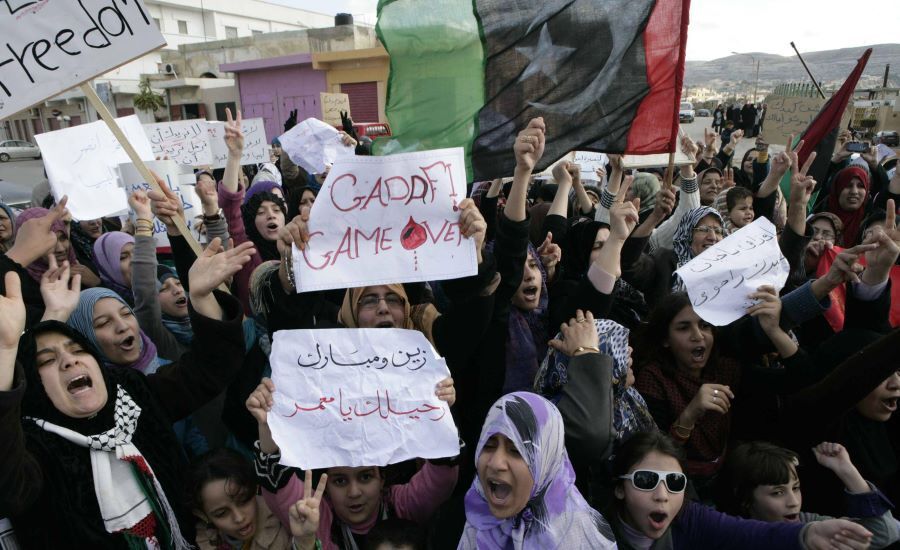
Regime opponents appeared to control the city of Az-Zawiyah, just 50km west of Tripoli, where thousands took to the streets to denounce the teetering leader in front of journalists on a guided visit.
Az-Zawiyah, a middle-class satellite town on the Mediterranean that houses a number of pro-Gaddafi officers, also hosts Libya’s largest oil refinery.
No Libyan security services were visible, but Az-Zawiyah saw clashes between regime supporters and opponents last Thursday, in which a human rights group said more than 35 people were killed.
Fears of all-out conflict as diehard loyalists mount a desperate rearguard action prompted countries to evacuate tens of thousands of citizens and close embassies.
US President Barack Obama said Gaddafi needs to “leave now,” having lost the legitimacy to rule, in a call echoed by leaders in Britain, Germany and Italy.
“The time has long come for him to leave,” German Chancellor Angela Merkel said, calling a UN Security Council decision against his regime a signal to all “despots.”
Italian Foreign Minister Franco Frattini said Gaddafi’s downfall was just a question of time. “It’s inevitable that this will happen... I think we are at a point of no return,” he said.
Britain revoked Gaddafi’s diplomatic immunity and Foreign Secretary William Hague said his departure would be the “best hope” for Libya.
Residents of Tripoli said banks were open but bread and petrol remained tightly rationed as the rebel grip on large swathes of the vast desert nation played havoc with goods’ distribution.
Tanks and all-terrain vehicles driven by regime partisans were patrolling almost deserted neighbourhoods around the capital, residents said.
Gaddafi’s son Seif al-Islam, once regarded as a reformist possible heir, said the crisis had “opened the doors to a civil war” and denied his family had secreted billions of dollars abroad.

CONNECT WITH US TODAY



Be the first to know the latest news and updates