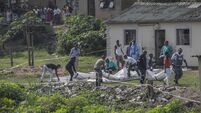
Israelis block Lebanese ports and step up attacks
Hezbollah fired more than 100 rockets into Israel, with one apparently striking the port city of Haifa.
The Shi’ite militant group denied it had rocketed Haifa, where no injuries were reported, though two days of violence elsewhere left at least 51 people dead on both sides of the border.
The crisis began with a Hezbollah raid on Israel that resulted in the capture of two Israeli soldiers.
The militant group is holding firm on its demands that the captives be traded for Arab prisoners.
Israeli Foreign Ministry spokesman Mark Regev said Israel had information Hezbollah was trying to transfer the two captured soldiers to Iran, which backs the militant group. He did not disclose the source of his information.
The soldiers were named as Ehud Goldwasser, 31, and Eldad Regev, 26.
Israeli Defence Minister Amir Peretz said his forces would not allow Hezbollah guerrillas to occupy positions along the southern Lebanese border.
“If the government of Lebanon fails to deploy its forces, as is expected of a sovereign government, we shall not allow Hezbollah forces to remain any further on the borders of the state of Israel,” Mr Peretz said.
The Israeli ambassador to the United States, Daniel Ayalon, called the attack on Haifa “a major, major escalation”. The city, 30 miles south of the border, is home to 270,000 residents and a major oil refinery.
“Those who fire into such a densely populated area will pay a heavy price,” said David Baker, an official in the Israeli prime minister’s office.
Hezbollah’s deputy leader Sheik Naim Kassem denied the group had fired on Haifa, telling Al-Jazeera by telephone that it would do so if Beirut or its southern suburbs were attacked.
Last night, helicopter gunships fired missiles on Beirut’s airport, setting fuel tanks ablaze, Lebanese security officials said. Warplanes earlier punched holes in the runways and at two military air bases.
Military jets attacked runways at the Rayak air base in the eastern Bekaa Valley and at the Qoleiat air base in the north. Rayak, four miles west of the Syrian border, is home to the country’s main military air base.
Israeli warships imposed a naval blockade of Lebanese ports, and the Israeli military said it could also target the Beirut-to-Damascus highway, the main land link between Lebanon and the outside world.
Israel’s army chief Brigadier General Dan Halutz warned “nothing is safe” in Lebanon and said Beirut itself — particularly Hezbollah offices and residences — would be a target. Major General Udi Adam said Israel had hit hundreds of targets and hadn’t ruled out sending in troops.
Lebanon asked the UN Security Council to demand a ceasefire.
The Israeli army said Hezbollah fired more than 100 rockets into northern Israeli towns, killing a man and a woman and wounding more than 35 civilians. Hezbollah said it was using a new missile more advanced than previous models.
Two days of Israeli bombings, the heaviest air campaign against its neighbour in 24 years, killed 47 and wounded 103, Health Minister Mohammed Jawad Khalife said. An Israeli civilian and eight Israeli soldiers have been killed.
The Israeli warnings of more attacks caused panic in Beirut, and many people stayed home from work. Long lines formed at gas stations and supermarkets.
US President George W Bush pledged to work with Israel, criticising Hezbollah for thwarting efforts for peace in the Middle East.
“My attitude is this: there are a group of terrorists who want to stop the advance of peace,” he said in Germany. “The soldiers need to be returned.”
CONNECT WITH US TODAY



Be the first to know the latest news and updates