Saddam’s fate still uncertain, says US

US FORCES said it may take some time to determine whether Saddam Hussein was killed in a bombing raid on a restaurant where he was believed to be meeting with his sons.

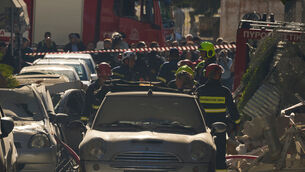
The site remained in Iraqi hands yesterday, a day after a US warplane dropped four bunker-buster bombs and blasted a smoking crater 60 feet deep at the restaurant. At least three houses were destroyed and 20 others damaged, some badly, in the attempt to kill Saddam.

"At this point in time, I'm not aware of anyone from coalition forces that have walked the site," said Brigadier General Vincent Brooks at US Central Command in Qatar.

"When that's possible, we'll have more information about what exactly happened there," Brig Gen Brooks said yesterday.

"Until then, we can only go with things we can gain information on. And we believe the strike was effective in hitting the target, creating the desired effect, but we don't know all the circumstances of what happened to those who were contained inside."

Brig Gen Brooks said it will take some time and perhaps detailed forensic work to establish who was killed. The airstrike in the affluent al-Mansour area of western Baghdad broke windows and doors up to 300 yards away, ripped orange trees out by the roots, hurled steel beams 100 yards and left a heap of broken concrete, mangled iron rods and shredded furniture and clothes.

Iraqi rescue workers using a bulldozer to search the rubble said that three bodies had been recovered those of a small boy, a young woman and an elderly man and that the death toll could be as high as 14. The woman's head had been severed from her torso.

"I don't know whether he survived," US President George W Bush said in Northern Ireland, where he was meeting with British Prime Minister Tony Blair. "The only thing I know is he's losing power."

Iraqi Information Minister Mohammed Saeed al-Sahhaf, speaking to reporters yesterday, did not mention Saddam's fate, and rejected any suggestion that Iraq would surrender to the American forces drawing a noose around the regime.

"They will be burnt. We are going to tackle them," he said.

Despite suspicions at the Pentagon that Saddam may have been killed, there were no signs of any unusual security measures at the site, and a reporter had no problem examining it, watching the rescue operation or speaking to neighbours for about 90 minutes yesterday.

The attack was carried out by a single B-1B bomber, which dropped four precision-guided, 2,000lb, bunker-penetrating bombs on a restaurant after US intelligence was tipped off that the Iraqi president, sons Oday and Qusay and other top leaders might be meeting there, officials said.

The US official said the Pentagon was confident that Saddam and his sons were in the building before it was bombed.

"Our intelligence was solid," the official said. He added Saddam was known to frequent the restaurant, apparently because he thought coalition forces would not target him so close to a civilian centre.

Those close to Saddam have said the Iraqi leader is so obsessed with security very few people would know his movements. He maintains dozens of residences and uses doubles to keep people guessing.

An exiled dissident said only two people are kept posted about Saddam's whereabouts Qusay, who commands the Republican Guard and heads the president's security, and his private secretary, Abed Hameed Hmoud Even Oday is thought to be out of the loop because he is considered too reckless.

The strike came on a day when US forces also occupied two of Saddam's palaces southwest of the target zone and knocked down a statue of the Iraqi leader as they tried to wrest control of Baghdad from his regime.

Seif Hatef, 21, said some of his friends were among the victims of the attack on the three buildings. "Such attacks will make Iraqis more determined to resist. Iraq will remain and this war will never finish," he said.

Workers at a nearby mall swept the glass and other debris from the sidewalk.

"When this war will end? It depends on that scum Bush," said Amer Hamad Abdullah al-Jabouri, who works at the complex.

Coalition strikes have targeted Iraqi leaders from the start of the war.

On March 19, the opening night of the war, Mr Bush authorised a strike on a suburban Baghdad compound where Saddam and his sons were thought to be staying. But US intelligence officials suspect he survived.

On Monday, US and British officials said they believed Saddam's top commander in southern Iraq, his first cousin Ali Hassan al-Majid, had been killed in a US airstrike at a house in Basra. Al-Majid, considered one of the most brutal and loyal members of Saddam's inner circle, was known as "Chemical Ali" for his role in a 1988 poison gas attack that killed tens of thousands of Iraqi Kurds.

A video clip of the US attack on the Basra house was shown at the Pentagon on Monday.

"We believe the reign of terror of Chemical Ali has come to an end. To Iraqis who have suffered at his hand, particularly in the last few weeks he will never again terrorise you or your families," US Defence Secretary Donald Rumsfeld said.

US tank crews called in air support yesterday to repel a fierce Iraqi counterattack against their bold incursion into Baghdad.

The clashes came as the US said it targeted Iraqi President Saddam Hussein and his two sons with bunker-busting bombs. The Pentagon said the strike was based on solid intelligence about his whereabouts.

The US had received information the Iraqi leader was meeting intelligence officials and senior Ba'ath party members in a bunker either behind or under a restaurant in the al-Mansour neighbourhood of Baghdad.

Two bodies were recovered from the rubble and rescuers said the death toll could reach 14. There were no immediate indications Saddam or his sons were killed. The massive bombs dropped by a lone B-1 bomber left a crater 60ft deep surrounded by a pile of rubble, twisted metal pipes and shreds of furniture and clothing.

Iraqi forces staged a major counterattack yesterday morning, sending buses and trucks full of fighters across the Tigris River in an attempt to overrun US forces holding a strategic intersection on the western side of Baghdad.

At least 50 Iraqi fighters were killed, said Captain Philip Wolford of Marysville, Ohio, USA, a company commander with the army's 3rd infantry division. Two US soldiers were reported wounded, one seriously, by snipers on rooftops.

The counterattack began shortly after dawn, when more than 20 buses and trucks dropped off dozens of Iraqi foot soldiers firing assault rifles and rocket-propelled grenades at US tanks blocking an intersection leading to a bridge over the Tigris, Wolford said.

US troops strafed the Iraqis from A-10 Warthog attack planes and opened up with artillery and mortar fire. Two A-10s strafed the building tops and the street with 30mm rapid-fire cannon that reverberated across the city. Col David Perkins of the 3rd Infantry Division said about 500 Iraqi forces took part in the counterattack. They were a combination of special Republican Guard, Fedayeen and Ba'ath Party loyalists and a lot of civilian-dressed fighters, he said.

Meanwhile, around daybreak, troops with the army's 101st Airborne Division launched an attack on an eight-storey former Republican Guard headquarters near the airport. State television went off the air in the morning. Many residents hid in their homes but some civilians seemed to casually go about their business with a Kalashnikov in hand.

Traffic built up toward the north of the city and thousands continued to flee to the relative safety of the north.

More in this section

Cookie Policy Privacy Policy Brand Safety FAQ Help Contact Us Terms and Conditions

© Examiner Echo Group Limited