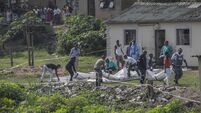
Mass grave found in holy Iraqi city
The remains were discovered on Monday and were sent for testing yesterday in an effort to identify the bodies.
A police spokesman did not say how many bodies were found.
Human rights organisations estimate that more than 300,000 people, mainly Kurds and Shi'ite Muslims, were killed and buried in mass graves during Saddam's 23-year rule.
Saddam and seven co-defendants are on trial for the deaths of more than 140 Shi'ites after a 1982 attempt on Saddam's life in the town of Dujail.
Meanwhile, Poland said it will maintain troops in Iraq until the end of 2006 but will cut the number to fewer than 1,000.
The move reverses the previous government's decision to bring troops home within the next few weeks.
The deployment is unpopular, and 17 Polish soldiers have died in Iraq.
Poland has trimmed troop numbers from 2,400 to around 1,400 since January.
Elsewhere, more than 10,000 people marched through Baghdad in support of a national unity government of Sunnis and Shi'ites, while insurgent attacks killed six Iraqi police and two civilians.
Violence has increased across Iraq after a lull following the December 15 parliamentary elections, with at least two dozen people killed in shootings and bombings Monday and 18 on Sunday.
Officials said insurgents were trying to deepen the political turmoil surrounding the vote. Preliminary figures have given a big lead to the religious Shi'ite bloc that controls the current interim government.
The violence came as opposition groups threatened a wave of protests and civil disobedience if election fraud claims are not properly investigated.
The demonstrators, some carrying photos of former Shi'ite prime minister Ayad Allawi, marched in favour of a government that would give more power to Sunni Arabs and secular Shi'ites.
"We're protesting to reject the elections fraud. We want to ask the government and the elections commission: 'Where did our votes go? Who stole them?' " said Abdul Hamid Abdul Razzaq, a 45-year-old barber.
Iraq's Electoral Commission said Monday that final results for the 275-seat parliament could be released in about a week.
Sunni Arab and secular Shi'ite factions are demanding an international body review more than 1,500 complaints, warning they may boycott the new legislature. They also want new elections in some provinces.
The United Nations has rejected an outside review.
The election commission considers 35 of the complaints serious enough to change some local results. But Farid Ayar, a commission official, said there was no reason to cancel the entire election.
Preliminary results previously released gave the United Iraqi Alliance, the religious Shi'ite coalition dominating the current government, a big lead but one unlikely to allow it to govern without forming a coalition.
Alliance leader Abdul Aziz al-Hakim traveled to the northern Kurdish city of Irbil yesterday to discuss the formation of a governing coalition with Jalal Talabani, Iraq's Kurdish president, and Massoud Barzani, president of the Kurdish region.
Mr Al-Hakim's secretary Haitham al-Husseini said there would also be negotiations with Sunni Arabs.

CONNECT WITH US TODAY



Be the first to know the latest news and updates