Beirut bomb blast kills former premier

RAFIK HARIRI, a billionaire who helped rebuild his country after decades of war but resigned as Lebanese prime minister last fall after a sharp dispute with Syria, was killed yesterday in a massive bomb explosion that tore through his motorcade.

Beirut bomb blast kills former premier

At least nine other people were killed and 100 wounded in the blast. It raised immediate fears that Lebanon largely peaceful since the 1990 end of its civil war was headed toward a new and bloody chapter in its differences with Syria, which has about 15,000 troops in the country.

At least 20 cars were set on fire in a blast that devastated the front of the famous St George Hotel, blowing off balconies, and damaged a British bank and the Phoenicia Hotel along the Mediterranean waterfront.

The 12pm (10am Irish time) explosion was so powerful that Mr Hariri's motorcade of bulletproof vehicles was left a burning wreck and a 30-foot crater was gouged in the street. It was not immediately known whether the explosives had been planted in a car or a building.

Former Economy Minister Bassel Fleihan, a member of parliament in Mr Hariri's bloc, was severely wounded and admitted to the intensive care unit of the American University Hospital.

Mr Hariri's own Future TV reported that Fleihan was in critical condition and the hospital was preparing to transfer him abroad.

Mr Hariri had moved toward the opposition camp after leaving office in October, in large part because of a dispute concerning Syria's controversial role in Lebanon. Mr Hariri rejected a Syrian-backed insistence that his rival, President Emile Lahoud, remain in office for a longer period.

The United States has strongly criticised Syria's interference in the country.

Mr Hariri, a Sunni Muslim, served 10 of 14 years in the post-war period starting in 1992, winning three separate elections.

An emergency Cabinet meeting was called and Lebanon's supreme defence council security Cabinet ministers, top leaders and military officials were in session at the presidential palace, a spokesman said.

Syrian president Bashar Assad said he "condemned this horrible criminal action", according to SANA, Syria's official news agency. Mr Assad urged the Lebanese people to reject those who plant "schism among the people" during this "critical situation".

Mr Hariri's assassination removes a main political buffer in a country divided among an opposition strongly opposed to Syria's role, and the pro-Syrian Government camp.

The Lebanese National News Agency, quoting a statement from the American University Hospital, said Mr Hariri was dead on arrival, his body mutilated in the massive explosion that shook buildings in the city centre and was heard in outlying hills overlooking the Lebanese capital.

Nine other people were also killed in the massive blast and 100 were wounded, the news agency said. Several of Mr Hariri's bodyguards were among those hurt or killed, Lebanese legislator Bassem Yammout told said.

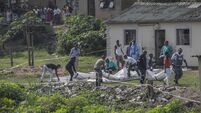
Bystanders and ambulance workers made crude stretchers to carry the wounded to vehicles to take them to nearby hospitals. TV video showed several men dragging the body of a victim partially covered by a brown blanket through the rubble-strewn street before letting go of his arms and letting him fall to the ground.

Flames still licked from his body, his face disfigured by burns. Several young women with blood running down their faces had to be helped from the scene. Rubble and twisted debris covered a road lined with burning cars, with smoke enveloping the area as firefighters carrying hoses raced to douse flames.

Mr Hariri's supporters quickly took to the streets, chanting praise for him outside the hospital. In his hometown of Sidon, supporters blocked roads and burned tires.

There was no credible claim of responsibility. Arab broadcaster Al-Jazeera said its Beirut office received a call from somebody who said a previously unknown group had killed Mr Hariri.

Explosions in Beirut, while common during the 1975-90 civil war, have become rare since the conflict ended.

In October, however, amid rising tensions between the government and opposition groups, a car bomb seriously injured an opposition politician and killed his driver in Beirut.

A self-made billionaire, he became prime minister in 1992 under the terms of a 1989 peace deal that required the premier to be a Sunni Muslim. He served until 1998, and again from 2000 until his resignation in October.

He was considered to be in the opposition. He has been in a rivalry with Lahoud for years.

Mr Hariri, a construction tycoon who made his fortune in Saudi Arabia, held joint Lebanese-Saudi citizenship even as premier. During Lebanon's civil war, he funded charitable ventures, and, when the violence subsided, dispatched trucks from his construction company to clear debris from the streets.

Mr Hariri enjoyed the backing of Western governments.

As prime minister, he travelled in an armoured limousine equipped with a device that jammed mobile phones to prevent assassination attempts by remote controlled bombs.

x

More in this section

Cookie Policy Privacy Policy Brand Safety FAQ Help Contact Us Terms and Conditions

© Examiner Echo Group Limited