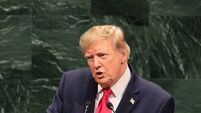
Europe looks to hold the cards to force Bush’s hand
THE Foreign Ministers from 25 European countries gathered in Tullamore at the weekend, but all the headlines focused on the George Bush and Tony Blair meeting in Washington.
Both meetings concentrated on the same two vexed issues Iraq and the Middle East. But all eyes are on the Bush administration waiting to see what it will do next.
In the meantime the EU ministers were left in the position they know best, that of a damage limitation exercise, declaring the glass was half full and figuring out how best to stay in the game.
Foreign Minister Brian Cowan brought them to his Offaly constituency as is traditional for such informal EU meetings designed to be a bonding exercise as much as an opportunity to chew the cud over world affairs.
They spent a long time talking about Iraq on the first of their two day meeting. They have now accepted the role set out for them by the US in Iraq to pay for cleaning up the mess and are now figuring out how to get a little payback in return.
Of course they have resisted the temptation to say to the Americans, "We told you so" over the increasing debacle that is Iraq, or point out that their refusal to provide troops to date has forced the US to turn to the UN.
Like conspirators they considered over the weekend how to ensure the UN and the international community gets the kind of role in Iraq that might bring peace, stability and a modicum of democracy.
The US wants to maintain a foothold in the greater Middle East and nobody is against them establishing and maintaining the necessary bases in Iraq.
The Europeans will hope that an Iraqi government will give them a sporting chance to benefit from oil and general commerce.
The Europeans now need to gauge to what extent the Americans intend to control an Iraqi government, whether it will be a puppet or client state and how the Europeans will learn to live with this. At present they are concentrating on pushing for an acceptable UN Security Council resolution and getting all four EU Security Council members Britain, France, Germany and Spain to have a united position.
They are working towards the June 30 date for the American handing over to an interim Iraqi administration and are pushing for democratic elections in 2005. In the final analysis mayhem in the Middle East is a greater threat to Europe than the US.
The more immediate problem will be deciding how the UN will take over the security aspect of the country.
The extent to which they try to react and then manage the Americans was well illustrated over the weekend in their handling of the Israel-Palestine issue.
Europe's leaders were horrified when George Bush backed the Israeli Prime Ministers wish list for the settlement of the Palestinian problem. The Arabs traditionally weak as allies pulled out of the Arab League summit after the bombing of the Hamas leader Ahmed Yassin and the Europeans do not want to alienate them further.
They had to be stung by the contrast between the pictures of a beaming Egyptian President Hosni Mubarak standing proudly beside George Bush in Washington one day and a few days later the corpulent and well satisfied image of Arial Sharon with Mr Bush being flashed all over the world having agreed the Palestinian issue without consulting anyone.
However the EU as ever anxious to avoid another row with Mr Bush issued an overly coy response to the Bush-Sharon deal, but was forced on two occasions over the weekend to re-issue their statement, both times giving the response slightly sharper teeth.
In many ways having the Bush-Blair meeting on Friday helped, because with some nudging from the British Prime Minister, Mr Bush did mention the magic words "negotiation" and peace map in their joint press conference in the White House Rose Garden.
But the EU-inspired Road Map, which they hope may lead to its own Good Friday (although unlikely to be concluded on such a symbolically difficult day for either party), has been an aspiration rather than a plan up to now.
However now there is a slight sense that the game is on. Foreign Minister Brian Cowan, who chaired the weekend meeting, insists negotiations have not begun and will not until the Israelis and Palestinians sit across a table from one another.
But the Israeli-Bush statement which did leave a number of issues open is being taken as a negotiating stance by the Europeans. The Tullamore meeting set out their red-line as the pre-1967 Israel border which must be respected. They even discussed such niceties and legalities as the difference between occupied and disputed territories and have decided that the land taken by the Israelis in 1967 has been occupied.
The effect is that the Israelis are responsible for making good any damage they caused in such an area but more importantly that the borders can only be changed by negotiation.
What else can such detail be but negotiation? The trick for the Europeans now will be to get the Israelis to play the game too and with the US so desperate for the Europeans to pick up the pieces in Iraq they just might be willing to nudge Mr Sharon in that direction.

CONNECT WITH US TODAY



Be the first to know the latest news and updates