Suicide bomber kills five at Israeli mall

A PALESTINIAN suicide bomber blew himself up yesterday among shoppers waiting to enter a shopping mall in the central Israeli town of Netanya, killing at least five bystanders and wounding more than 30.

Suicide bomber kills five at Israeli mall

The bombing escalated already heightened tensions between Israel and the Palestinians, marked by recent airstrikes and rocket attacks. Israeli Palestinian leader Mahmoud Abbas quickly condemned the bombing.

Islamic Jihad, a militant group that has carried out several suicide bombings in recent months, claimed responsibility for the attack, saying it was retaliation for Israeli targeted killings of the group’s leaders.

Police said the bomber blew himself up as he was about to undergo a random security check at the mall’s entrance. Avi Sasson, deputy police commander in the northern region, said a guard spotted the bomber.

“Just as police were going to check him, he put his hand in a bag and blew up,” he told Israel Radio.

The blast shattered windows and pocked the outside of the brown, multi-story building. Pieces of concrete were ripped off the facade, blood stained the base of the building and debris was scattered on the sidewalk.

“I heard a huge bomb. It felt like my head was exploding. I turned around and I saw a red ball of fire, and then I ran,” said Masouda Israel, a 67-year-old woman.

“You see these things on TV, but when you’re there, it’s totally different.”

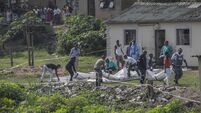
Bodies lay under blankets while emergency workers hurriedly pushed wounded on wheeled stretchers toward ambulances.

Israeli malls have been fortified in the wake of past attacks. Shoppers must go through several security checks, including opening the trunks of their cars and passing through metal detectors, before entering.

Prime Minister Ariel Sharon repeatedly has said that long deadlocked peace negotiations cannot resume until militant violence stops, and yesterday’s attack was likely to set back renewed efforts to return to the internationally sponsored “road map” peace talks.

“The grave attack in Netanya is more proof of the ineffectiveness of the Palestinian Authority under the leadership of Abu Mazen,” said Israeli Foreign Minister Silvan Shalom, referring to Abbas by his nickname. “Israel will act against the terror organisations with all its might and all the means at its disposal. Israel’s response will be hard and painful.”

In Ramallah, Mr Abbas promised an especially harsh response by his security forces.

“This operation ... against civilians causes the most serious harm to our commitment to the peace process, and the Palestinian Authority will not go easy on whoever is proved to be responsible for this operation,” his office said in a statement.

With Israeli elections planned for March 28, pressure could mount on Mr Sharon for an even tougher response.

Mr Sharon left his hard-line Likud to form a new centrist party two weeks ago, saying it would give him more freedom to seek a peace deal with the Palestinians.

Israeli columnist Gershom Gorenberg said yesterday’s blast was likely to cause Mr Sharon to “emphasise the hardline or the more military side of his personality” ahead of the vote.

“In many ways the Palestinians have the fate of the [Israeli] political process in their hands right now,” he added.

The Palestinians also have parliamentary elections on January 25, and any violence could weaken Mr Abbas’ Fatah party, laying bare its ineffectiveness in its race against the Islamic Hamas group.

Islamic Jihad identified yesterday’s attacker as Lotfi Abu Saada, from the village of Illar, north of the West Bank town of Tulkaram. A video released by the group showed the bomber posing with a grenade launcher and an assault rifle.

Relatives described Abu Saada, 23, as a primary school dropout who was illiterate and exploited by his handlers.

“My son is a poor soul. He doesn’t know anything about this,” said his mother, Amina.

Islamic Jihad has carried out all four previous suicide bombings since a ceasefire declaration last February. The group has said it reserves the right to retaliate for any perceived Israeli violations.

Israeli troops killed Luay Saadi, a West Bank leader of the group, on October 24 and late last month arrested another leader, Iyad Abu Rob, after a day-long siege in the town of Jenin.

The attack followed growing tensions along Israel’s border with the Gaza Strip. Palestinian militants fired two rockets from Gaza into Israel at nightfall Sunday, following the first Israeli airstrikes in Gaza in more than a month. Israel withdrew from Gaza in September and has promised a tough response to any attacks coming out of the area.

During five years of fighting, Netanya, a coastal city about 32 kilometres north of Tel Aviv, has been a frequent target of suicide bombings due to its close proximity to the West Bank.

But following Israel’s construction of a West Bank separation barrier in the area, along with a ceasefire declaration in February, such attacks have dropped sharply.

Yesterday’s attack was the fifth since the ceasefire declaration, and the first suicide bombing in Israel since October 26, when a 20-year-old Palestinian blew himself up at a falafel stand in the town of Hadera, killing five Israelis.

More in this section

Cookie Policy Privacy Policy Brand Safety FAQ Help Contact Us Terms and Conditions

© Examiner Echo Group Limited