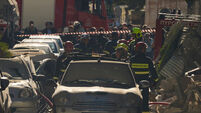
Double plane crash spark fears of terrorist attacks

THE crashes of two Russian planes on Tuesday brought immediate worries of terrorist attacks - Siberia Airlines said on its website that its air traffic control centre notified it that the Tu-154 had activated a hijack alert.

Double plane crash spark fears of terrorist attacks

But Federal Security Service (FSB) spokesman Nikolai Zakharov said “at this time, no signs have been found of terrorist acts”.

Another spokesman said that the preliminary investigation of the crash sites has not revealed evidence of a terrorist act on board either plane, although the security service said terrorism was still on the table as a possible cause.

Mr Zakharov said the investigation is focusing on possible fouled aviation fuel or pilot error, although witnesses heard explosions associated with the planes going down.

Pilots familiar with the Tu-154 said the planes’ flight data recorders would be able to determine if there had been a “flameout”, which takes place when jet fuel is contaminated with water. But explosions would not occur from a flameout.

“Siberia Airlines does not exclude the possibility that the Tu-154 plane crash was caused by a terrorist attack,” the airline’s statement said.

“This is supported not only by the circumstances of the two air disasters taking place at the same time, but also by the telegram received by the Siberia Airlines Flight Control Centre.”

The telegram, the airline said, noted that the two airplanes “simultaneously disappeared in Moscow and Rostov zonal centres. A hijacking warning alarm went off on one of the planes.”

Russia’s chief of air control later told the airline the alarm had come from its plane “just before the loss of contact with the plane and its disappearance from the radar screens”.

The flight data recorders - three from the larger Tu-154 and two from the Tu-134 - may make clear what happened. Investigators have recovered all five flight recorders.

Russian President Vladimir Putin ordered the FSB - the country’s top intelligence agency - to investigate the crashes.

The FSB said no evidence pointing to terrorism has been found yet.

Investigators are considering several possible causes of the disasters including “illegal interference in the operation of civil aviation or abuse of aircraft operation rules”.

Bombers’ bloody toll

Main terror-related explosions in Russia in recent months:

2004: May 9: A bomb rips through a stadium in Grozny, killing Chechen president Akhmad Kadyrov. As many as 24 people are killed.

Feb. 6: Explosion rips through a subway car in the Moscow metro, killing 41 people.

2003: Dec. 5: Suicide bombing on commuter train in southern Russia kills 44 people.

Aug. 1: Suicide bomber kills 50 after ramming truck filled with explosives into a military hospital near Chechnya.

July 5: Double suicide bombing at a Moscow rock concert kills the female attackers and 15 others.

June 5: Female suicide attacker detonates bomb near a bus carrying soldiers and civilians to a military airfield in Mozdok, killing at least 16 people.

May 14: Female suicide bomber in crowd of Muslim pilgrims, kills at least 18 people.

May 12: Suicide truck-bomb attack kills at least 60 in Chechnya.

2002: Dec. 27: Suicide truck-bomb attack destroys headquarters of Chechnya’s government, killing 72.

More in this section

Cookie Policy Privacy Policy Brand Safety FAQ Help Contact Us Terms and Conditions

© Examiner Echo Group Limited