Trump issues stark threat to Iran: 'A whole civilization will die tonight' without deal
Iran showed no sign of accepting Donald Trump's ultimatum to open the Strait of Hormuz by the end of Tuesday, and the US president said "a whole civilization will die tonight" unless Tehran reached a last-minute deal.
As the clock ticked down on Mr Trump's deadline, strikes on Iran intensified throughout the day, hitting railway and road bridges, an airport and a petrochemical plant and knocking out power lines, according to Iranian media. Explosions were reported on Kharg Island, home to Iran's oil export terminal, which Mr Trump has openly mused about destroying or seizing.
Iran responded by declaring it would no longer hold back from hitting its Gulf neighbours' infrastructure, and claimed to have carried out fresh strikes on a ship in the Gulf and Saudi industrial facilities linked to US firms.
Read More
Mr Trump wrote on his social media site: “A whole civilization will die tonight, never to be brought back again.”
He added: “I don’t want that to happen, but it probably will.”
But Mr Trump’s statement nonetheless kept the possibility of an off-ramp open, saying that “maybe something revolutionarily wonderful can happen.”
A senior Iranian source told Reuters that Tehran had rejected a proposal conveyed by intermediaries of a temporary ceasefire.
Talks on a lasting peace could begin only after the US and Israel end their strikes, provide a guarantee they will not resume and offer compensation for damages, the Iranian source said, adding that any future settlement must leave Iran in control of the strait, imposing fees on ships that use it.
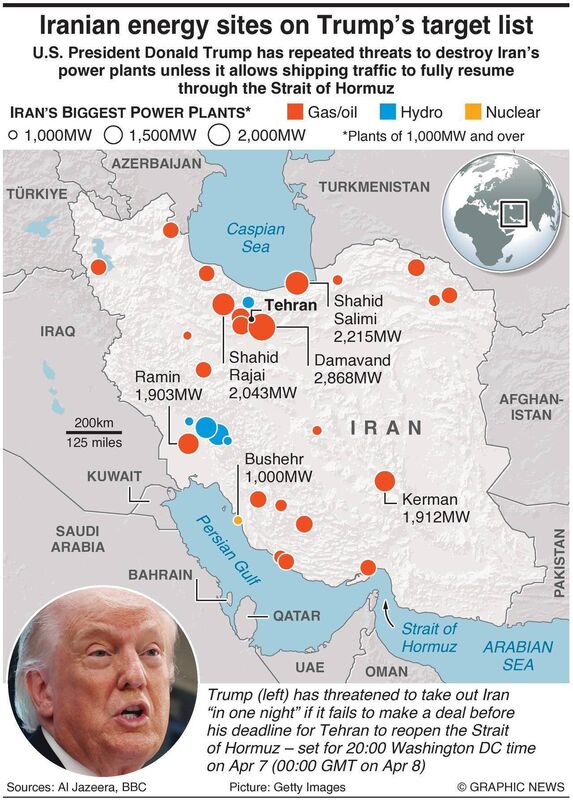
Mr Trump has given Iran until 8pm in Washington (1am Irish time and 4:30am in Tehran) to end its blockade of Gulf oil, saying he will otherwise destroy every bridge and power plant in Iran within four hours. Iran says it will retaliate against infrastructure of US allies in the Gulf, whose desert cities would be uninhabitable without power or water.
Despite the intensification of strikes on the ground and rhetoric from both sides, global markets were largely frozen, hesitant to bet on whether Mr Trump would follow through on his threats or call them off as he has in the past.
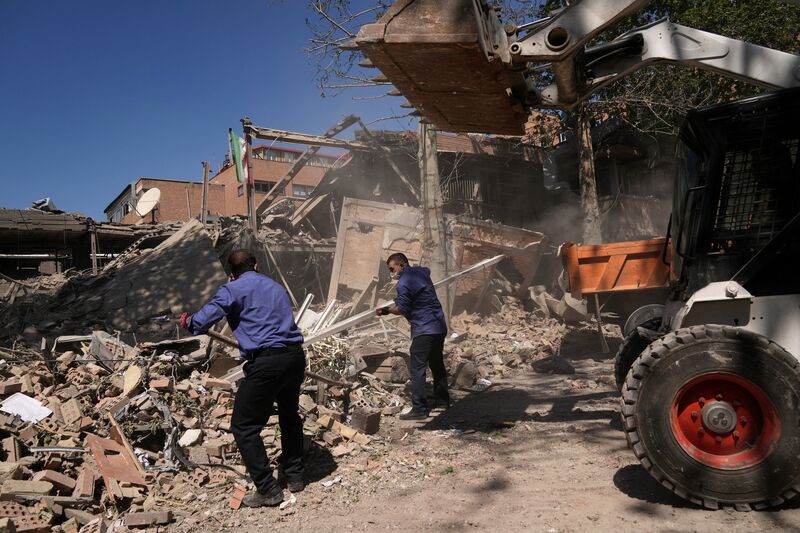
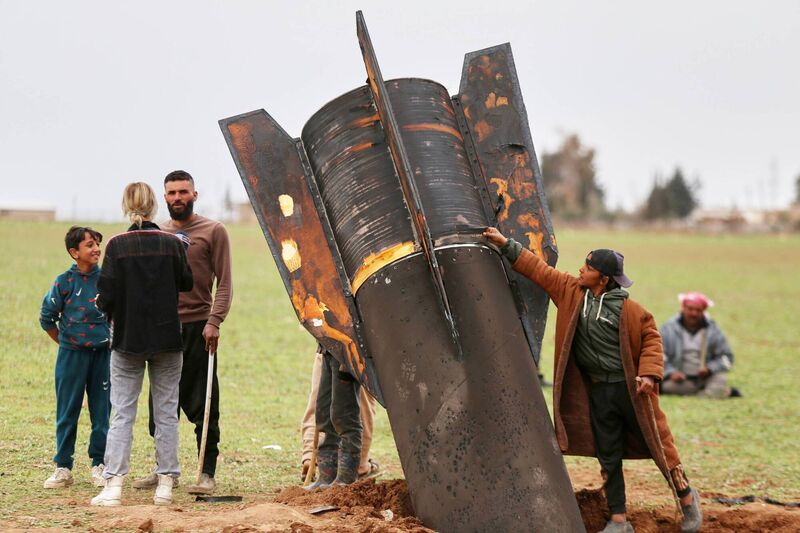
Among the reports of strikes inside Iran throughout the day were attacks on railway bridges, a highway bridge, a petrochemical plant and an airport. Power was knocked out in parts of Karaj just west of Tehran by a strike on transmission lines and a substation.
Israel warned Iranians in a Persian-language social media post to stay away from trains, saying anyone near railways would be in danger.
A synagogue in Tehran was destroyed overnight by what Iran described as Israeli air strikes. Footage in Iranian media showed Hebrew texts scattered in the debris.
"The synagogue building was completely destroyed and our Torah scrolls were left under the rubble," said Homayoun Sameh, a lawmaker representing Iran's Jewish community, one of the Middle East's largest outside Israel. Israel's military had no immediate comment.
Iran's Revolutionary Guards said in a statement that Tehran's response to the attacks on its infrastructure would "deprive America and its allies in the region of oil and gas for years".
"America's regional partners should know that up to today we have shown great restraint for the sake of good neighbourliness and have had some consideration in choosing targets for retaliation," it said. "But all these considerations have since been removed."
Iranians hoped the threatened escalation could be averted.
"I hope it is another bluff by Trump," Shima, 37, from the central city of Isfahan, told Reuters by phone.
Mr Trump has abruptly called off similar threats over the past several weeks, citing what he has described as productive negotiations with figures in Iran who he has never identified. Tehran has denied any such substantive talks have taken place.
The two countries have so far exchanged proposals, with Pakistan acting as the main go-between. But there has been no sign of compromise, with both sides claiming to have won the war and demanding concessions to end it.
Iran's ambassador to Pakistan said on Tuesday "positive and productive endeavours" by Islamabad to mediate an end to the war were "approaching a critical, sensitive stage", but gave no further details.
A proposal conveyed by Pakistan called for a temporary ceasefire and the lifting of Iran's effective blockade of the strait, while putting off a broader peace settlement for further talks, according to a source familiar with the plan.
But Iran's 10-point response, as reported by IRNA news agency on Monday, would require a permanent end to the war, the lifting of sanctions and a promise of the reconstruction of Iranian sites damaged by the Israeli-US strikes.
It would also include a new mechanism to govern passage through the strait - previously an open international waterway through which a fifth of global oil and liquefied natural gas typically passed. Since the United States and Israel attacked Iran on February 28, Iran has effectively closed it to nearly all ships apart from its own.
Mr Trump imposed his latest deadline on Iran in a social media message on Sunday that declared "Open the Fuckin' Strait, you crazy bastards, or you'll be living in Hell – JUST WATCH!", language Iranian officials described as desperate or even mad.
At a press conference on Monday, Mr Trump doubled down: "Every bridge in Iran will be decimated," he threatened. "Every power plant in Iran will be out of business, burning, exploding, and never to be used again."
He has also repeatedly asserted that Iran's leadership has been replaced by figures who are willing to make concessions, but he has not identified them. No such figures have come forward publicly.


CONNECT WITH US TODAY



Be the first to know the latest news and updates