Vance arrives in Hungary days before election, hoping to boost Orban’s campaign
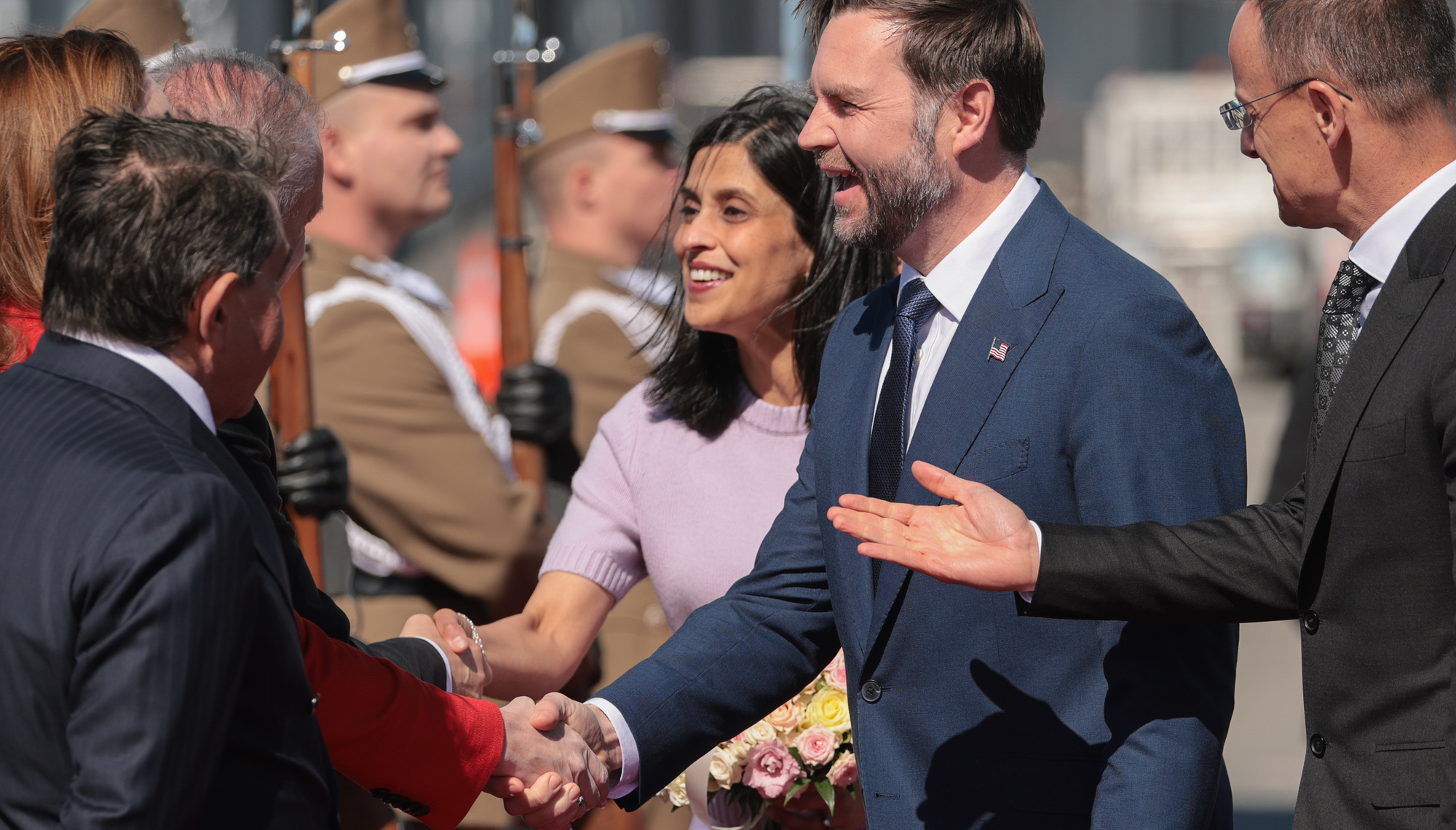
The US vice president, centre right, and his wife Usha, centre left, were greeted at the airport in Budapest by Hungarian foreign minister Peter Szijjarto, right (Jonathan Ernst/Pool Photo via AP)
US Vice President JD Vance arrived in Hungary’s capital on Tuesday in a bid to turn the tide of an election campaign where long-serving Prime Minister Viktor Orban, a close ally of US President Donald Trump, is trailing in the polls.
Mr Vance’s two-day trip, where he is scheduled to hold an official visit with Mr Orban and later appear at one of his campaign rallies, was the clearest sign yet that the Trump administration was going all-in for an Orban victory when Hungarians go to the polls on Sunday.
Read More
In power since 2010, Mr Orban is running for his fifth-straight term as prime minister.
He and his nationalist-populist Fidesz party are facing their toughest race in two decades against a centre-right challenger, the Tisza party led by Peter Magyar, that could bring an end to Mr Orban’s 16 years in power.

Long accused by critics of taking over Hungary’s institutions, clamping down on press freedom and overseeing entrenched political corruption — charges he denies — Mr Orban has become an icon in the global far-right movement.
Mr Trump has repeatedly endorsed Mr Orban’s candidacy for re-election, and many in the Make America Great Again movement approve of the Hungarian leader’s opposition to immigration, curtailing of LGBT+ rights, and capture of the media and academia.
But with most independent polls showing a double-digit deficit for Fidesz among decided voters ahead of the April 12 vote, Mr Orban has sought to boost his profile by appearing publicly with his international admirers.
Mr Vance and his wife Usha were greeted at the Budapest airport on Tuesday by Hungarian foreign minister Peter Szijjarto. The two men greeted one another warmly, and Mr Szijjarto presented Ms Vance with a bouquet of flowers.
The vice president’s visit was not the first sign of US support for Mr Orban.

Hungary, which has broken with most European Union countries by refusing to assist Ukraine with financial assistance or weapons to ward off Russia’s full-scale invasion, has remained firmly committed to purchasing Russian energy despite EU efforts to wean off such supplies.
In November, Hungary received an exemption from US sanctions on Russian oil and gas after a White House meeting between Mr Orban and Mr Trump.
In February, US secretary of state Marco Rubio visited Budapest where he praised Mr Orban and the “person-to-person connection” he had established with the president, telling Mr Orban: “President Trump is deeply committed to your success because your success is our success.”
Late last month, Mr Orban hosted dozens of allies from around Europe and beyond at the Hungarian iteration of the Conservative Political Action Conference (CPAC), and at a meeting of the far-right Patriots for Europe party family, the third-largest group in the European Parliament.
Mr Trump sent a video message to CPAC Hungary, saying Mr Orban had his “complete and total endorsement” and was a “fantastic guy”.
The Trump administration’s embrace of Mr Orban reflects its affinity for European far-right parties broadly, and the admiration, from Spain to France to Germany and the Netherlands, has been mutual.

Still, Mr Trump’s recent approach to foreign affairs has reverberated in Europe, with his actions over Greenland, Venezuela and Iran straining those relationships.
But Mr Orban has remained deferential, and has echoed Mr Trump’s false claims that he won the 2020 election. In comments to state radio just before Mr Trump began his second term, Mr Orban said Democrats “took the presidency away from Donald Trump through fraud”.
Mr Vance’s planned appearance at Mr Orban’s election rally was an unusual step from a foreign leader, and a break with the practice of most politicians who avoid actively taking part in the political campaigns of other countries.
Mr Orban himself has bristled at the mention of the Hungarian election by other EU leaders, decrying any expressions of support for his opponent as a grave breach of Hungary’s sovereignty and meddling in the election.
CONNECT WITH US TODAY



Be the first to know the latest news and updates