Sea change required to meet rising tide of disquiet over coastal erosion
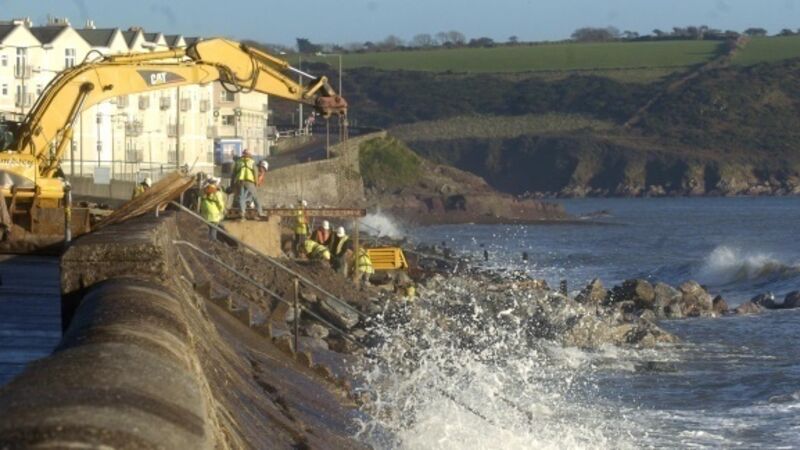
I DON’T like to mention it in polite company, but my foundations are a bit exposed. The recent storm lashed at Portrane and made my Martello Tower spring leaks in more places than you could imagine. Eight buckets were deployed at the height of it, and we’re now in the check/replace/repaint phase.

Sea change required to meet rising tide of disquiet over coastal erosion

It’s on the outside, however, that we’re indecently exposed. Huge waves lashed over the garden walls onto the hydrangeas. Now, hydrangeas, in my experience, are the cockroaches of the horticultural world. Nothing can kill them.

What’s worrying is that, to get to the hydrangeas, the sea water didn’t just have to climb the walls. In front of the walls, it was faced with a deep soil bank, out of which the storm-wave took lumps. Lumps? Massive chunks.


This is not desperate, from our point of view, for reasons I’ll explain a little later, but plays hell with some of my neighbours, one of whom owns a mobile home park, where some of the massive chunks bitten out of the edge of the land used to sit beneath the pleasing decking at the back |of some of those homes. Go a little further north, and you find Portrane Beach changed, perhaps not utterly, but changed a lot by the water, which abolishes sand dunes overnight.It has been estimated that a quarter of a mile of beach was lost, quite apart from the pleasing boardwalk, which was left in ribbons.

According to a speaker at a post-storm community meeting, 135km of land have been lost to the sea in recent decades in this one area.

We on Dublin’s northside see but a portion of a problem that runs, in varying degrees of intensity, around the coast and which is set to get a lot worse in the not-too-distant future. We know this is probably caused by climate change, but fixing our collective carbon footprint is not going to be easy if we’ve been rendered homeless by the incoming tide.

We need action in the short term to prevent that happening. So reading UCC’s coastal expert, Professor Robert Devoy, in the Irish Independent on Saturday did nothing for our collective mood.

Prof Devoy says some bits of the Irish seaboard may need to be lost to the sea. Need to be? Pardon?

“Of course it wouldn’t be easy for coastal communities to accept,” he is quoted as fair-mindedly saying, “but the reality is we’re approaching a time when we might consider letting some coastal land go and retreat further inland.”

Oh, great. I abandon Portrane and go to live with my pal Eoghan in Swords. It’s further inland and a grand place altogether. Admittedly, his wife and two children may have reservations, but they’ll just have to get flexible about it.

“The increasing sea levels and water temperatures coupled with an increase in the frequency of the bigger storms,” opines Prof Devoy, “means the parts of the Irish coastline which are made up of soft glacial sediment will face increased rates of erosion.”

And when that happens — all together now — them that are living on said soft glacial sediment will just have to abandon their homes (because who would buy them, with their asses hanging halfway over the cliff like the bus in the final shot of the Michael Caine Italian Job movie?) simultaneously abandon all the negative equity invested therein and flee to the midlands.

Right? Wrong. Over my dead body. Over the lined-up dead bodies of a lot of my neighbours, ditto. They are mad as hell and determined not to take any more. Some of them are already taking unilateral action with trucks and diggers.

One of the problems about taking any action is that this is a Special Area of Conservation, which is splendid up to the point where an official from the local authority points out that such status means obedience to strict, not to say rigid, EU guidelines on biodiversity and related matters. That’s when arguments start. At the meeting last week of frazzled neighbours, for example, one of those present got colourful on the subject.

“We are in a severe crapper down here,” he stated, to enthusiastic acquiescence.

“We’re not accepting that an Area of Special Conservation doesn’t apply to people. If a bird has his nest in the dune over there [and the dune disappears] he can fly and build his nest in another dune on another beach. I can’t lift my house and do the exact same thing.”

He does have a point. I yield to nobody in my enthusiasm for biodiversity, but you have to admit that, no matter how protective we properly get about lads such as the Juvenile Sea Squirt, the Lesser Spotted Newt, and any number of threatened insects, the fact is that they are always going to be more mobile than the average settled family.

So why does the public mind believe, very strongly, that Irish people can do damn all about protecting the foreshore which in turn protects where they live, because, first of all, of a bureaucracy with an unequalled capacity to bog down creativity, initiative and voluntary action by individuals or communities? People at the meeting pointed out that a lot of men in the area possess heavy machinery that could dig up and put sand back on the beach. Of course, it might get swept away during the next big storm, but forcing the sea to make the effort to take away the new stuff would serve as some protection for the remaining dunes. That’s how they do it in Florida. They keep freighting deep-water sand into the beaches to build them up.

INTERESTINGLY though, even people whose livelihoods and homes are physically threatened by the sea every day at the moment still shy like nervous foals at using the dirty phrase “reclaiming land”.

“We’re not actually reclaiming land,” one of them said. “We’re just putting a line and saying this is as far as the sea can come in.”

Reclaiming land is no long environmentally respectable. Fairview Park, one of northside Dublin’s most precious assets, is built entirely on reclaimed land, so what the hell is wrong with this approach?

Why doesn’t someone take a wrecking ball to half a dozen ghost estates, bring the concrete blocks to the shore, create permanent barriers and back-fill like hell with enough soil to sustain trees which would then hold onto the soil with their roots?

No doubt there’s a good answer to this, but what communities around the country are developing is a sense that everybody in charge is afraid of Europe, or Health and Safety regulations (in the words of an H&S consultant at last week’s meeting) “being used as an excuse to do shag all”.

Lest anybody think this a personal vested interest, it’s rather the opposite. My garden wall may fall into the Irish Sea in the next big storm, but my tower sits on solid rock, eight metres above sea level, so I’ll be a bit dead before it gets swept away.

You have to hand it to the guys who made the decisions about where it should be built.

Britain’s admiralty. Bless ’em.

More in this section

Revoiced

Newsletter

Sign up to the best reads of the week from irishexaminer.com selected just for you.

Cookie Policy Privacy Policy Brand Safety FAQ Help Contact Us Terms and Conditions

© Examiner Echo Group Limited