Everyone lost something over the course of this Nations League window
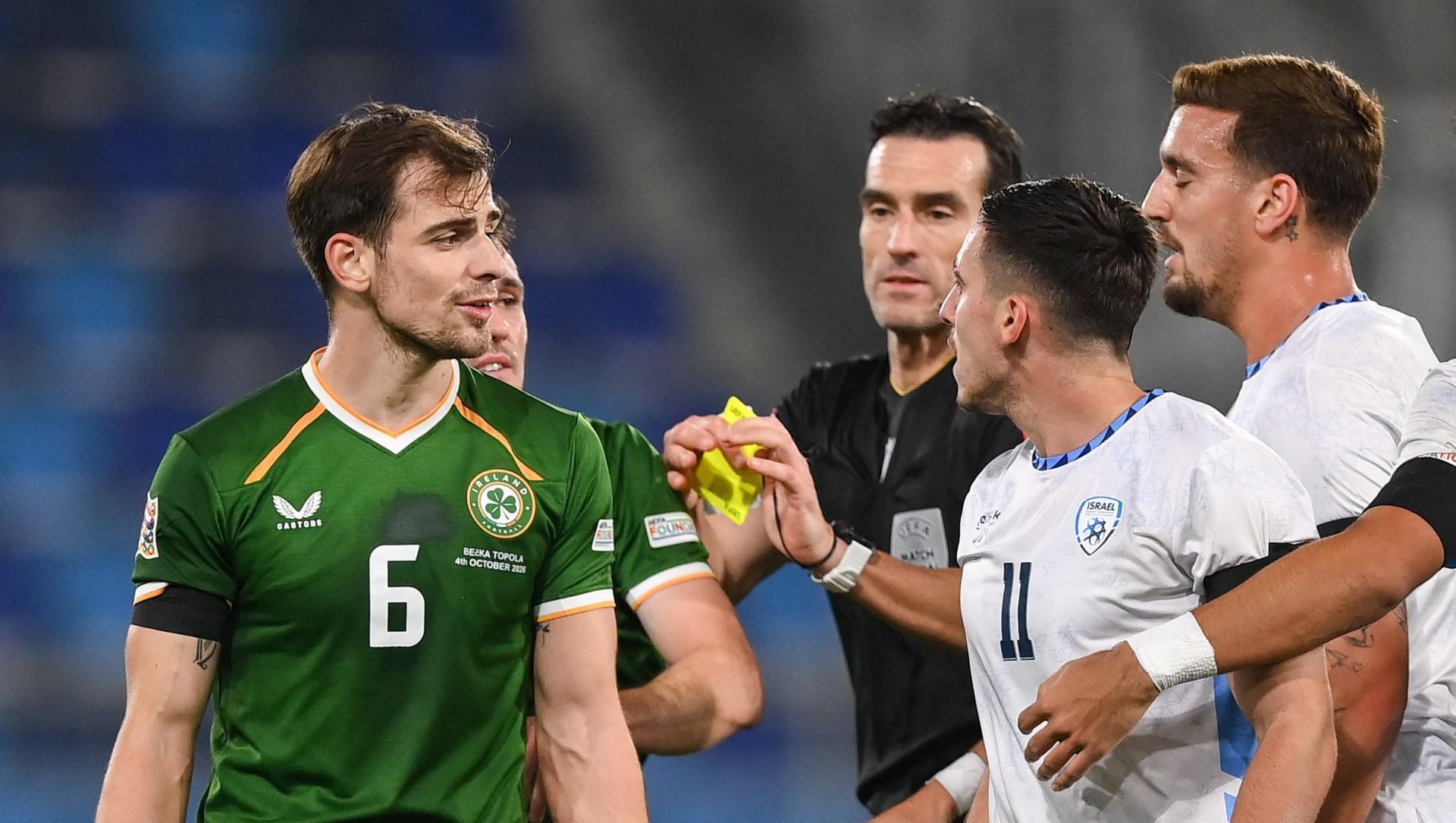
Jayson Molumby of Republic of Ireland argues with Oscar Gloukh of Israel after the final whistle of the UEFA Nations League B match between the Republic of Ireland and Israel at TSC Arena in Bačka Topola, Serbia. Photo by Stephen McCarthy/Sportsfile
And so the most controversial, surreal and frazzling week in the history of the Republic of Ireland’s men’s team came to a close with a 1-1 scoreline against Israel that, for the Boys in Green in years past, has had an almost fuzzy, familiar feel to it.
Scratch beneath that surface and it was a Nations League game that could easily have been lost. Heimir Hallgrimsson has spoken about the mental strain of this whole window. Add four games in ten days to it and the demands have been unprecedented.
Critics of this game being played will rail at the thought that these 90 minutes mattered, but Ireland’s 3-0 win over Israel last Sunday reframed the entire debate for many. It’s fair to say that a loss against them, rightly or wrongly, would have held its own outsized significance.
But how will you choose to remember all… this?
Will your mind revert to those seven seconds of magic last Thursday when Troy Parrott jinked and weaved his way towards the Austrian net? Or will it replay the chaos of the press conferences and the quiet, simmering tension of the games in Debrecen and Backa Topola?
Read More
You can sway one way or the other — and who wouldn’t want to luxuriate in an endless loop of Parrott’s genius — but there isn’t any separating the component parts of this international window in the way we do oil and water.
It was depressing and surreal and, yes, it was actually glorious for the briefest of times.
But that was just the football. There was nothing glorious about the rest of it. Whatever your view on the games being played or not, the discourse alone left everyone on the Irish side stained and agitated and drained. The whole thing debased us all.
What had for so long stood as a binary choice between playing or boycotting an Israeli team representing a state found by a UN commission to be committing genocide in the Middle East splintered into a mishmash of more localised culture wars.
The detours taken spanned everything from October 7th, the Flydubai incident, a friendly Ireland played against Nazi Germany in Dalymount Park in 1936 and Qatar’s human rights record. And it skirted with knotty political issues in both Kosovo and Serbia.
Heimir declines to comment on spiting incident at half time, allegedly by an Israel player towards the Ireland fitness coach but predicts action from Uefa. pic.twitter.com/ELlPSJmR99
— John Fallon (@JFallonExaminer) October 4, 2026
All this on the back of two games that, combined, were played in front of a few hundred souls in stadiums thousands of miles from both countries, with some media from Ireland voluntarily staying away and some from Israel barred from the last press event.
It was a chapter that pivoted on Ireland team meetings in Pristina and Debrecen that appeared to come close to an actual boycott, Gavin Bazunu’s conscience persuading him to stand down and precipitating a drama that relegated Saipan to the ranks of the frivolous.
Speaking of which, thoughts on the actual football were relegated again to the status of sideshow for this last of four games. Unlike last Thursday, there was no escaping the wider context with the backdrop of an empty stadium and the simmering dislike.
Last summer’s World Cup gave us an average of 11 fouls per game. We had 19 here by half-time alone, two yellow cards and a tension that threatened to boil over as players and team staff funnelled towards the dressing-rooms come the interval.
The best thing about it all is that these games are behind us.
Tumultuous as the last ten days or so have been, there will be a sense of relief that these Israel fixtures actually fell in the same international window, one week apart, even while that made for heightened tensions over such a shortened, heightened spell.
The alternative was just one meeting this month before another six weeks spent dreading the idea of a return. Austria in Linz, and Kosovo in Dublin, are next up in November. Just football, points and performances. And breathe…
That isn’t to say that this story is over. This isn’t as simple as stepping into a shower after a game played on a mud bath. There can’t be any instant shedding of the scars and the angst that spilled over onto the pitch, towards the FAI and into and at the media.
The ‘Stop The Game’ campaign has already signposted its determination to continue its campaign. It has criticised what it says is the “financial fiction” of the FAI’s claim that losses of €10m would have been incurred had they boycotted these Israel games.
Ireland came away with four points from the two fixtures, but everyone lost something.


CONNECT WITH US TODAY



Be the first to know the latest news and updates