'We're up 70% from the World Cup in 23' but growth in registered female footballers has slowed
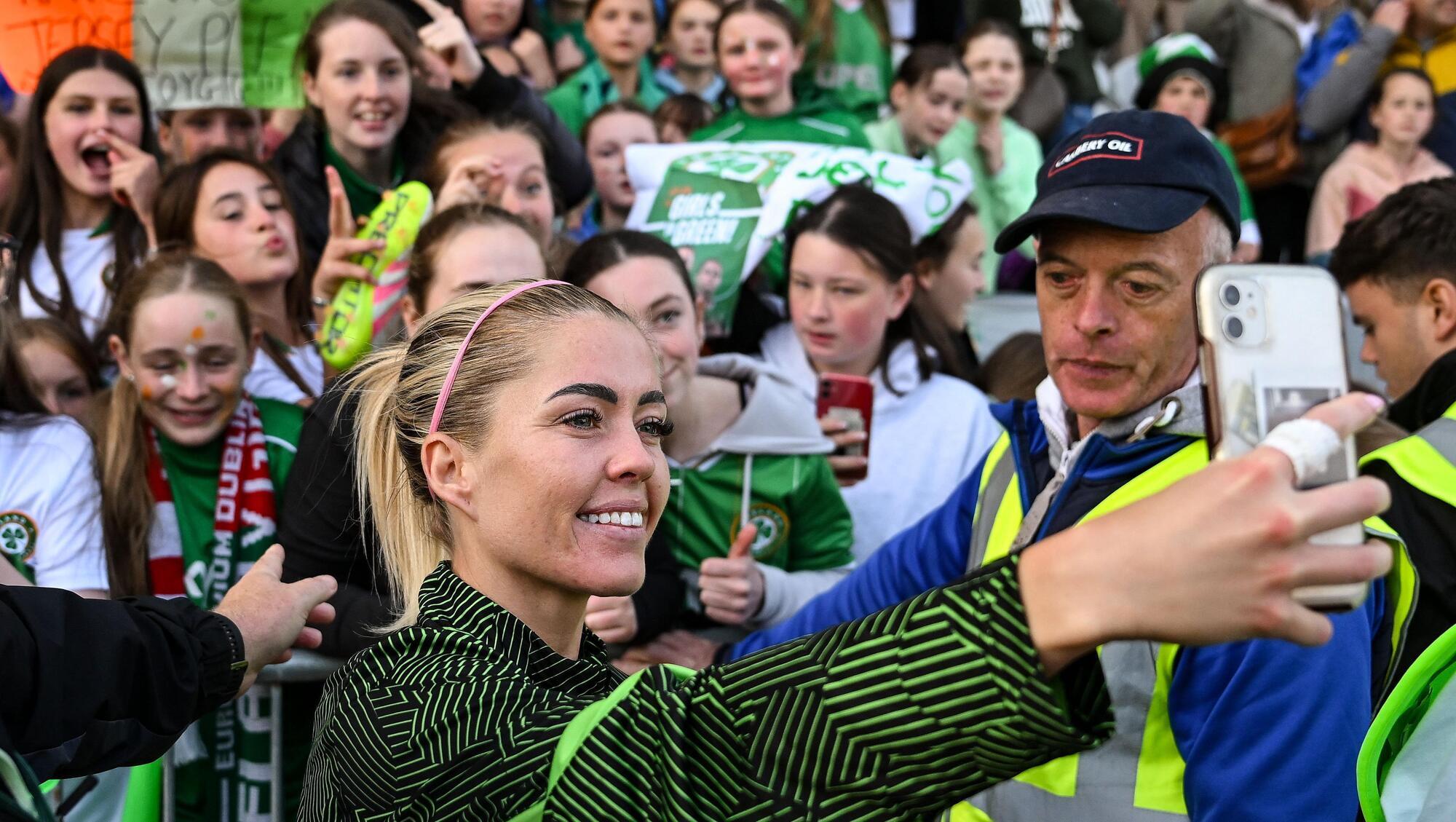
Growth in registered female football players has plateaued after an initial explosion in participation following the World Cup breakthrough. Pic: David Fitzgerald/Sportsfile.
Growth in registered female football players has plateaued after an initial explosion in participation following the World Cup breakthrough.
Lizzy Kent was installed as head of women’s and girls’ football at the FAI in January and will produce her own action plan once the underwhelming two-year version unfurled by her predecessor Hannah Dingley expires in March.
Compared to a figure of 45,000 players referenced in that blueprint of 2025, the latest figure is put at 47,000, a mere 5% increase over an 18-month period.
The number of players registered to clubs and leagues doubled over a 15-year period to 22,000 by 2020.
“We're up 70% from the World Cup in 2023, which is exponential,” stated Wexford native Kent, who missed out on the job to Dingley in 2024.
“The piece on that is how we can build and support around that now.”
As part of the FAI’s ‘transformation’ programme, which entailed 60 staff losing their jobs over the past year, Kent has five coordinators, based provincially.
Shelbourne players Pearl Slattery and Rachel Graham cover Leinster, Conor McKahey Munster, Glen Byrne Connacht and Aisling Conway in Ulster.
Kent knows the Irish landscape intimately from rising through the ranks at her local club Adamstown – alongside Kevin Doyle – before managing Wexford Youths and serving six years as assistant to Dave Connell’s Women’s U19s.
She was part of the staff with the squad that reached the Lithuania-hosted Euros in 2024.
Her objective in assuming the job was meeting every grassroots club nationwide, albeit the timeline has extended from October and December.
Integration is the hot topic this week and the fact that only 23% of clubs had access to female toilet facilities highlighted the task for equality.
Updates on improvements were elusive at the briefing as it was explained an audit is underway to evaluate the targets set out in Dingley’s own ‘action plan’.
“There's a little bit of how we can think outside the box on this,” said Kent.
“Barriers for participation are there which we probably need to understand a little bit more.
“And then actually support how we can build that out, how we can ensure that when we're talking in two or three years’ time, facilities are less of a conversation.
“Schools and colleges have linked in to utilise facilities and spaces, but it is a challenge. There's no point in saying any differently.” Pinch points remain up the ladder too.
There’s no sign of an U21 or U23 international team to bridge the gap between the U19s and senior Ireland teams.
“There’s no current update from Uefa on that so, for me, we need to move in that space now and do what’s suitable home-based for Ireland.
“I would hope that we would have more updates in the not-too-distant future regarding that.”
Kent worked with the Wexford team that were part of the national league that began in 2011. Fifteen years on and progress has been modest.
Even Kent admitted the ambition of new Ireland underage coach Chelsea Noonan to have a fully professional league within five years is unrealistic.
“We started the process, which we're two or three years into it,” she said. “Is it sustainable? I think that's something we'd need to investigate further.
“If, for example, we can grow our attendances then we can increase money within the women's game.
“I think it's something that's feasible but, if not, we don't want to be in a position where we move there but then challenged with how we can maintain it.
“We can move closer towards it, but I'll push that out a little bit further than five years.”

CONNECT WITH US TODAY



Be the first to know the latest news and updates