The other Lionel: how Scaloni went from accidental manager to World Cup hero
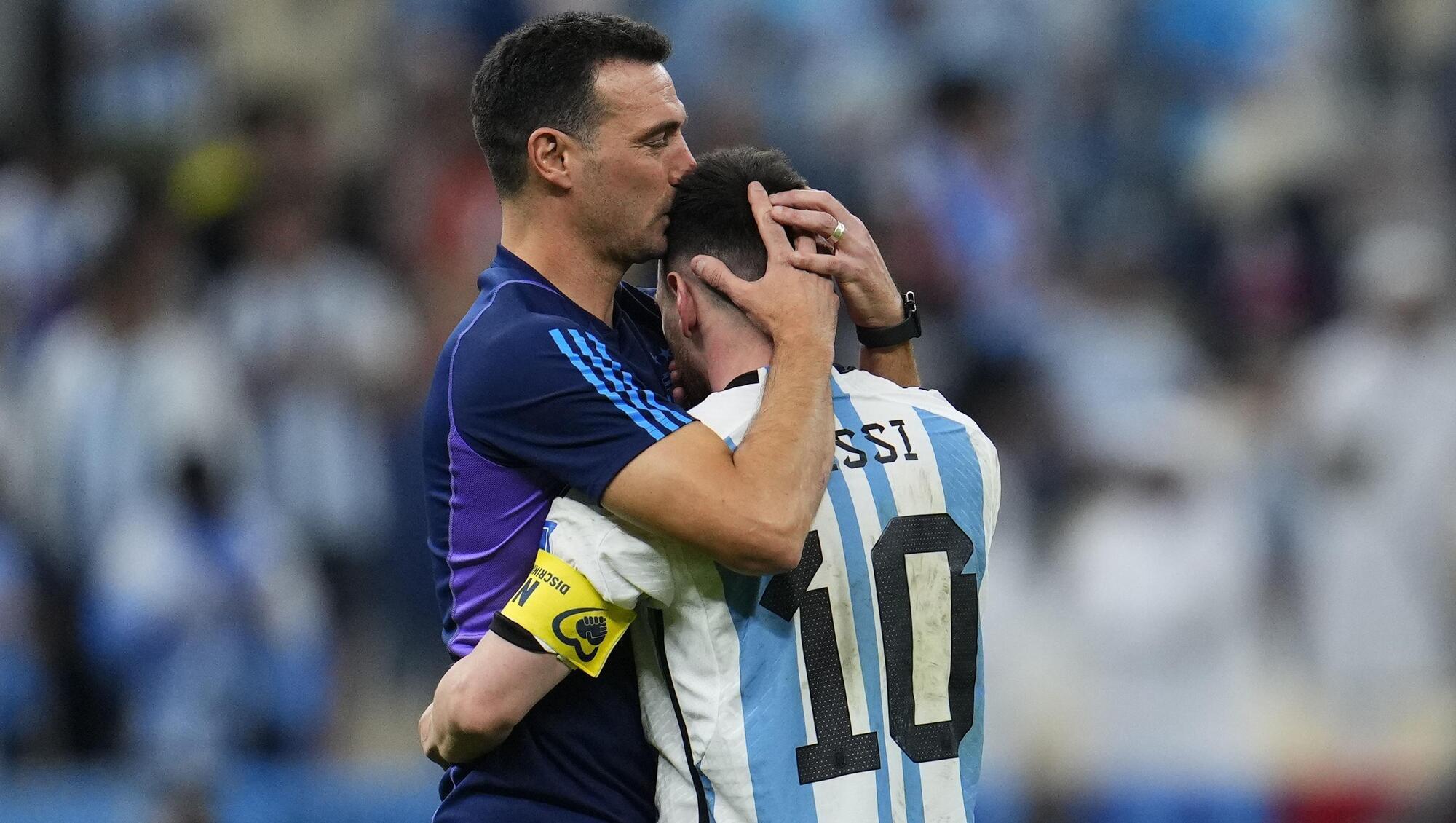
LIONEL THE GREAT(S): Argentina's head coach Lionel Scaloni kisses Argentina's Lionel Messi.
On Lionel Messi’s ill-fated international debut in Budapest in 2005, when he was (very harshly) sent off 45 seconds after coming off the bench for swinging an arm at the Hungary defender Vilmos Vanczak, he received only two passes.
Both came from Lionel Scaloni. It may not be much, but those two passes were the first contact in a relationship that may culminate in Argentina becoming only the third nation to successfully defend the World Cup.
Messi has spoken of Scaloni as one of the first members of the squad to truly welcome him.
After he had scored against Serbia and Montenegro in the World Cup group stage in 2006, when at the age of 18 years and 357 days he became the youngest player to play for Argentina at the tournament, the first player to come up to Messi in the tunnel, grabbing him from behind in a congratulatory hug, was Scaloni.
The former West Ham full-back is only nine years Messi’s senior but there has been an almost paternal aspect to their relationship ever since.
What has followed has been a story of implausible success as, after years of frustration, the greatest player of his generation, arguably one of the three greatest ever to play the game, has been coaxed to triumph on the greatest stage by a coach who essentially got the job by mistake.
Scaloni became manager of Argentina in the aftermath of the 2018 World Cup. The tournament had been a shambles. Jorge Sampaoli had been brought in at great expense from Sevilla, but his hard-pressing game with a high line was never a comfortable fit with Argentina’s lumbering defence.
Read More
After scraping a draw with Iceland, Argentina were humbled 3-0 by Croatia and made it out of the group via a nervous win against Nigeria, secured thanks to a brilliant goal from Messi and Marcos Rojo’s late volley. In the last 16 they lost 4-3 to France in a game that was nowhere near as tight as the scoreline made it appear; France had been superior in almost every way.
Sampaoli had clearly struggled with the pressure, at times looking grey-faced and ill during games, and he left the job after the tournament. But who could take over? The Argentinian Football Association (AFA) had no money and the task of leading a side that had not won a senior tournament since 1993 despite five Under-20 World Cup successes, despite Messi, seemed essentially impossible.
Scaloni, the under-21 manager, had been an assistant to Sampaoli in Russia and, as the cheapest viable option, was initially asked to see Argentina through the six friendlies they had arranged until the end of the year.
Scaloni kept working with the under-21s, leading them at the L’Alcudia tournament in Valencia. Just over 200 miles up the Mediterranean coast, Messi remained silent in Barcelona. He had briefly quit the national team in his disappointment after the penalty shootout defeat by Chile in the 2016 Copa América final. It wasn’t entirely clear what his plans were in the wake of 2018.
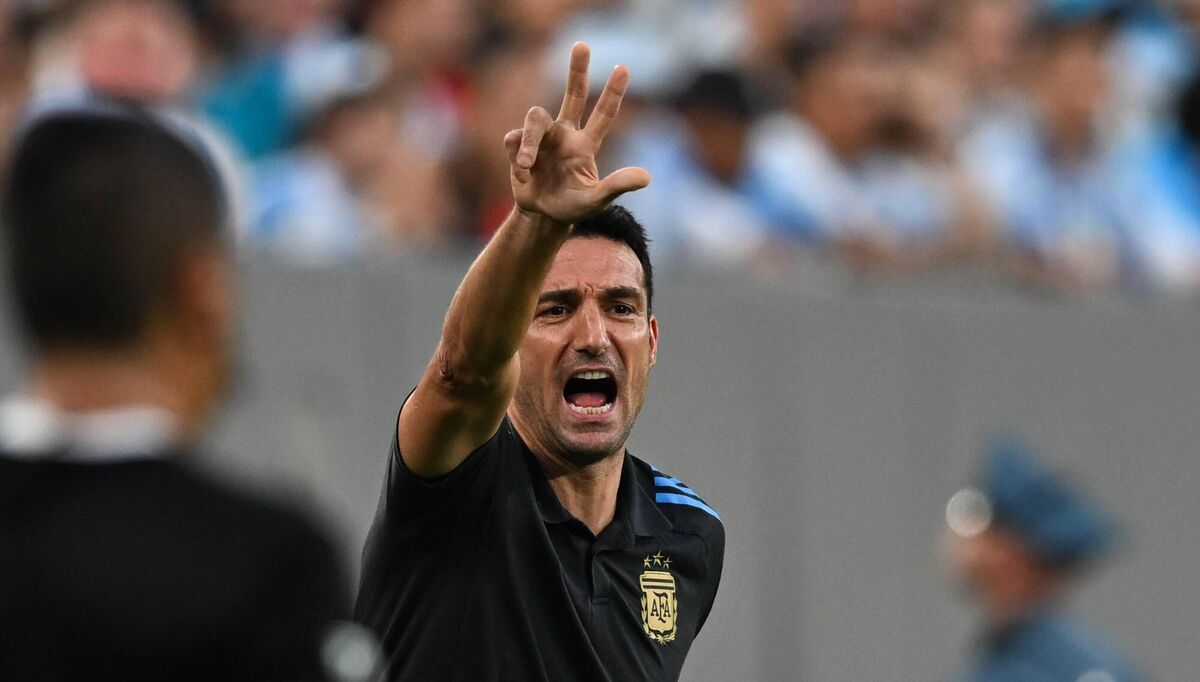
Nothing was entirely clear – except that Scaloni knew Argentina needed Messi. One of Scaloni’s assistants was the former River Plate and Valencia playmaker Pablo Aimar, who happened to have been Messi’s idol growing up. So when Scaloni called Messi, he got Aimar to join the call. He laid out his vision of a rejuvenated side with Messi at its heart.
Messi was won over, perhaps recognising a shared heritage. Scaloni, Aimar and another of his assistants, the former centre-back Walter Samuel, were all part of José Pékerman’s second Under-20 World Cup-winning team in Malaysia in 1997.
Messi was in the fourth of Argentina’s five champion youth teams; Pékerman was senior national manager by then, but his influence remained strong. Pékerman always stressed the importance of developing his charges not just as players but as human beings.
Scaloni’s approach is similar. His analyst, Matías Manna, has always said that one asado [barbecue] can be as valuable as 20 tactical sessions with videos. Especially in major tournaments, when players must spend several weeks together, when everything is so concentrated, so much more intense, togetherness is vital.
Argentina have had that. Under pressure, as they were against Cape Verde, as they were against Egypt, as they were against Switzerland, they keep finding an inner reserve to carry them through.
Messi occupies a curious place within that. He is more of a leader now than he was even four years ago and back then he was notably more vocal than he had been in the introverted days of Brazil or Russia. He draws all of the attention and yet his teammates seem not to resent that.
Rather they talk of winning for him. “He has a group of friends by his side,” Scaloni said earlier in this tournament, “people who will give their all for him, who see him as a god, but also as a kid from the barrio.” That’s a fine balance to strike but Scaloni has achieved it.
In Qatar, Scaloni’s most notable attribute was his calmness. “The sun will rise tomorrow,” he said after the defeat by Saudi Arabia and the dramatic victory against the Netherlands. At times it felt as if he was responsible for the stability of an entire nation. His collapse into tears after the winning penalty in the final shootout was poignant, a humble and reserved man allowing the magnitude of what he had achieved to wash over him.
Scaloni has shown far more emotion in this tournament, to the point that he couldn’t complete his interview after the win over Egypt. There’s a sense that, like his squad, Scaloni is riding a great emotional wave, struggling to hold himself together. But if he can do that for two more games, he will become only the second manager after Vittorio Pozzo to win two World Cups.
This from a man who was essentially appointed only because the AFA couldn’t afford anybody more famous. The accidental manager could become the greatest World Cup coach in almost a century.

CONNECT WITH US TODAY



Be the first to know the latest news and updates