With less staff and better structures, FAI sees a smarter future
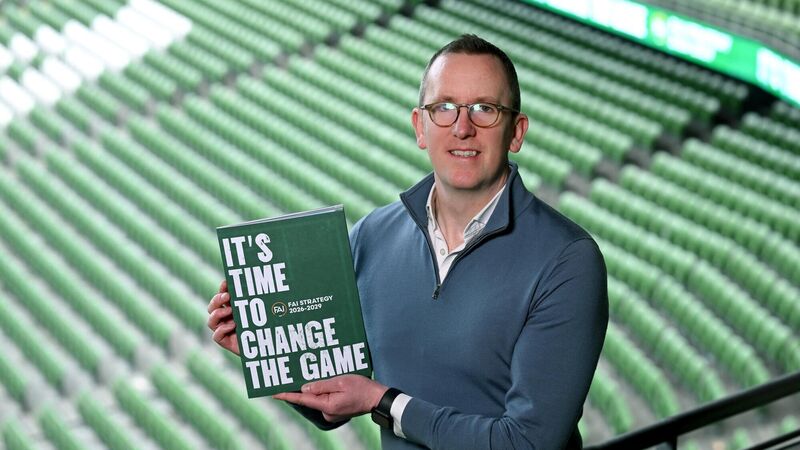
DON'T JUDGE BOOK BY COVER: FAI chief David Courell releasing their strategy. Pic: Stephen McCarthy/Sportsfile
The FAI is adamant it can meet the needs of Irish football despite shedding a quarter of its staff.
As part of its ‘transformation plan’, the association opened a voluntary programme that led to 48 employees departing in recent months. The compulsory aspect kicks in this week, seeing another 15 laid off to reduce headcount to around 200.
Gone is the development officer model, initiated by Brian Kerr as technical director in 1998, which entailed front-facing coaches, mostly co-funded by councils, dealing with clubs in their locality and region.
Also ditched are the third-level courses that helped produce the likes of Roy Keane and Matt Doherty, as is the transition year course for fourth-year pupils concentrating on football.
Central to the FAI’s reasoning for the overhaul is their ranking as the third worst ranking of Uefa’s 55 members. The FAI were unable to provide comparison details, only it came under headings of playing base, players in international football and club football.
This despite trumpeting in their strategy until 2029 – entitled Time To Change The Game – a 10% increase in the country’s largest participative sport to 245,000 people.
“I know it may appear to be counterintuitive, given we now have less people than we had six months ago, but I believe fundamentally that our structure is better to deliver this strategy than we would have been six months ago,” said chief executive David Courell.
“That’s because we did it in a very methodical manner. We developed our strategy which we've had in the can for some time. We developed our transformation structure around that so that they actually line up and that is what delivers effectively.
“Our model has completely changed. We don't have any development officers but we have seen the benefit of specialising. The breadth of what we're asking clubs and leagues to do is getting more and more. We want to be able to have someone that can support them in a way that they can get there faster.”
He added on the new-look services: “Club and league development, we now have people that are dedicated to that. They will be focusing on governance, on participation increases, etc. We've got dedicated leads on volunteers. We've never had that before.
“We've got dedicated leads on referee coaching development. There's a whole raft of specialists that have pivoted from generalists into specialists. The support is there - it's just in a different role.”
There’s a clear emphasis on traditional programmes now being club-led. The announcement by the Government of €3m funding towards the League of Ireland academy personnel doesn’t address the core part of the FAI’s membership, grassroots.
For instance, they want eight League of Ireland clubs to have their own transition year courses and running within the next four years.
Meanwhile, the ill-fated philanthropic arm of the association – recently rebranded as the Global Ireland Football Foundation – is to generate €15m by 2029.
This had been circled in their facilities plan as a key driver for the FAI delivering their share of the €865m estimated to meet their infrastructural needs. The €122m raised so far has come through state-led grants.
“The IRFU had a charitable arm relating to ex-players,” explained Courell about efforts by other codes to source funds from the diaspora. “I believe the GAA have a long proven track record of fundraising overseas, maybe not at HQ level but county level. My understanding is that it's to support programmes, not facilities. Ours is dedicated to facilities, so is quite novel and ambitious.
“I’m really encouraged by the starting point that we find ourselves in now. We've had unbelievably strong initial appointments to the board. I’m very excited about what’s to come.
“We’d love to secure more (than €15m). That’s something that will hopefully come but we must be realistic to ensure we don’t overstretch.”
Although Ireland has the 14th highest rate of participation across the 55 Uefa member countries, languishing in the doldrum of performers rankles.
“We qualify for major tournaments less often than comparable European nations,” their strategy states. “‘Access to clear and consistent player pathways varies across the country’ and that ‘League of Ireland clubs operate with far lower staffing, facilities and commercial capacity than European peers’.
“Many clubs lack the basic infrastructure required for modern participation and development”.
When it comes to the blame game, the FAI pointedly surmised: “This is not an effort problem. It is a system problem.”


CONNECT WITH US TODAY



Be the first to know the latest news and updates