Semi-automated offside technology failed at Newcastle for Semenyo goal
‘Edge cases’ blamed for long VAR delay before City’s disallowed goal that frustrated Pep Guardiola.
Semi-automated offside technology failed at Newcastle for Semenyo goal

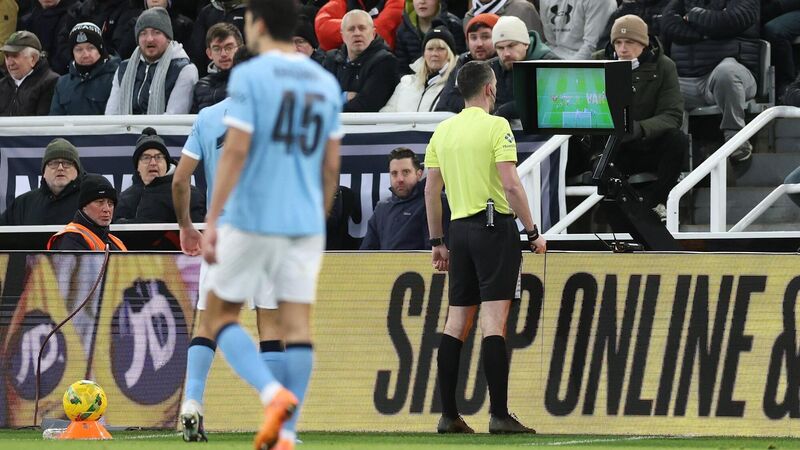
Referee Chris Kavanagh reviews the VAR monitor, which resulted in a goal scored by Antoine Semenyo of Manchester City (not pictured) being ruled out for offside during the Carabao Cup Semi Final First Leg match between Newcastle United and Manchester City at St James' Park on January 13, 2026 in Newcastle upon Tyne, England. (Photo by Stu Forster/Getty Images)

Semi-automated offside technology (SAOT) failed during Newcastle and Manchester City’s Carabao Cup semi-final on Tuesday night, leading to a five-minute delay in ruling out an Antoine Semenyo goal.

The lengthy deliberation, that required VAR officials to manually apply the lines which eventually found Erling Haaland to have influenced play from an offside position, became the major talking point of the game. City’s manager, Pep Guardiola, criticised VAR in his post-match interviews and said the offside ruling had helped his team to win because it had made his players “angry”.


SAOT technology uses in-stadium cameras to build a live picture of the position of players on the field, before generating a 3D image that can be used by VAR officials to assess offside calls. It is understood the system, the same as used in the Premier League, was unable to locate the position of the ball in the buildup to the Semenyo goal because it was obscured by surrounding players. Without a 3D image, VAR operatives were forced to revert to manually applying offside lines to video footage.

The incident is a blow to Professional Game Match Officials (PGMO), which has been focused on reducing the interruptions from VAR decisions this season. PGMO has insisted the referee’s call should stand whenever possible and encouraged officials to back away from forensic assessments of tight calls owing to the delays they can cause.

The average length of a VAR adjudication has dropped this season to less than 50 seconds but the extreme examples, known as “edge cases”, continue to sour the match-going experience for spectators. A similar failure led to a lengthy delay during the Premier League match between Newcastle and Bournemouth last month.

PGMO officials said they “understand that lengthy VAR decisions cause frustration” and that they are “continuing to work tirelessly through regular and dedicated VAR training to expedite our process for the benefit of the game”.

After the match Guardiola had criticised what he regards as inconsistencies around VAR, with Newcastle’s winner against City in the league in November confirmed after a lengthy offside check.

“I think my players were angry,” Guardiola said. “Maybe it [the VAR delay] helped us to be that way. We know how it works and it made us stronger. The spirit was there. But I feel it and smell it in every training session.

“Today, four people were not able to decide because the line was, I don’t know, but the second goal Newcastle scored [in November] the line was perfect. I’m not suspicious of that in 10 years. I didn’t say anything when we lost 2-1 here. I didn’t say anything in the FA Cup final against Crystal Palace, it is a red card after 30 or 40 minutes for [Dean] Henderson. OK, it’s fine.”

Meanwhile, competitions are set to be given a choice over whether to use VAR to check corner kicks, with some concerned it is a further step towards re-refereeing the game.

Fifa is keen on corner kick awards being checked at the World Cup this summer. For that to happen, a trial would need to be approved by the game’s lawmaking body, the International Football Association Board, either at next week’s annual business meeting in London or at the annual general meeting in Wales on 28 February.

Approval is considered likely but it is understooed there is resistance from a number of quarters to corners becoming a compulsory part of the VAR protocol, even if Fifas trial is judged a success. Competitions may therefore be able to opt to use technology to check corners, while others can stick to the existing VAR protocol which covers goals, penalties, straight red cards and mistaken identity.

There have been concerns expressed that opening the door to checking corners could be the thin end of the wedge and lead to matches being re-refereed by VAR, at a time when many feel VAR should be doing less, not more.

Guardian

x

More in this section

Sport

Newsletter

Latest news from the world of sport, along with the best in opinion from our outstanding team of sports writers. and reporters

Cookie Policy Privacy Policy Brand Safety FAQ Help Contact Us Terms and Conditions

© Examiner Echo Group Limited