The top 20 moments for Irish football in 2025
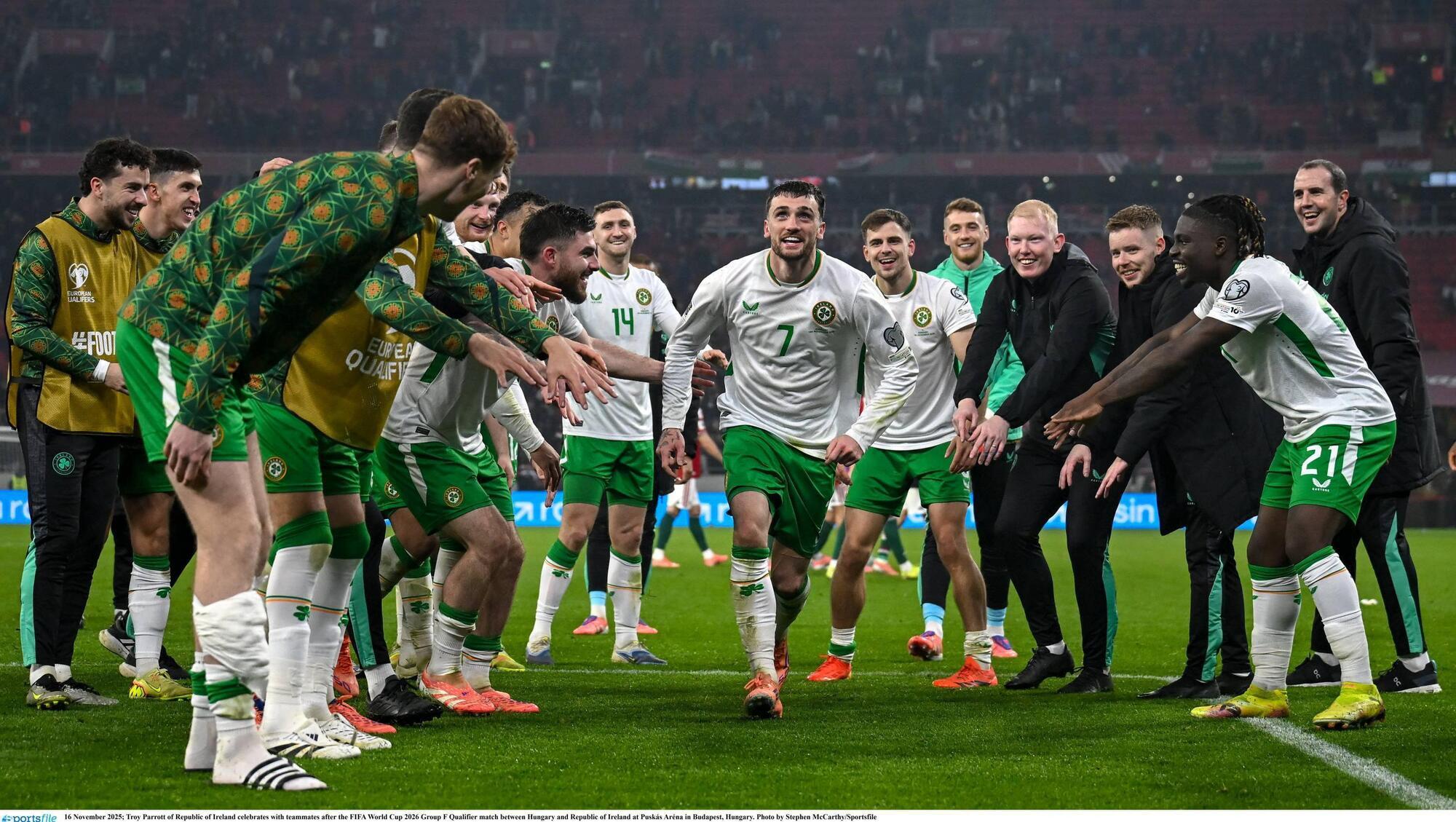
SPORTS PICTURES OF THE YEAR 2025. Troy Parrott of Republic of Ireland celebrates with teammates after the FIFA World Cup 2026 Group F Qualifier match between Hungary and Republic of Ireland at Puskás Aréna in Budapest, Hungary. Photo by Stephen McCarthy/Sportsfile
Never in the history of the FAI Cup had a team cancelled out a three-goal deficit to prevail in a tie but Kerry stencilled the largest imprint of their history by causing the upset of this year’s competition.

Giant-killing scalps are a rarity in the Blue Riband but not only did Colin Healy’s side eliminate Sligo in extra-time but, with it, land the Kingdom’s first semi-final spot since they joined the senior ranks in 2023.
Teen star Owen Elding enhanced his reputation by firing a hat-trick to put Sligo in total command by the hour but Cian Brosnan’s brace, either side of a Joe Adams penalty, forced extra-time. A cacophony of delirium engulfed Mounthawk Park when Daniel Okwute pounced with the winner three minutes from time.
Ireland’s seventh Premier League manager, and the first since Chris Hughton left Brighton and Hove Albion in 2019, was the most surprising. The first managerial post Andrews was entrusted with came in the ruthless domain of the Premier League, promoted from within the Brentford framework to fill the vacancy created by the migration of Thomas Frank to Tottenham Hotspur.
Rather than plump for a candidate with top-level, or any, managerial experience on his CV, the Bees hierarchy, led by analytical owner Matthew Benham, trusted potential in their set-piece coach to defy their meagre wage budget, by English standards, of £50m, to sustain their success.
Frank being followed out the door by Bryan Mbeumo, Yoane Wissa, Christian Nørgaard and Mark Flekken depleted their squad but Caoimhín Kelleher was one of the club’s several shrew replacements.
Debate on sculpting a system to arrest the alarming decline in top-flight Irish players across Europe has long been ongoing. Brexit restrictions placed the onus on League of Ireland clubs to develop players before the higher UK transfer age of 18 and this was behind the FAI’s quest to move all levels, from U8s, to the summer season in place for LOI since 2002. Central to the FAI’s failure was skirting around this motivation, feebly relying on weather reasons to pitch, but the majority of leagues in the country accord to the normal format that 80% of European leagues operate, from September to May. Eventually the FAI’s binding resolution fell asunder, leading to a face-saving exemption clause that’s been duly ignored.
It was 24 years ago to the week that the name of Ireland featured in a World Cup draw.
This one was different, for they entered as a placeholder under the banner of Uefa playoff pathway D.
Either Ireland, Czechia, Denmark or North Macedonia will line up in Group A next June alongside South Africa, South Korea and co-hosts Mexico.
Heimir Hallgrímsson was compelled to be present for the extravaganza, a gaudy love-in between the two presidents, Fifa’s Gianni Infantino and the US’s Donald Trump.
Ireland, and the rest of the 64 nations involved, were forced to endure a two-hour farrago of pomp before learning their groups.
September 2024 presented a bleak outlook for the club that dominated the noughties.
Relegation for the first time in 16 years formed a mere morsel of their challenges, as survival in itself was in jeopardy. Collateral damage from successive ownership reigns put the club on the financial brink until a second tilt at a takeover by local barriter John Temple bore fruit.
Former player Ciarán Kilduff returning to the club as manager provided the springboard, fusing stalwarts such as Daryl Horgan and Keith Ward with fledglings like Vinny Leonard and Seán Keogh. The latter teen was snapped up by Brighton and Hove Albion in a record deal for Dundalk but they still staved off the challenge from Cobh Ramblers to finish 10 points clear at the summit.
Political promises had cautioned football folk against taking Micheál Martin’s pledge for financial support back in 2021 on face value.
Never before had a pot of money been ringfenced for the development of high-potential footballers but the realities of Brexit, coupled with the senior men’s team slipping into the 60s of Fifa’s rankings, meant the alarm spread into Leinster House.
Governance slippages within the FAI delayed the awarding but stellar work by the likes of Will Clarke and Pat Duffy succeeded in placing clear blue water between the FAI and LOI clubs. Having retired ministers Dermot Ahern and Michael Ring on the LOI committee also helped break new ground. That it was the first tranche of multi-annual funding made Budget Day feel like Christmas Day.
As John Aldridge can attest from his 20-game wait for an Ireland breakthrough, goals are the currency strikers are judged by.
Ferguson set a high bar from his early exploits as a teenager at Brighton and Hove Albion but a concoction of injury and bluntness extended his famine to 13 months.
Switching scenery in the summer from England to Italy for a loan move with Roma was worthwhile but, for all his impressive form at the outset, it wasn’t until his 11th appearance that the elusive strike came against Cremonese. It was the first Serie A goal by an Irishman since Liam Brady in 1987.
England’s international success, back-to-back Euro titles, a World Cup final appearance, coupled with State and private investment. turned the Women’s Super League into a magnet the global elite wanted to inhabit.
For all the individual talent in England, their teams were unable to usurp the German, French and Spanish powerhouses in the Champions League.
Just once since an Irish-dominated Arsenal won the competition in 2007 had an English side (Chelsea) reached the final but the current Gunners generation finally ended the hoodoo.
At the heart of their triumph was Ireland skipper McCabe, whose number of minutes (1,296) was the highest of any player in the competition.
Sport, including football, touches all forms of humankind and the Bradley family had the country behind them when Josh underwent a battle with leukaemia from 2022 at the age of eight.
While Bradley was known as the country’s most successful domestic manager, the biggest challenge of his life was at home supporting his son before and after aggressive rounds of chemotherapy.
What the public saw was the 2023 league trophy being handed to the youngster to hoist to the Tallaght crowd but away from the limelight but the concern was real.
Thankfully, the now 11-year-old got to ‘ring the bell’ at the Crumlin Children’s hospital, just days before his father’s Hoops side won in Portugal to all but seal another European league phase.
Another Rovers resilience story of a different hue.
It’s difficult to comprehend that Lopes was working as a bank official less than a decade ago, unsure whether he’d follow peers and rivals like John Egan into the full-time football ranks.
Not only has he achieved it as Hoops captain but World Cup matches loom next summer against Spain, Uruguay and Saudi Arabia. They won’t be for Ireland but an Irishman will be at the global spectacle, lining out for Cape Verde against the Spanish two days before his 34th birthday.
FAI Cup winners in 2023, league winners in 2024, Athlone Town required the artillery of US-born newcomer Kelly Brady to meld the two assignments into an historic double.
Endurance and conditioning are commonly cited as the elements lacking in home-based players seeking international recognition but Brady, who declared through her Irish-born parents at underage level, was worthy of her maiden senior call-up.
Her haul of 27 goals across their domestic dominance and strides into two European competitions underpinned the Midlanders’ prowess, earning a contract offer for their star striker from Crystal Palace.
Colin O’Brien became a victim of the FAI downgrading their underage managers into ‘special purpose contractors’ but there was a crowning glory for the Corkman before he escaped the dysfunction.
Hungary in 2023 was the fourth time O’Brien led Ireland to the U17 Euro finals but 2025 broke fresh ground, reaching a first-ever World Cup at this age-level.
Ireland, with Damien Duff watching on as a Fifa observer, didn’t disappoint in Qatar, breezing through their group into the knockout stages.
In-demand Michael Noonan forward was the fore, completing a comeback win to send Ireland top and all but seal their passage.
Progress can be subjective but growing expectation around the LOI decrees that the title-winners progressing along the champions path of the European snakes and ladders structures to the league phase is the litmus test.
Shels conquered that mission, technically without having to leave the island of Ireland.
Quirks of the localised Uefa draw format resulted in them drawing Linfield twice, in the first round of the Champions League in July and the Conference League playoff six weeks later.
The All-Island derby descended into something of a mismatch as the Reds prevailed 5-1 on aggregate and then 2-1. Grossing a cool €4.45m from their exploits replenished three years of trading losses too.
Uefa’s obsession with competitive games has created a plethora of extra playoff games. Once Carla Ward lost the second game of her reign, a 4-0 mauling away to Slovenia, it was always likely a playoff would be required to reach the top tier of nations for next year’s World Cup qualifiers.
Belgium were seeded higher than Ireland but didn’t have a player in their armoury of Katie McCabe’s world-class status.
Her masterclass in the first leg generated a two-goal cushion heading to Leuven but extra-time was looming when the hosts hit back to leave the aggregate score at 2-2.
Substitute Abbie Larkin had other ideas, plundering a stoppage-time winner to allow Ireland that rare privilege of celebrating a defeat.
A Sunday morning bombshell, regardless of how it was dressed up.
Duff was the honey LOI folk gorged on during his first three full seasons as a standalone manager. Digital traffic validated his exalted status, especially after elevating Shelbourne from 20-1 outsiders to champions last season.
Duff lasted longer in the post than his detractors predicted but rather than enjoy the milestone of Champions League participation, he decided to step away a week beforehand on his own terms.
The brought you the news first of how he left players and staff shellshocked by announcing his exit during a training session.
Stephen Bradley is adamant Rovers don’t receive the credit they deserve for collecting nine trophies in his nine-year term but there’s no denying it takes a generational team to scoop a double.
It was the first by any club for seven years and ended a 38-year wait for Rovers.
City were staring relegation in the face when they shocked St Patrick’s Athletic in the semi, channelling their energy into the showpiece. Only for the brilliance of Ed McGinty in the Hoops goal and a pivotal red card, the Leesiders might have caused an upset in front of 35,252. Instead, veteran Rory Gaffney stabbed two second-half goals to complete the job.
Howls of injustice rippled through the Lisbon air when Dara O’Shea was penalised for a handball that clearly struck his chest. Ireland held the Uefa Nations League champions scoreless for over 70 minutes in their backyard but Ronaldo was sure of himself when he stood over the ball from 12 yards. Caoimhín Kelleher had denied Kylian Mbappé from the spot 11 months earlier and was again the party-pooper, sticking out his leg to deflect the centrally hit penalty away to safety. Ronaldo’s record haul of 143 goals includes 22 penalties but two of his 10 misses were against Ireland on home soil four years apart.
Footballing royalty guarantees bums on seats for the FAI and Ronaldo’s latest visit to Dublin – surely his last at 40 – always threatened to be eventful.
The game’s first billionaire joked at the pre-match press conference about praying for a positive reception but he was widely goaded as a night of frustration ensued. Rage got the better of him approaching the hour when an elbow landed into the back of his nemesis O’Shea. VAR caught his petulance and the mock clapping, followed by jabbing his finger at Hallgrímsson on the way off, affixed the pantomime villain tag.
That crisp Thursday night in D4 will enter the annals not just for the Portugal captain’s indiscretion but being Ireland’s statement home win in 10 years.
That cannot be overshadowed by anything peripheral, for Ireland delivered an epic performance from start to finish. This wasn’t in the vein of the hit-and-hope, back-to-the-walls win over Germany in 2015, rather an accomplished paralysis of the threats posed by the fifth best in the world and optimising Ireland’s strengths. Parrott’s opener, off a rehearsed corner, had Lansdowne rocking and he followed up with a sumptuous second that exhibited his striker’s instincts.
Read More
Widespread wisdom foresaw a scenario whereby Ireland needed victory in Budapest to snaffle the runners-up spot by a nose at the finish line.
That’s how it transpired going into the last of six qualifiers, allowing Dominik Szoboszlai’s side the error margin of avoiding defeat to consolidate the playoff route.
Twice they led at the Puskás Arena. Twice Parrott equalised to present hope.
Ireland took to the pitch just 65 hours after their Portuguese heroics, only to surpass that glory by grabbing the winner just as the last of six stoppage-time lapsed.
Regardless of what comes next, that fifth Parrott goal over two games marks the Reeling In the Years sports clip of 2025 – arguably of the decade.