What's new? Automated offside, less injury time, more balls
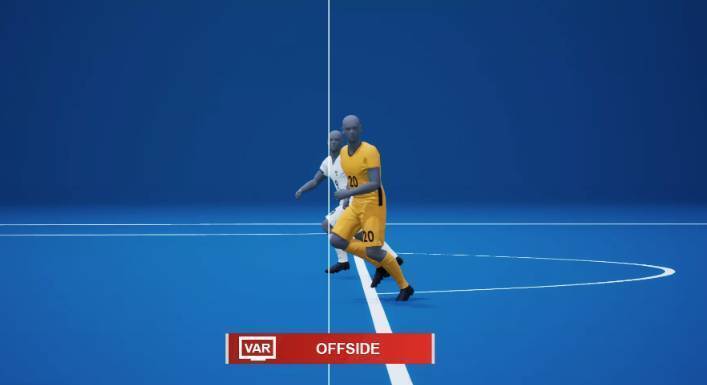
COMPUTER GAMES: The SAOT technology will not be ready at the start of the season and is set to be introduced following one of the autumn international breaks.
Chief among the changes is a reworking of VAR through the introduction of semi-automated offside technology (SAOT), meaning that lengthy waits for remote referees from Stockley Park to confirm a goal’s legality will eventually be a thing of the past. The technology has been used by FIFA since the 2022 World Cup and has since been seen in the Champions League and Paris Olympics. VAR’s operators faced considerable scrutiny throughout last season as managers and players questioned its accuracy, but SAOT’s introduction should alleviate some of that pressure.
The ‘automated’ element is the placement of the offside line, which has proven to be rather time-consuming since VAR’s introduction in 2019. The process will not be fully automatic, though, and will require referees to manually check the point at which the relevant pass was played and determine a player’s involvement in a sequence of play. Despite that, the Premier League estimates that the technology’s introduction will accelerate offside decisions by an average of 31 seconds.
SAOT will not be ready at the start of the season and is set to be introduced following one of the autumn international breaks, meaning that fans could see the technology adopted as early as mid-September.
Methods of calculating injury time are also set to change. From the start of the new season, teams will be afforded 30 seconds to restart play after a goal before referees begin to add extra time, an update intended to shorten matches amid increasing goal tallies.
The League has again updated the ever-changing rules around handballs, now mandating that hand contact leading to a penalty will no longer be uniformly penalised with a yellow card. Bookings will still be given should a handling be deemed ‘deliberate’.
Should a penalty be awarded, laws surrounding encroachment have been refined. Current rules state that no player may cross the line into the penalty area until the kick is taken, though updated rules add that offences will only be penalised if it is deemed to have distracted either the goalkeeper or the penalty taker, or should the encroaching player gain an unfair advantage in claiming a rebound.
Rules surrounding the placement of the ball at a penalty kick have also become more stringent: the ball must now either touch or “overhang” the centre of the penalty spot. While the difference may only total a matter of centimetres, it will serve to lessen the taker’s advantage.

As ever, a new season brings with it the latest edition of the Premier League match ball, which will be provided by Nike for the 25th year running. They hope that improved aerodynamics will allow players better control and ‘truer flight’. The technology involved is a far departure from that featured on the Geo Merlin, the first ball Nike provided to the league, which was simply marketed as the roundest ever made.
Supporters will see plenty of Nike’s latest contribution due to the Premier League’s updated ‘multiball’ system, which will see the number of balls used at any one match increase from 10 to 15 as a means of accelerating restarts.
In past seasons only three substitutes could warm up at once, but the limit has been raised to five following the 2020 decision to allow five personnel changes per match.
The swath of updated rules will be enforced by two fresh faces, as PGMOL have promoted Sam Barrott (CRRCT) and Craig Taylor to Select Group 1, its corps of full-time Premier League officials.


CONNECT WITH US TODAY



Be the first to know the latest news and updates