Dion Fanning: Whatever you do, do nothing - the Don Carlo philosophy
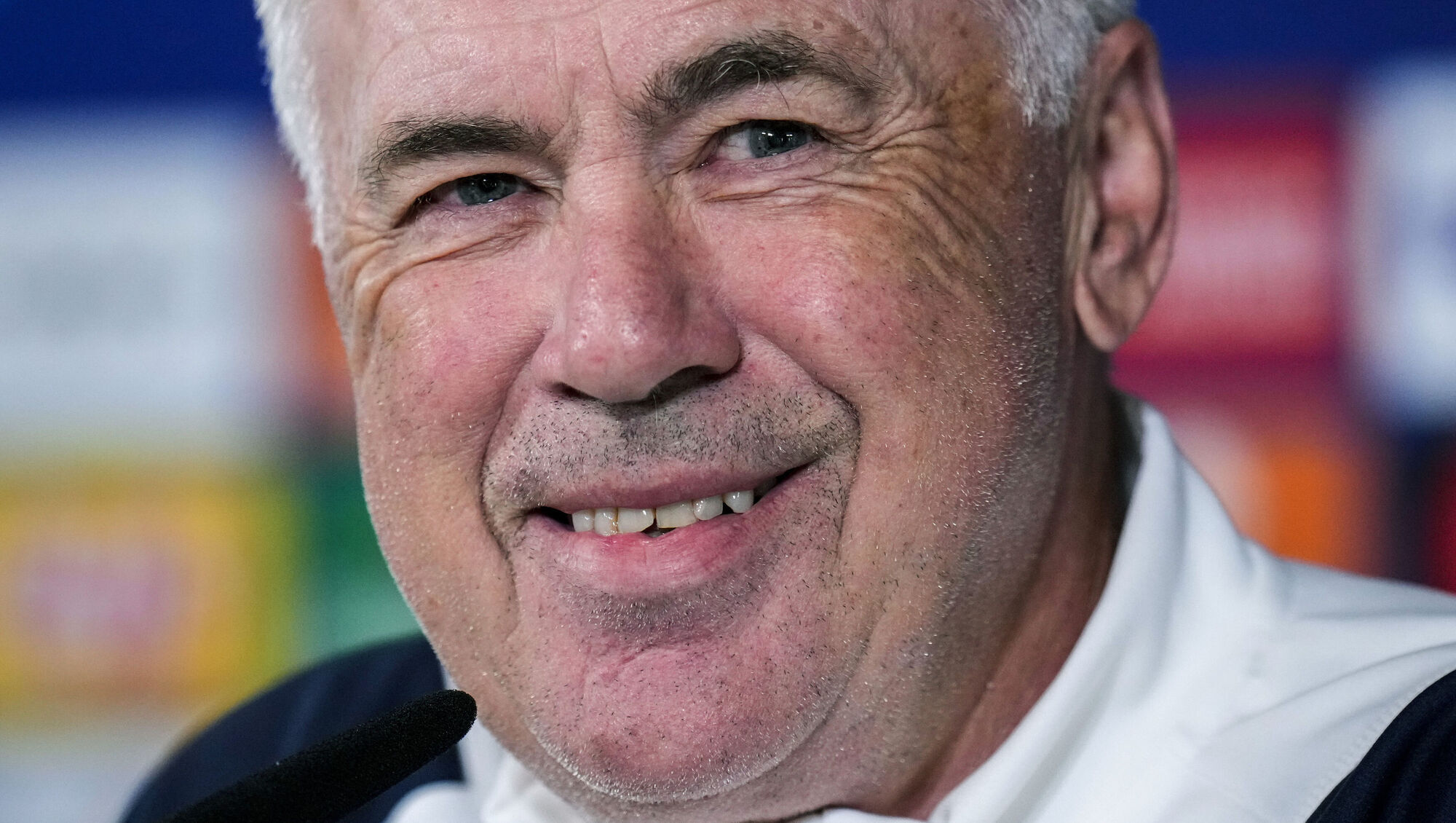
LONDON CALLING: Real Madrid's head coach Carlo Ancelotti attends a press conference this week. Pic: AP Photo/Manu Fernandez)
When Carlo Ancelotti, improbably, became Everton manager in December 2019, the first thing he did was to do nothing.
His predecessor Marco Silva had been sacked following a 5-2 defeat at Liverpool and Duncan Ferguson had been made caretaker as Everton considered their options.
Duncan Disorderly and Don Carlo would seem an unlikely pair but a friendship was formed and a relationship that remains was shaped in the early days.
Ancelotti doesn’t just manage upwards well, he manages in the round and his first acts as Everton manager were an indication of that.
Ferguson had put a little run together when he was made caretaker and he had switched Everton to a 4-4-2 formation. They had beaten Chelsea and drawn with Manchester United and Arsenal. It looked as if David Moyes would be returning to the club before Ancelotti was the startling appointment. Ferguson would later have ambitions to manage Everton himself but when Anecelotti arrived, he told Ferguson to keep taking training and he would in the short term retain the same 4-4-2 formation that the caretaker had adopted.

Nobody could describe it as a manager not changing a winning formula, but it was a not-losing formula which was something. More importantly, it told instead of Ancelotti’s calmness and his self-assurance. He had no need to make a gesture so that everyone at Everton would understand who he was. Instead, by doing the opposite, by actively doing nothing, everyone would understand who he was.
Ferguson remained devoted, talking about all he had learned from Ancelotti and joking that whenever they went out for a meal, it was Ferguson, not Don Carlo who would foot the bill.
Ancelotti was said to be on €11 million a year at Everton before he departed for Real Madrid in the summer of 2021. Since then there has been another Champions League, to make it four in his career, and at Wembley Saturday evening he will manage in his sixth final, straddling eras, achieving a kind of permanence rare in the modern game. Marcello Lippi was the first coach he faced in a final. Lippi is now 78. His opponent tonight, Dortmund’s head coach Edin Terzic, is 41.
But more importantly he has sustained through trends, whims and fashions. After Lippi, he played Rafa Benitez in two Champions League finals when he was at Milan. He faced Diego Simeone and Jurgen Klopp during two different spells at Madrid and now he faces another coach with other ideas.
Most people in football who are described as pragmatists are anything but. They are fatalists, certain that the worst will happen and determined to take no risks as they try to prevent it. They have a dogma whereas Ancelotti is closer to a pragmatist.
He is a pragmatist who makes smart decisions, most notably what clubs he manages. He is said to be a manager without a philosophy but this is a philosophy too. Doing nothing can also be an act of will.
There is a story of the Conservative Party minister appointed to a new job who was asked as he left Downing Street what he wanted to achieve in office and he replied “nothing”.
Light touch regulation was as much a philosophy as state intervention although Ancelotti’s light touch could be said to have been more successful than those who believed in leaving the markets to it.
His own success as a player and a manager has given him authority but in his autobiography, he wrote about how that has its limitations. “This honeymoon period with the players never lasts long because immediately after that, they are looking at you and asking, ‘What can this guy do for me?’”
The answer has been quite a bit. Ancelotti endures because of shrewd management, shrewd management of his own ego as much as anything else. At Chelsea, after a bad result he would receive a brief text message from the owner Roman Abramovich. The message was always simply ‘?”. Ancelotti would often reply with a ‘!’.
What did Abramovich want? Ancelotti tried to oblige. “On one of the first occasions I met Abramovich,” Ancelotti wrote in his autobiography, “he told me ‘I want to find a manager that gives my team an identity, because when I watch Chelsea I’m not able to find an identity. When I see Barcelona or Manchester United, I find an identity in the team — when I watch Chelsea I cannot find an identity.’ So we changed the style of play — we played with more possession.”
Ancelotti wanted to sign Andrea Pirlo to underline this new identity but when Chelsea couldn’t, he found another way.
“I didn’t change the style of the training,” he explained in his most recent autobiography, echoing his approach at Everton. “The players felt comfortable with it as it was, so it seemed right to keep it. We did change the style of the play, though, and that helped in a different way because the players had to concentrate and learn, which always motivates the best of them. Of course, just as I would see later with Real Madrid, we had to change the way we played because the owner wanted something different about the style.”
This sense of accommodation means that Ancelotti works best at clubs where radical change is not required. There is something of Alex Ferguson’s words about Sven Goran Eriksson in how he manages. "He doesn't change anything,” Ferguson said of Eriksson in 2003. He had been lined up to succeed Ferguson before he changed his mind on retirement. “He sails along, nobody falls out with him. He comes out and says 'the first half we were good, second half we were not so good. I am very pleased with the result'.”
Like Ancelotti, Eriksson was successful with that approach even if its limitations were revealed during his time at England when he allowed players who weren’t capable of it to think for themselves.
Ancelotti has, for the most part, worked with those who can. Luka Modric and Toni Kroos are two who have shown the rewards that come with trusting the very best players.
Yet perhaps people tire of the pragmatists too. After delivering Real Madrid’s tenth Champions League and their first in 12 years in 2014, he was sacked by Florentino Perez a year later when Madrid failed to win anything.
His return in 2021 left many at Everton dismayed but that was a significant departure for Ancelotti who may have found the club a challenge beyond even his intelligence.
When he doesn’t succeed, Ancelotti can seem like a passive manager. He was sacked by Abramovich in the dressing room at Goodison Park after Chelsea finished second in 2011, a year after they’d won the Premier League.
Ancelotti wrote that Abramovich felt he was too gentle with his players and wanted him to be tougher. “I’d heard it before and I’ve heard it since, but he was wrong — they are all wrong. I don’t change my character.”
When they wonder if Carlo Ancelotti has a philosophy, it might be in his understanding that football is a game of the mind as well as the body. A man’s character is his fate, the Greeks said, and it may well be his philosophy too.
CONNECT WITH US TODAY



Be the first to know the latest news and updates