Summer soccer still a hard sell as FAI sets out its 12-year vision
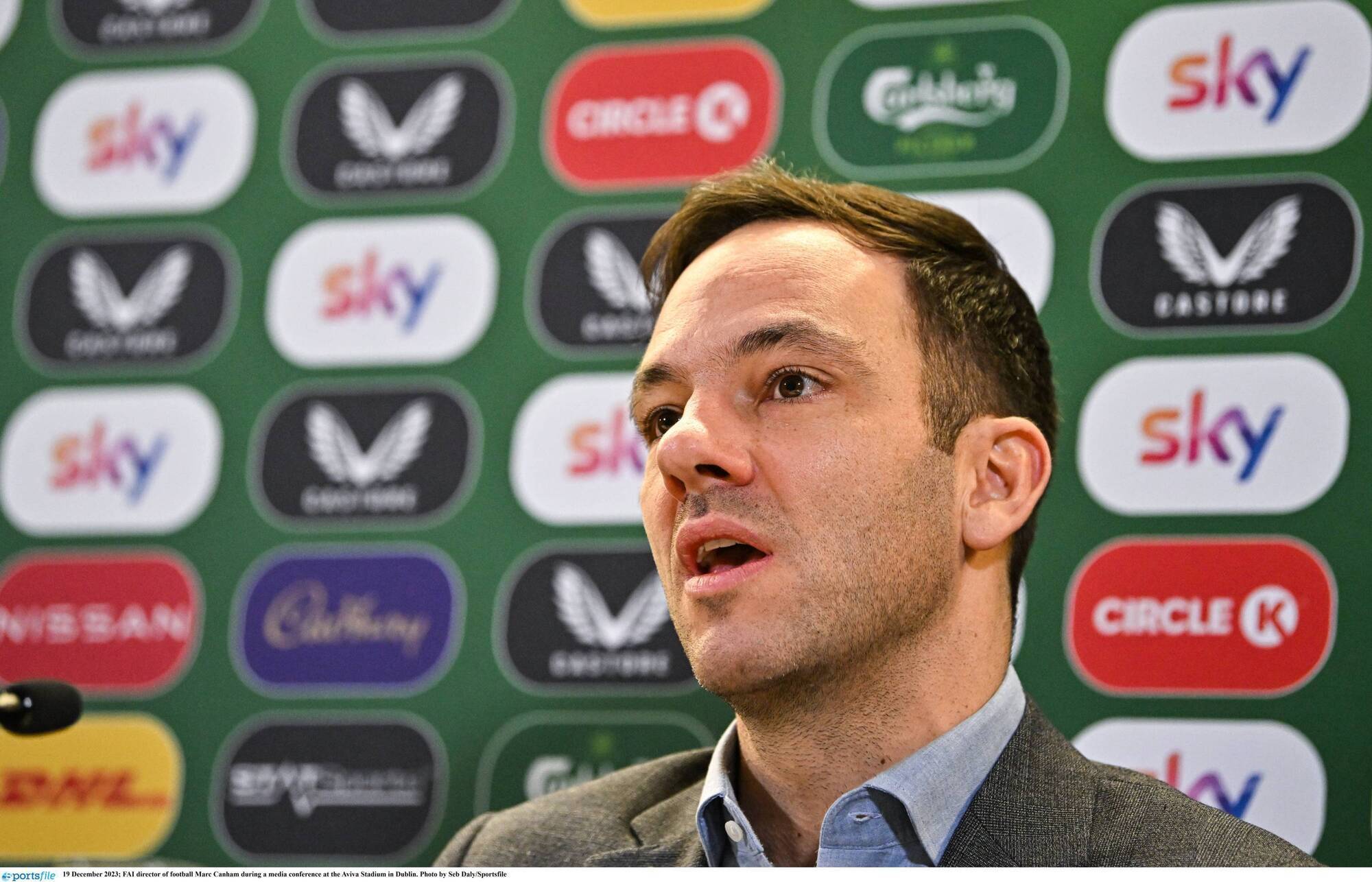
FAI director of football Marc Canham
Just don’t call it summer soccer. That was arguably the central takeaway as the FAI unveiled its Football Pathways Plan at a well-attended meeting in Cork on Wednesday night.
The Rochestown Park gathering is one of four briefings this week, as FAI director of football Marc Canham outlines where the association is at with its “12-year vision” for the Irish game. A long-term plan to be delivered in ‘three-year blocks’.
The people who organise fixtures and line pitches and sort the kids into 4-3-3 travelled from all around Munster to hear plenty of worthy ambition, as the FAI set out its aim to build the “most integrated football ecosystem in the world”.
“We don’t want to copy and paste from another country,” said Canham, formerly director of coaching at the Premier League.
Ireland’s “strong multi-sport” culture is a unique advantage we can harness, he stressed. Look at clubs like Benfica, who have to encourage their academy youngsters to take up other sports to build more rounded athletes.
All of what was presented is up for discussion, details will come later, Canham insisted. But among the top-line items is a six-tier pyramid for men’s and women’s football in Ireland, needing around 146 clubs with the ambition and resources to climb that ladder. The start point for men would be a National Leagues North and South, sitting below the League of Ireland First Division. For women, the initial step is a First Division.
Some interested parties in the room wondered where grassroots clubs would find money to participate and travel. Would there be grants? That kind of detail will come later, said Canham and Fran Gavin, the FAI’s head of competitions and football services.
A new National Football Centre and academy for boys and girls is planned, along with a “pre-academy 9-13” phase for schoolboy football. Rather than bolt an U13 National League onto the grades already in place, League of Ireland clubs would collaborate with schoolboy clubs to provide extra coaching for their best players at that age. Girls League of Ireland academies would also start earlier.
“We don’t want to specialise too early,” Canham said. “But we want to increase development time from a young age.”
There was lots of stuff nobody could really argue with about creating more participation opportunities, about improving governance of clubs and leagues, about streamlining player development.
But the one everybody wanted to talk about was the plan Canham floated last week when announcing these briefings — to switch all of Irish football to the calendar year model employed by League of Ireland clubs.
Or, as most in the room would call it, the return of summer football. At the moment, around two-thirds of Irish football instead builds its seasons roughly around the school year.
How will a February to November season possibly work in Ireland’s ‘strong multi-sport culture’? That’s what some wanted to know. Others just sounded a bit weary. A similar plan, introduced by Canhan’s predecessor Ruud Dokter fell apart towards the end of the John Delaney era. Many leagues switched, but have since switched back. Besides clashes with other sports, working kids’ seasons around summer holidays proved difficult. “Can we switch back again if it doesn’t work this time,” one league administrator asked.
The GAA loomed large over the discussion. Particularly for clubs in rural areas, the idea that you could field a competitive underage soccer team, maybe even field 11 full-stop, while GAA championships are up and running remains fanciful. Not everybody wanted to grab the microphone but some voiced concerns quietly. “It’s the same players playing everything,” one said. “The kids might even prefer to play soccer, but tell that to the parents in a place like ours. You can’t change culture easily.”
Canham was keen to steer the debate away from detailed timelines. The plan simply means players would be registered from January to December. Leagues could still play in exactly the same months as they do now, just register players and start competitions at the beginning of the year.
“It’s not about summer football or winter football. Exactly when you play we would work with you on.
“You might need breaks for different reasons. At periods when there’s a big volume of GAA it might be beneficial to take a break. We would like everyone to go on that journey in a collaborative way.
“We would review after three years. If it isn’t working we would look to adapt and change.”
The presentation suggested seasons at the ages of 12-14 could be divided into two blocks, perhaps allowing a break for summer. Looks like GAA soon won’t have a monopoly on that popular phrase ‘split-season’.
Canham promised talks with the GAA will be held around the calendar. Though what that might achieve, when the GAA doesn’t appear to have a minute to spare in its own seasons, seems debatable.
Canham added: “The GAA isn’t going away. They are playing 12 months of the year. Why would we organise ourselves around them? We shouldn’t design our calendar around other sports. We have to be open to losing players to other sport. We have to create the best experience so they don’t want to leave.”
Call it what you want, but there were plenty other concerns about the logistics of shifting competitions more or less on their heads.
How would you get grounds like Turner’s Cross for cup finals towards end of the year, when the weather is bad and the League of Ireland is still running?
How can you run National Cups efficiently if leagues are free to take breaks when it suits local circumstances?
When the FAI’s registration system is already groaning under the workload, how would it cope when everybody is piling in at the same time in January?
What about university football, where everybody is gone in the summer?
“We don’t have specific answers yet,” said Canham, more than once. None of this was presented as a fait accompli, more a start point for discussion. There will, you suspect, be plenty of devil in the details.


CONNECT WITH US TODAY



Be the first to know the latest news and updates