How does the Nations League work and what must Ireland do?
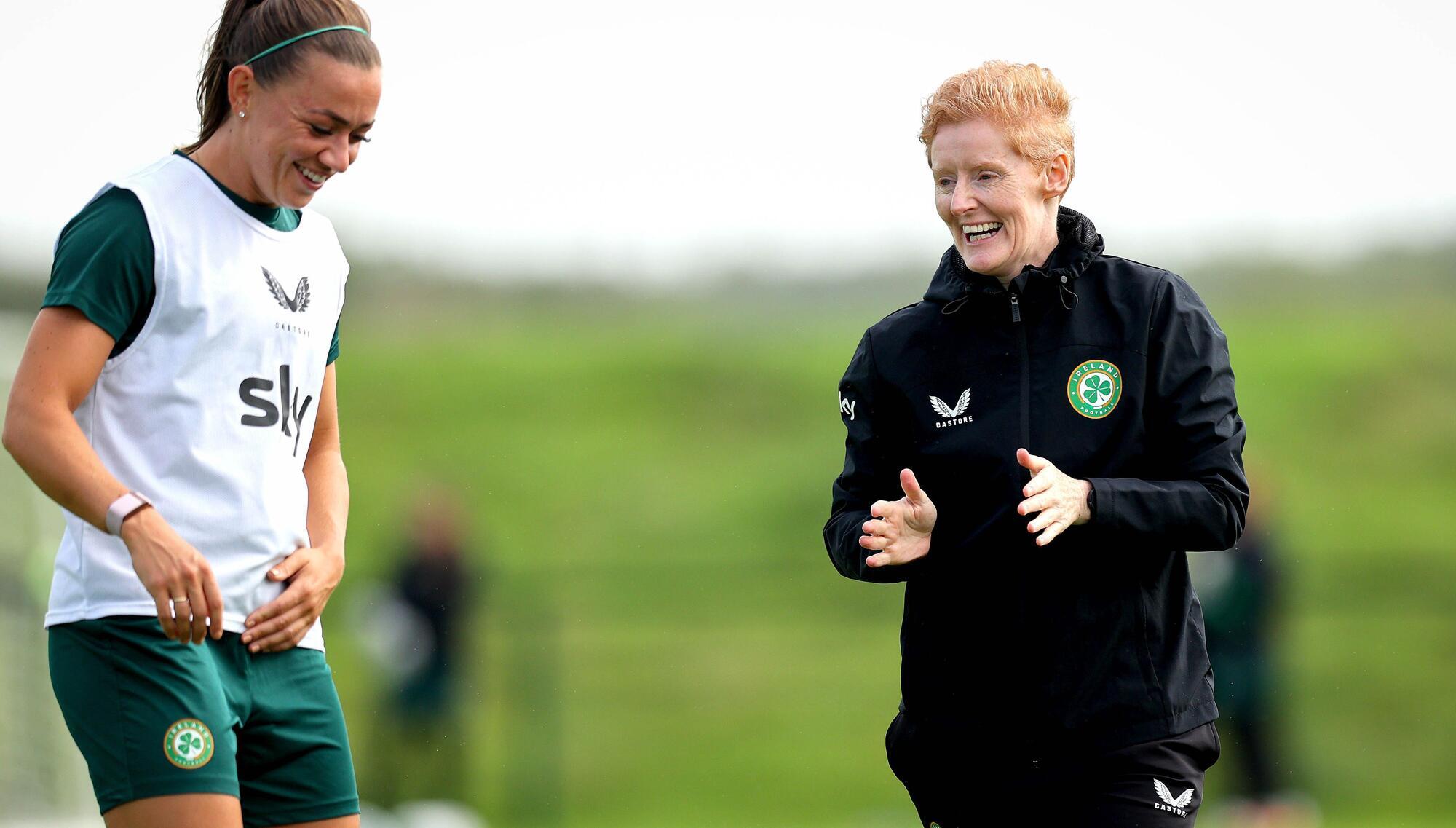
BACK AT IT: Katie McCabe and interim head coach Eileen Gleeson. Picture: INPHO/Ryan Byrne
A mere mention of the Nations League tends to bamboozle Irish fans but the stakes are far more clearcut when it comes to the women’s team.
Whereas three series of UEFA’s latest international competition have been contested, two under Stephen Kenny, Saturday sees the maiden equivalent version kick off.

There is also a key difference in the timing relevance of the outcome.
The men’s instalment is contested and generally used as a Plan B for teams – as Ireland are tenuously relying on – after the subsequent European qualifiers.
With the women, the two competitions are directly interconnected, one after the other.
Here’s a Q&A explainer to try simplifying UEFA’s latest brainchild:
Rather harshly, according to ousted manager Vera Pauw. Late last year, she viewed this development as a means to favour the established countries reaching major tournaments.
UEFA allocated their 51 nations (excluding suspended) into three leagues depending on their coefficient.
The cutoff, crucially, was after the World Cup groups concluded in September 2022.
At that stage, the criteria, based on the three previous campaigns, the 2019 World Cup (20%), Euro 2022 (40%) and 2023 World Cup (40%), had Ireland straddling the League A and B threshold.
Scotland grabbed the last of 16 League A berths, leaving Ireland in 17th, top of League B.
A month later, Ireland beat Scotland in the World Cup qualification playoff.
Extremely high. FIFA rankings, albeit an imperfect science, are the prevailing metric when it comes to comparing nations.
Ireland are positioned 24, way ahead of Hungary in 42nd place, followed five spots later by Northern Ireland. Albania, whom Ireland face home and away during the October window, languish at position number 72.
Northern Ireland’s shock qualification for the 2022 Euros in England constitutes the sole major tournament appearance among Ireland’s group rivals.
It has a significant bearing. If Ireland were to secure top spot in the pool, either before or after their final game up the M1 in Northern Ireland on December 5, they will be promoted to League A.
That League starting next in April 2024 acts as the qualifying series for the Euros. Eight teams, those who finish first and second in the four League A groups, progress directly to the finals. Given Ireland would likely be facing at least one powerhouse, possibly two, that will be difficult.
They will still be guaranteed a playoff route by finishing third or last, meeting nations from League C, either the group victors or the best runners-up. That is a semi-final for a final against a team that could emerge from League B.
Those one-off ties will determine the tranche of final seven teams to join the already-qualified top eight from League A and hosts Switzerland at the 16-team showpiece in July 2025.
That would hurtle them into a two-legged playoff next February against one of the four nations that finish third in League A. Were League A to go with ranking, Ireland could face one of Belgium, Austria, Iceland or Italy.
Prevail from that clash and promotion to League A is wrapped up.
Potentially. The UNL concept is designed to pit nations against similar standard opponents but the breadth of standard places Ireland as racing favourites to hit the summit.
Going into next year’s Euros with a string of wins behind them, many you’d expect convincingly, ought to fill the team with confidence for making a splash in what can be branded the proper League A competition next year.
Cakewalks against Albania also generate a byproduct of scope to experiment in selection. Ireland’s age profile at the World Cup should make it obvious that new blood is essential. Any prospective new permanent manager will understand that element is imperative to equip the team for tougher assignments in 2024.
It will unless Marc Canham unearths a successor for Pauw in the meantime. He indicated during last week’s first media appearance 15 months since his appointment that external expertise, a recruitment firm such as CAA, would be engaged to case the net wide to source the new supremo.
That only applies to the League A teams involved in the upcoming cycle. The winners of the four top groups will be paired into semi-finals next February. Whichever two teams emerge will contest the final in the knowledge they will represent Europe at next year’s Paris Olympics. Should France qualify for the final, whoever wins the third-place playoff will join them and the other finalist on the Olympic stage.