New Women's chief Eileen Gleeson targets State support to enshrine World Cup legacy
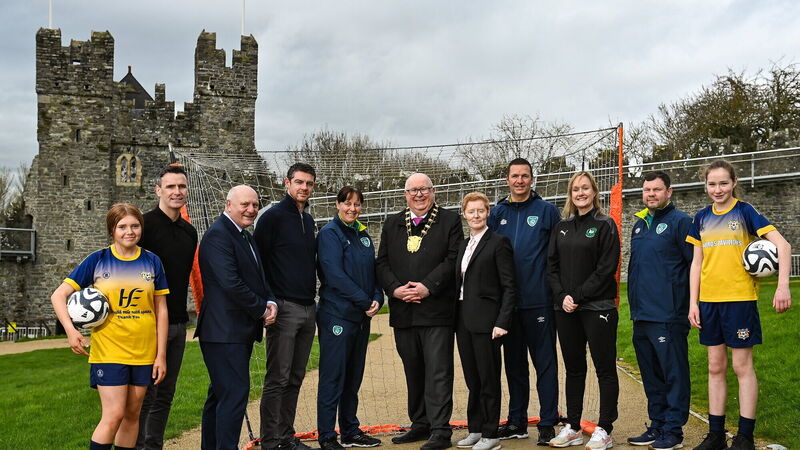
TARGETING DEVELOPMENT: From left, Swords Manor player Ellie Kerwin, age 13, Dennis Hyland, TY Co-Ordinator, FAI Regional Manager Barry Ferguson, FAI President Gerry McAnaney, FAI Fingal Development Officer Sharon Boyle, Lord Mayor of Fingal Howard Mahoney, Eileen Gleeson, FAI Head of Women and Girl's Football, FAI Fingal Development Officer Paul Keogh, Sandra Harvey from Swords Celtic, FAI Fingal Development Officer Jamie Wilson and Swords Manor player Layla Donohue, age 12, during the launch of FAI / Fingal Girls' Transition Year Football & Fitness Course at Swords County Hall in Dublin. Pic: David Fitzgerald/Sportsfile
Eileen Gleeson believes passing the World Cup qualification watershed will finally wake the Government up to driving the development of Irish women’s football.
Appointed as the first ever head of women’s football in January, having previously managed Peamount United and Glasgow City, as well as three years working as Vera Pauw’s assistant, Gleeson had to adopt a broader view.
This year will be etched in history as the one Ireland venture to Australia in July for group games against the co-hosts – set to be an 82,000 sell-out in Sydney – Olympic gold medalists Canada and Nigeria.
However, away from that razzmatazz, the women’s section of the game is hampered by a litany of obstacles, including major drop-off rates among teens, limited access to clubs provincially, facilities shortfall and an overall absence of an industry for players aspiring to operate professionally.
Initiatives like the specific girls-only transition year programme the FAI launched on Tuesday, funded by Fingal County Council, are small steps to offering an insight into full-time training but will function in isolation unless it’s replicated by other local authorities.
25 players will be part of the first intake, mirroring the male programme in Corduff that has Andrew Omobamidele and Killian Phillips as it’s marquee graduates from annual courses running since 2016.
All of this requires investment and given the parlous condition of the FAI balance sheet – strangled by €63m of debts and interest payments – it will only be sourced from external channels.
It has been acknowledged by the FAI that an infrastructural plan – believed to revolve around grand aid to the tune of €100m annually – will be submitted to Leinster House this year but the neglect of Irish football over years and decades tempers expectancy levels.
“I’m confident,” Gleeson said about the eureka moment of Amber Barrett’s qualification-clinching goal at Hampden Park last October prompting action rather than platitudes from politicians.
“We always need state support. We’re currently developing the legacy programme, with a working group in place.
“There are a lot of new initiatives that will be released soon but that whole legacy programme must be built around sustainability.
"What will happen post-World Cup are concepts for building capacity to manage the intake and participation.
“Developing the domestic league too so we can retain and provide a high-enough level to progress and internationally a sustained qualification for competitions and progress within Champions League for clubs.
“We're looking at all that., trying not to have a narrow view – to bring a more strategic approach to the women's game.”
Interest in female football was incrementally growing but the FAI must be equipped to manage the surge once the national team become the centrepiece of the country when they consume the nation’s attention during what could be a long, hot summer.
“The FAI has a target in the strategic plan from last year of a 50,000-increase participation by 2025,” said Gleeson, who admits she’s no interest in succeeding Pauw if the Dutchwoman chooses not to extend her contract after the World Cup.
“I think numbers are wonderful as a target but it is about building the capacity and having the infrastructure, retention and pathway process to facilitate those numbers.
“It’s important to have capacity and quality to reach numbers.
“We live by the hashtag 'We are one' but within that you've to acknowledge the difference that we're dealing with females.
“It's about talent ID, talent development, talent management of young females and ensuring that the pathways that we do develop in collaboration with all stakeholders reflects the individual needs of a female player.
"Whether that's simply around retaining young females around 14 or 15 where there's a big drop-off, what is the ideal pathway for the female, but the overarching aim is they have a progressive pathway, regardless of whether it's participatory, competition or performance-led, as a female, they have that pathway.”
CONNECT WITH US TODAY



Be the first to know the latest news and updates