Have England become the Tottenham of international football?
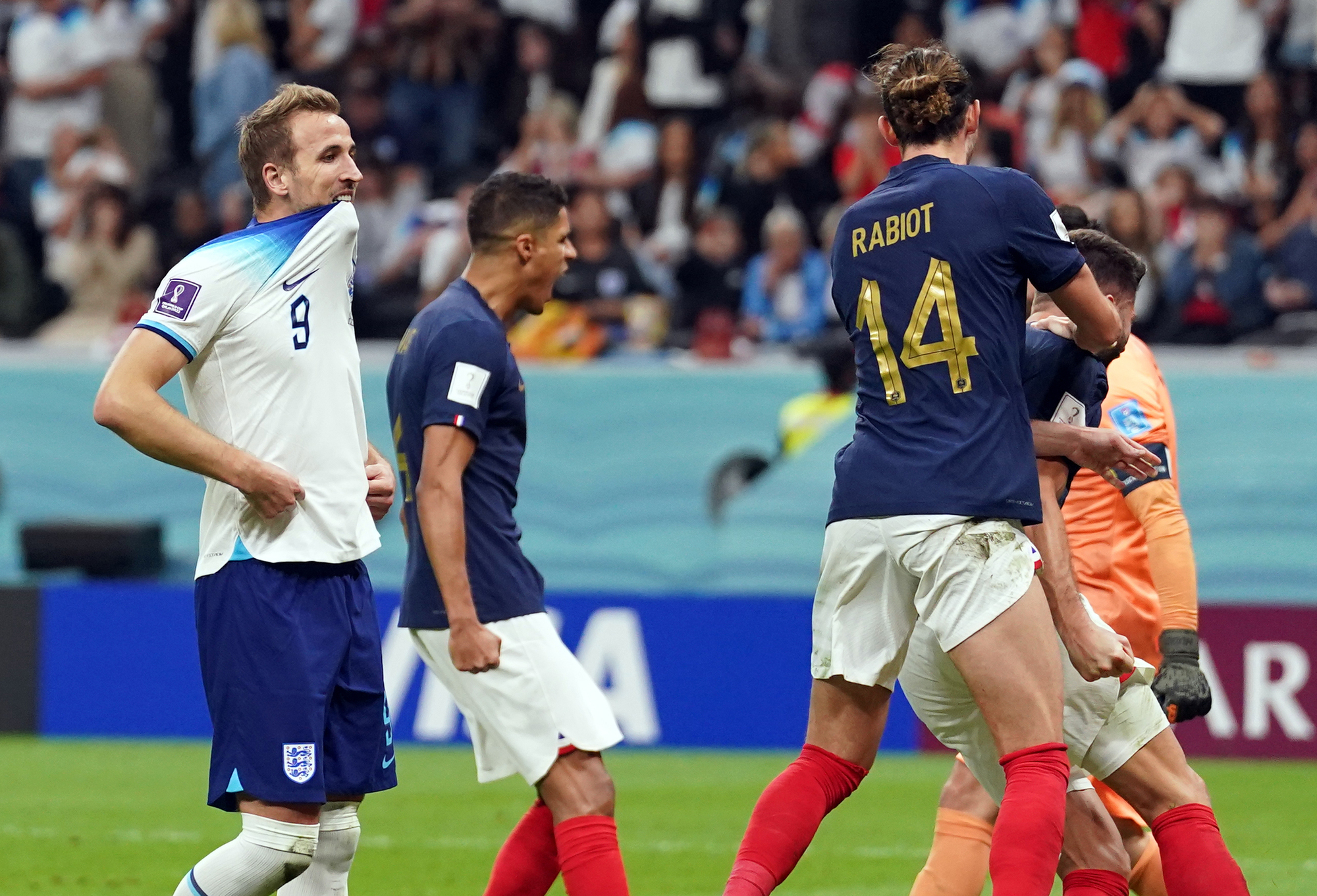
DEJECTION: England's Harry Kane after missing from the penalty spot.
Didier Deschamps had been speaking for 10 minutes, expressing pride in the qualities that had taken his France team to within 90 minutes of a second successive World Cup final. He said they had been pushed close to their limits by strong opponents, lauding England’s technical ability and their intensity. “They’re so quick, so strong, so energetic, that we had to defend very well,” the France coach said. “It comes down to small details and luckily, tonight it went our way. You need a bit of luck sometimes.” It was everything an English audience wanted to hear: soft elevator music to bring comfort in that biennial moment of tristesse.
And then Deschamps said something a little more blunt. After praising the attitude his players had shown since this World Cup began — in every meeting, every mealtime and every training session — he said, “But none of it is worth anything if you don’t get the results.” Or, as his match-winner Olivier Giroud put it even more bluntly when he spoke to The Athletic on his way out of the stadium: “The truth of the pitch talked tonight.”
The World Cup is brutal. England have known that for decades, experiencing just about every type of elimination since that isolated triumph on home soil in 1966. Where does Saturday night’s quarter-final fit into all that?
There were familiar frustrations with a referee, familiar regrets over a missed penalty and a familiar sense of hand-wringing over those instances where England just lacked that extra bit of something. But it was a defeat that didn’t easily, instantly lend itself to any particular pigeonhole.
Perhaps the most familiar aspect was that England were beaten by the first top-tier nation they ran into at a tournament. It’s all very well beating Iran, Wales and Senegal, but they fell short — narrowly — against France, just as they did against West Germany in 1970 and 1990, Argentina in 1986 and 1998, Brazil in 2002, and so on.
As their manager Gareth Southgate said, they went “toe-to-toe” with the reigning world champions and “didn’t look out of place”. He suggested the performance was “probably the best we’ve played against a major nation across the period I’ve been in charge”, and he was probably right.
“But we’ve fallen short,” Southgate added. “And in the end, the scoreline is all that matters.” Back to the brutality of the World Cup — “the truth of the pitch”, as Giroud put it, and when it came down to it, a strong, measured, confident, technically-proficient England performance still wasn’t quite enough.
There are so many variables in football, particularly in knockout ties between well-matched teams. We have seen that throughout this World Cup. Of the four quarter-finals, two went to penalty shootouts and the other two were decided by a one-goal margin, so what did Argentina, Croatia, Morocco and France have that the Netherlands, Brazil, Portugal and England did not?
Composure from the penalty spot is one obvious answer. Experience? Know-how? To some extent, possibly, but then how do you explain Morocco’s victories here over Belgium, Spain and Portugal? Tactical discipline, tenacity, never-say-die spirit, fraternite…?
This is a rare period in England’s history when they seem to have developed some combination of those qualities. After a decade of underachievement (1996-2006) was followed by one of drift (2006-16), Southgate has built a team with an identity, a sense of unity and the ability to play intelligently both with and without the ball.
They have become a credible, competitive team under Southgate: reaching the World Cup semi-finals in 2018, the European Championship final last year (losing on penalties to Italy) and now a World Cup quarter-final.
When you wonder what England have really lacked, it would have been the ability to control and dictate the rhythm of a game, particularly against high-class opposition. That remains a challenge for English football — perhaps a solution will arise if Phil Foden of Man City gets the long-anticipated opportunity to evolve in a deeper role for club and country — but it wasn’t necessarily the issue last night against France.
If anything, what England lacked was ruthlessness. That is less about Kane’s penalty miss than about the feeling that they didn’t display quite enough of the killer instinct you need at this level.
Then, there is that other type of ruthlessness: the hard-nosed, bloody-minded type that Argentina, Croatia and, yes, Morocco have displayed by the bucketload. The last of Qatar 2022’s quarter-finals was arguably the most compelling from a technical viewpoint but it didn’t seem to have quite the same emotional intensity or the same air of belligerence of the first three, which is surprising when you consider that, for years, England were renowned for their fighting spirit and little else.
Are England now too nice? Is Southgate too nice? It is a tired trope but maybe it contains a small degree of truth. At times in the past, it seemed delusional to suggest that all England needed was to be a little bit more streetwise —but maybe this England team does lack a certain… nastiness. They depart the competition with a single yellow card from their five games.
None of this is intended to sound regressive. England have developed into a sensible, mature, progressive team. They are intelligent, tactically disciplined, confident with and without the ball. They are a team with a modern identity and, with young players of the quality of Declan Rice, Jude Bellingham, Saka and Foden on an upward curve, they should be better than this by the time Euro 2024 comes around in 18 months.
It is just that the very best teams, the trophy-winning teams, are the ones who find a way to dig in and get a result, even when things appear to be going against them.
Deschamps referred to England’s counter-attacking threat and how he was pleased his team had dealt with it. He didn’t point out that their first means of doing so was to concede free kicks deep in English territory to stop Saka or Foden getting away, but it went without saying. Cynical and frustrating as it might be, that is part of the game — and it was one area last night where France were unquestionably smarter.
Lloris said that “in games like this, you have to be ruthless in every way” — and he was right. He knows from bitter experience at Tottenham how it feels to end up on the wrong side of that equation, coming up against opponents who have the know-how and the muscle memory to get the job done. Is that ultimately the issue?
Are England the Tottenham of international football? It’s a Catch-22 thing. To win a trophy, you need to develop a winning mentality. To develop a winning mentality, you need to win a trophy.
International football is a strange beast, particularly when it comes down to the knockout stage, and at no stage since 1966 have England appeared more in tune — technically, tactically, psychologically — with the unique challenges of competing in tournaments. But there will always be matches where it comes down to how Giroud put it. The “truth of the pitch” speaks and the harsh truth is that England still keep falling narrowly short.
And so minds turn towards the 2024 European Championship in Germany, by which time this team should be two years wiser as well as two years older. But you have probably heard that one before.
CONNECT WITH US TODAY



Be the first to know the latest news and updates