The ‘cardboard laughing stock’ who pulled off an all-time World Cup shock
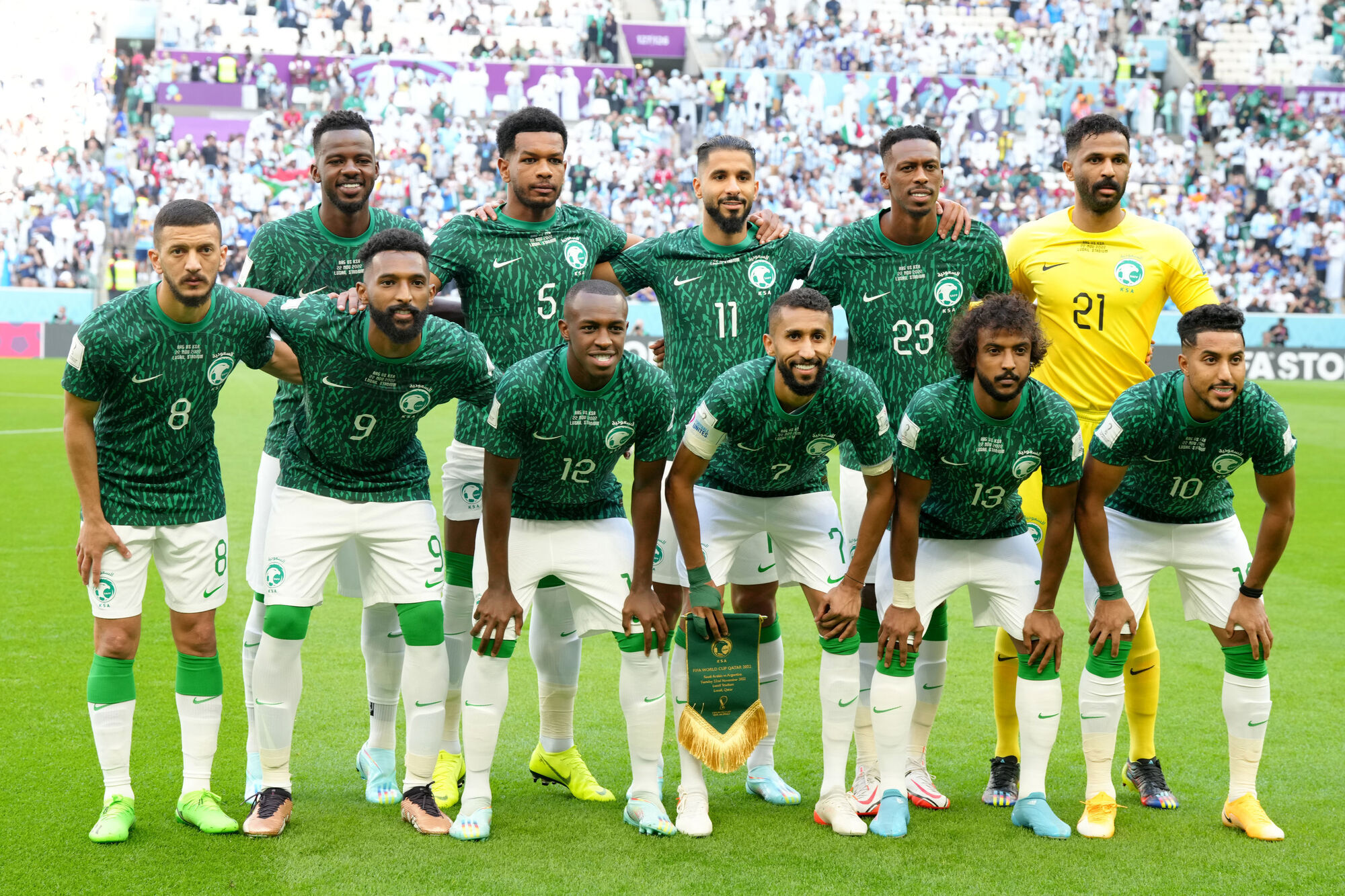
SHOCK OF THE AGES: Saudi Arabia pose for a team photo. Pic: Nick Potts/PA Wire.
THERE is always something of an unknown quantity to Saudi Arabia. Most of the 32 teams at this World Cup have at least a sprinkling of players who play in the leading European leagues.
Saudi Arabia’s players, like Qatar’s, play exclusively in their own domestic league, the Saudi Pro League.
Iran, in contrast, have players based in Spain, Croatia, Greece, Qatar, Turkey, Denmark, England, Portugal, Cyprus, Belgium, Germany, the Netherlands and the United Arab Emirates.
Some might see that as an indictment of Saudi Arabian football, but Yasser Almisehal, President of the Saudi Arabian Football Federation offers a different perspective. “The main reason no Saudi players play abroad is simply that the best players here are given very, very attractive offers by the Saudi clubs,” he says. “There is always a fight or a competition to get the best Saudi players, especially when their contract is expiring, so they get very, very high offers.”
The best-paid players in the Saudi Pro League are those signed from overseas, such as Al-Hilal’s former West Bromwich Albion midfielder Matheus Pereira, Al-Ittihad’s former Wolves and Leeds Utd winger Helder Costa and Al-Nassr’s former Benfica forward Talisca. But Saudi stars such as Al-Shabab’s Fahad Al-Muwallad and the Al-Hilal duo of Al-Dawsari and Salman Al-Faraj are not too far behind.
According to an agent who has negotiated with Middle Eastern clubs in the past, the leading Saudi players are “talented enough to play at a good level in Europe — not Premier League — but no European club would match the kind of money they’re on”.
Renard does not dispute that. “With what they are getting here, maybe they would have to play for Manchester City,” he laughs.
In January 2018, as part of an agreement between the SAFF and La Liga, nine Saudi players went on loan to Spanish clubs in the hope of gaining European experience before that year’s World Cup. These included Al-Dawsari at Villarreal, Al-Muwallad at Levante and midfielder Yahya Al-Shehri at Leganes.
But the nine players played a combined total of 59 minutes in La Liga — 26 minutes across two appearances for Al-Muwallad, 33 minutes in a 2-2 draw against Real Madrid for Al-Dawsari — and the project was quickly shelved.
Renard, who replaced Pizzi as Saudi Arabia coach in 2019, feels the La Liga experiment was well-intentioned but misjudged. “You arrive six months before the World Cup and you need time to adjust because in Saudi Arabia you don’t train with the same intensity as they do in Spain,” he says.
“You’re coming to a squad that is already established and the coach maybe doesn’t know you well and you have to adjust to a different country, different culture, different language, different way of training, different way of playing … and then January, February, March, April, May and it’s already finished.
“That must have been difficult for the Saudi players. If they were staying for one year or longer, it might have been different.
“Maybe we need one or two (to play in Europe). At one time, Egyptian players were only playing in Egypt. (Mohamed) Aboutrika was a fantastic player but he only played in Egypt because at that time their players were staying there. It’s similar with Saudi Arabia. And if you’re talking about a player at 27/28, it’s not easy to go to Europe, away from your family, away from your town, a different lifestyle, a different way of playing, not certain to play.
“It’s difficult to adapt at that age. But if we were to send some young players to Europe — 15, 16, 17 — I’m sure we would see the difference because they have the talent. Now we have some Saudi people owning some European clubs, so I hope they will take some young players from Saudi and I hope one day, they might be able to play in the Champions League. I’m sure it’s possible.”
Many of Saudi Arabia’s players perform in the Asian Champions League, of course — Al-Dawsari and Al-Faraj were key players in the Al-Hilal team that won it in 2021. But surely playing Argentina represented a daunting step-up in class.
Renard insists otherwise. “No, it’s not a disadvantage,” he says. “Sometimes it’s an advantage because all of them are playing in the Saudi league, getting better and better, the level increasing here. This is my fourth season here and I know this league very well. It isn’t an easy league. The technical quality is high.
“If I was to take one example, I love the Liverpool football under Jurgen Klopp,” he says. “This season they have had a lot of injured players, but if you can press the way they did when Sadio Mane was with them and Roberto Firmino in his best time and Mohammed Salah, when they won the Champions League, with Jordan Henderson and Fabinho in midfield, they were amazing. They were all working together for the team. This is what I like.”
The obvious question is whether it is possible to play like that in the heat of the Middle East — and with a Saudi Arabia team whose entire football culture is built around playing in sweltering conditions. “We actually did this very well in the qualifiers,” Renard says. “We were trying to press very high to win the ball, because if you look at the statistics, most of the time we had the ball."
© 2022 The Athletic Media Company. This article first appeared in The Athletic.

CONNECT WITH US TODAY



Be the first to know the latest news and updates