"'Hairy' prefaces my name, 'disgraced' used to...now I think it's time it is just Richard Keys.”
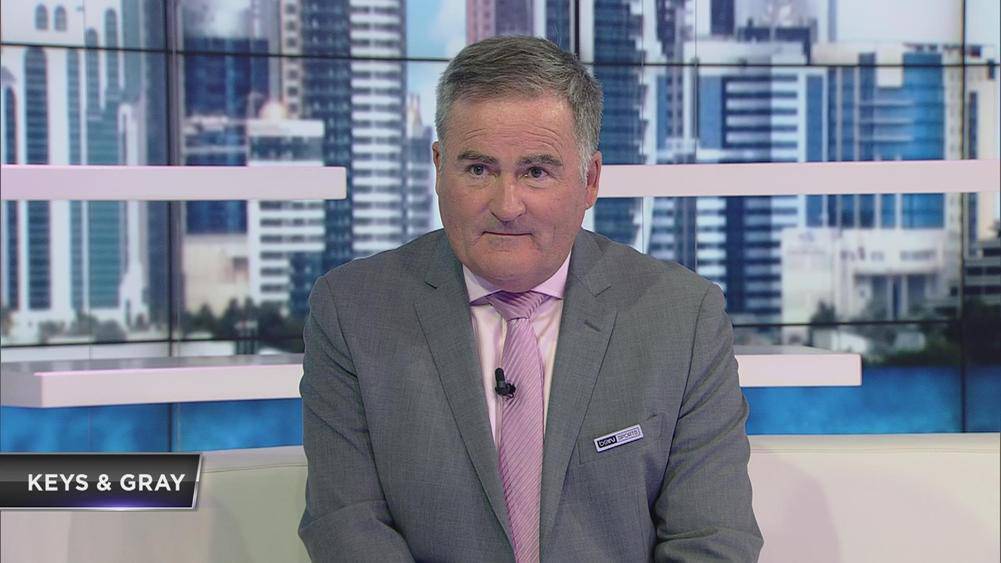
READY FOR HIS MOMENT: Richard Keys joined beIN Sports in 2011 and the World Cup is now following him to Qatar.
Like Frank Sinatra, Richard Keys is defiant when he says: “Regrets? I've had a few. But I did it my way.” The former Sky Sports kingpin has almost made as many comebacks as Old Blue Eyes, but retirement is the last thing on his mind as he contemplates the greatest sporting event on Earth taking place in his adopted homeland of Qatar.
It is almost a decade since he and screen partner Andy Gray decamped to the Middle-East following their controversial exit from Sky Sports in 2011. More on that later.
Their double act had made Sky's original Super Sunday and Monday Night Football programmes hugely popular in the UK, paving the way for others with a format that many have followed but few have surpassed.
Now their shows on BeIn Sports command audiences of tens of millions of viewers across 23 countries, and they are still treated as broadcasting royalty by guests including Arsene Wenger, Jose Mourinho and the many other managers and former players with whom they do what they do best – discussing football.
But Keys is still like Marmite to many, dividing mass opinion with his own opinions, which he is happy to promulgate on social media and his regular blog posts.
Controversy is never far away, and even in the past fortnight he has been consulting his lawyers about the latest accusations made by Gabby Logan in her recent memoir. The broadcaster said Keys and Gray made 'cruel' jokes in her presence in 2005, adding: “They were dinosaurs waiting to become extinct.” Keys, in particular, feels let down because, by Logan's own admission, he went out of his way to help her make great strides in a male-dominated world during the early years of her career.
When we meet for coffee in Doha for this interview earlier this week he had just spoken to his lawyer and asked not to go into detail over the latest controversy. He rarely does interviews, but agreed to my request because we'd known each other for over 30 years and share a background at Hayters, the renowned news agency that has launched hundreds of careers in sports journalism.
He still has fond memories of his 'apprenticeship' under the late Reg Hayter, who once took offence at part of an interview I had done with Keys during the early 90s, when he described the agency as “a bit of a sweatshop, but the best grounding you could get in sports reporting.” It was the former rather than latter part that upset Hayter, and Keys laughs at the memory. “Whatever he thought at the time, it was really hard work but the best leg-up anyone of our generation could have had.
“I'd come to Fleet Street from the Wolverhampton Express and Star because Reg doubled my wages from £29 per week to 50 quid a week, and for that I had to find a flat in London and work all hours. But I loved it and the characters I worked with, many of them giants of our business now, and it was the start of my career in broadcasting.
“Reg came in on my first day and said BRMB wanted a radio report from Arsenal v Aston Villa tonight. Everybody else put their heads down but I thought that is what I have come for so I said 'I'll do that.' Local radio was just about to take off and from that point on I took on as much work as I could. I got such a buzz from it, I knew what I wanted to do. I wanted to broadcast.”
The incident illustrates a key part of his character, never afraid to take a chance on something new, even if others warn caution. He moved from London to Liverpool for a two-year stint at Radio City, where he made “friends for life” including many players and the commentator Clive Tyldsley - “the best radio commentator I've ever heard” - and then on to covering the Manchester beat, United one week, City the next.
Six months later he was asked by a former boss to join the ailing breakfast channel TVAM. “So I gave everything up again and left a plum job to go and write scripts at TVAM.” That soon turned to presenting, along with Martin Tyler, as the channel struggled financially. “They stopped paying freelancers, there was a gap and I said I could do it. They hastily arranged a screen test, which was okay, and within the blink of an eye again, I'm now presenting sports bulletins at TVAM. It was an extraordinary ride.”
By the age of 27 he was presenting the flagship show Good Morning Britain along with Anne Diamond, but within three years was on the move again to British Satellite Broadcasting, shortly before their merger with Sky and the beginning of their coverage of the nascent Premier League.
“Satellite TV was starting up, I was getting frustrated, and I thought: 'Take Two, another big risk. Let's go there. So that's what I did. The takeover was scary but I've always put myself into a position where if there was a wave, I could catch it.” Sky was great for Keys and Gray, and the benefits were mutual as the channel and its coverage grew, critically and commercially.
“We were the new kids on the block, taking on the BBC, which was the mainstream," he says. "We were like a small commando unit, going in to blow things up and get out again, making waves, small wins inch by inch. It was great fun, scary again. Youthful bravado will probably always win out because there's something exciting about it. I've always enjoyed the adrenaline of my job for the last 35 years or so.” Tellingly he adds: “I've always enjoyed television most when it goes wrong. It's a whole lot easier when it's going as you planned. It's better when it's a test, which is when an anchor earns his or her money, when you're asked to do something out of your comfort zone.”
He ascribes the success of his double act with Gray on the former Scotland star's perfectly-weighted analysis, drawn out by the smart questioning of Keys, who describes himself as a journalist first and foremost.
“I think what Andy did with analysis helped a generation understand football better. He started with a blank sheet of paper and just started talking about football the way he looks at it. There is a huge difference between the way you and I look at the game and how professionals do. And the viewers loved it.”
The love-in at Sky came to a shuddering halt in January 2011 when a tape was leaked in which Gray had made derogatory comments off air about the capabilities of female referees. The story gathered pace when more tapes emerged of the pair's use of sexist language. Gray was sacked, and then Keys went on Talksport in an attempt to explain the situation, admitting it was 'prehistoric banter' but alluding to an agenda against them, and dark forces at work.
The following day, with questions being asked in UK Parliament and the affair dominating newspapers and the airwaves, Keys resigned. He still believes it was a set-up by those in power at the highest level at Sky, who wanted to project a more diverse and progressive image. Keys believes he and Gray were sacrificed, collateral damage in a drive for greater diversity.
He told me: “The situation we found ourselves in runs a whole lot deeper than what was presented at the time. It had very little to do with what was presented into the public arena, which was the tip of an iceberg.
“I never have but one day I will talk about what really happened because of the agenda. I got a lot of stick for using that phrase, and dark forces, but I knew instinctively there was a lot more happening. And it was only over a period of time that I discovered exactly what was and it's such a shame.”
In response to those critics who see him as unaware and unapologetic, he added: “I think probably all of us who were working there at the time, we'd probably had our time, we were done. The changes that came were probably required, but they should have been managed differently. And that's my regret.
“The perception at the moment, and I don't know if it'll ever change, is totally wrong and I don't think the amount of hard work we all put in at that time, not just Andy and me, was ever really ever appreciated or accepted or understood. We were commodities that were disposable, for many different reasons, by the Murdoch empire. And at some point I would I would like to put that right but not now.”
He is much happier talking about the pair's rehabilitation into broadcasting, given a second chance soon afterwards by Moz Dee, the visionary Irishman running Talksport at the time.
“I knew Moz as a friend, but at that time very few if any people were prepared to take what was a big risk on us. But Moz was, and I will forever be grateful. He came from left-field, and we wouldn't be where we are now if not for him. I remember him saying: 'You'll be back on television' and he was right.
“The first day at Talksport was extraordinary. The pasting we'd taken had opened a big wound and we were not in a very good place. My mind was scrambled, I didn't understand what had happened. We really shouldn't have been near a microphone. Andy thought it was too soon, I thought if we didn't go back on air then, we would never return.
“Moz got us through a difficult time. We probably were not very good for a while because we were suffering with mental health issues. I didn't know that then, but I look back on it now and we are all aware of that subject, and take it more seriously now, which is a good thing.
“Moz had two phrases he used with us. One of them was 'baby steps' and the other was 'muscle memory'. We got through it, and at the end of that year we won a Sony Radio Award!”
A year later, BeIn Sport came knocking, and the move to Qatar followed in 2011. “Coming here was unscheduled but turned out to be very good for a number of people including me and Andy and a few back home who got breaks that the perhaps they wouldn't have done otherwise.” The latter reference is to Gary Neville and Jamie Carragher, themselves controversial figures for different reasons, who have inherited Keys and Gray's mantle at Sky.
Against the perception of some critics that see him as a disgraced king in exile, sniping from the sidelines, Keys is not bitter. “I love it here. We put BeIn English on the map in this part of the world and it is now a significant channel, in 23 countries and an awful lot of Arabic radio stations. I take great pride in that.” He considers Qatar home and is delighted to see it host the World Cup, whatever critics in Europe and particularly England might say. “I work in a country that I'm enormously proud of. I know is not necessarily overly popular in England, who have have serious issues with Qatar. And I think that's based on missing out on hosting the 2018 World Cup to Russia, in a process in which Qatar got 2022. I still think the English press are trying to come to terms with the fact that they felt 2018 had been stolen, and that Qataris somehow manipulated that which is absolute nonsense.
“People who live outside England see the English as arrogant. I remember Geoff Thomson would introduce himself at FIFA meetings as head of the FA, meaning the English FA. That doesn't play well on the international stage. We made ourselves very difficult to warm to and still do.
“We don't want to embrace, we sit on the sidelines pointing and shouting, and it doesn't win any friends. Here they embrace, engage and are friendly and I defend passionately the Arab World Cup. It's not before time. It's not an England World Cup. It's for the world. England may have played a part in the process of football becoming a sport that everybody plays, but does not own football. The game belongs to the world, and therefore should be shared and enjoyed by the world. I feel enormously happy about the fact that it's coming. It's something I've waited 10 years for.”
Keys warms to his theme, dismissing the idea that he is an agent provocateur, a professional agitator. “People say I am a disruptor, but it was me who was disrupted,” he says. “I've never been afraid to go in where others don't want to go.” He is unrepentant about his highly opinionated blog. “I have an opinion, as everybody does and it allows me to keep my hand in writing. I may not go with the pack. I spend some time each weekend working out what I think Mondays and Tuesdays will look like in the national newspapers, and I try to go in a different direction. It stirs debate and it stirs a reaction which is okay.”
He was an early adopter of Twitter but laments the regular spats he gets into with his critics. “It has to a large degree been taken over by people who actually I feel sorry for because they must have very shallow, very meaningless lives to want to spend as much time on social media as they do abusing people.
“I don't understand that, especially when you've got a chance to speak to people that are in the public eye. I still talk to the big names in the game, have dinner with Arsene Wenger, Jose Mourinho. I know a little bit more than your average Joe on the terraces.
“But they (trolls) just want to tell you that you've got hairy hands.” He shows me his remarkably un-hairy hands and continues: “Hairy always prefaces my name, 'disgraced' used to and now I just think it's time it is just Richard Keys.” Going back to his exit from Sky, and the changes in the broadcasting landscape since then, he adds: “I understand that it's all had to change and that's only right. That's how it should be. But I'm very grateful to these guys here at BeIn because they still value experience and what we've done. Its’s a commodity I can trade here.
“I don't think there's a place for most people of our generation back in the UK (media) and that's a shame because we've got stories to tell and we've got friends to share with. But it's gone and I don't have a problem with that. Everything in the business had to change and I'm a great supporter of that. I'm very happy that that's the case. It should not just be the preserve of the ageing white man, not for a minute should it be. Life changes. The whole arena has changed. That probably is something that maybe I didn't understand as well as I do now. And now I'm a great advocate of it.
“Time passes. We all learn from things that have happened as we've travelled. It's been a hell of a ride and I'm very comfortable about where we are and what we do now.”

CONNECT WITH US TODAY



Be the first to know the latest news and updates