Will this be the best ever World Cup or will there be chaos?
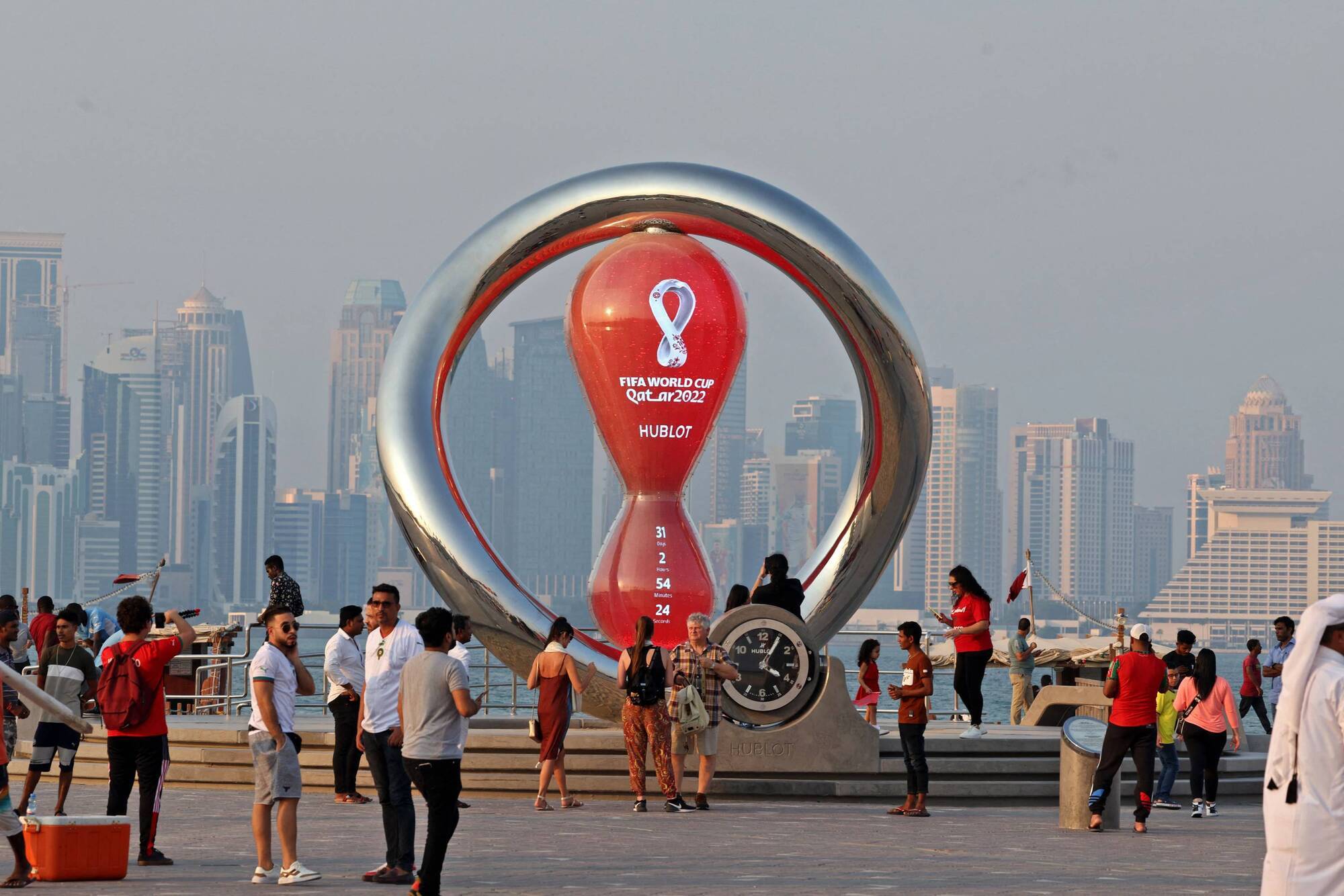
A picture taken on Thursday shows people walking past the Qatar 2022 FIFA World Cup countdown clock as it nears marking 30 days, in the Qatari capital Doha. Picture: Karim JAAFAR / AFP
THE World Cup kicks off in Qatar in a month's time, and the question everyone is asking is; what will it be like?
We've never had a World Cup in winter, nor in the Arab world or in such a compact country as Qatar, which is about a sixth the size of Ireland.
There has never been such controversy about the choice of hosts, nor uncertainty about their ability to deliver the world's biggest sporting event, so new is football to this tiny peninsula on the Gulf coast.
So as one of the 12,300 media accredited to cover the greatest show on Earth, I took a trip to Doha this week to see for myself how preparations are going, to find out what the locals as well as the organisers have to say, and to try to get some idea of what it will be like once the referee's whistle goes to get Qatar v Ecuador underway on Sunday November 20 in the Al Bayt stadium.
Will this be the best ever World Cup, as FIFA president Gianni Infantino confidently and boldly predicted last weekend in Doha? Or will there be the chaos expected by Qatar's critics, whose voice is widely represented in the European and North American media?
I have covered seven World Cups since USA '94, and never known antipathy towards the hosts such as Qatar has generated. The controversy has grown exponentially as the country has expanded and modernised at lightning speed, with questions rightly and repeatedly asked about human rights violations, and the conditions under which many migrant construction workers lived – and sometimes died. The number of deaths stated by the organising Supreme Committee (SC) and groups such as Human Rights Watch vary enormously, but there is no doubt that such a rapid pace of development, building the infrastructure in order to host the World Cup has come at a tragic human cost.
It was a radically different place, both in appearance and character, when I first visited in 2006 to cover the Asian Games. Doha was a fraction of the size it is now, with only a handful of high-rise buildings compared to the Manhattan-style skyline that now looks out across the Persian Gulf.
The number of western-style hotels could be counted on the fingers of one hand, so the best place for visitors and expatriates to get a drink was the ramshackle Rugby Club, right out on the edge of town where you could become a member for the day and buy a beer and enjoy the barbecue. It has since closed down, a victim of the pandemic, but there are plenty of places to eat and drink, no matter what you might read in the media.
Rhodri Williams, the former BBC and Sky presenter, has lived in Doha for a decade working for Al Kass TV and also runs three restaurant-bars at the Intercontinental Hotel. He will be playing host to hundreds of his fellow Welsh fans during the tournament, as well as Argentinians, English, Germans and the rest. “We decided to make the evenings when Wales were playing all-ticket events, and we sold out inside 13 minutes,” he said.
“We'll have hundreds here, and hundreds more on waiting lists. But there are no shortage of places to get a beer and enjoy the football in Doha.”
He does not think fans will have a problem enjoying themselves, despite scare stories. “It is against the law to be drunk and disorderly in public in Qatar, but it is the same in most countries. I've lived here for ten years, I like to enjoy myself and I've never had a problem here,” he adds.
The biggest shock for most fans will be the price of beer. Most bars ask around 50 Qatari Riyals for a pint, which is around €14, although the official FIFA fan festivals were charging around half that when Liverpool played in the Club World Cup in 2019.
There will be one huge Fan Festival at the Al Bidda Park in central Doha, accommodating 40,000 fans each night, and around 90 other fan-flavoured events throughout the country. Music stars such as Robbie Williams, Dua Lipa and Black Eyed Peas will be flying in to entertain fans, and there is talk of Shakira kicking it off on the opening night.
Getting around should not be a problem with an extensive Metro system that was built from scratch in barely six years and is clean, efficient and inexpensive. A single journey costs around 50 cents, but transport will be free during the tournament for anyone showing a Hayya card, the digital app required to buy match tickets.
I visited the Main Ticketing Centre when it was opened on Tuesday, and found the cheapest ticket on sale cost around €200. The organisers say they have sold almost 3 million tickets already, and are expecting over a million fans to visit during the month. Accommodation is a thorny issue, as ever, but another 30,000 hotel rooms were released last week, two huge cruise liners will arrive in early November, and there are even tented villages for the most basic option. I visited the apartment we have booked in central Doha and it is brand new, spacious and with all mod-cons. Most importantly it is finished, as are the eight stadia that will host the 64 games.
I went up to see Lusail Stadium, where the final will be played, in a brand new city built north of Doha. They are just putting the finishing touches to it, overlaying signage, as appears to be the case with the training bases teams will use when they start arriving in the first two weeks of November. It was hot when I visited on Wednesday, somewhere in the mid-30s at midday, but temperatures will cool over the coming weeks to something more comfortable for fans, and safe for players. Air-conditioning is standard in most buildings and transportation.
Getting there should not be a problem, either, as the Hayya card also replaces the need for an entry visa into Hamad International, which has been voted the world's best airport for the past two years.
Many fans plan to base themselves in Dubai and take shuttle flights in and out for matches, but there are direct flights out of Dublin for under €1000.
Everywhere you look in Doha, huge images of football’s superstars adorn tower blocks, but walking along the Corniche by the waterfront, it is still hard to gauge the level of excitement among locals because most of the sites are still under wrap.
But once the teams and the fans arrive, the stadia are unveiled in all their glory, and the football begins, then we can assess whether Infantino was right to say: “The world is excited. Qatar is ready. The stage is set. Together, we will deliver the best World Cup ever on and off the field.”
CONNECT WITH US TODAY



Be the first to know the latest news and updates