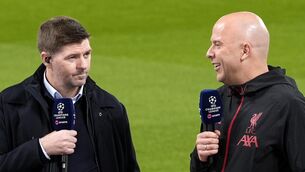
The Big Interview: "There I was one Monday morning, rambling around, going nowhere. And the bould Paul rang. ‘Howiya, Roddy!’"

A LIFE LESS ORDINARY: Paul Howard and Roddy Collins have crossed paths throughout their respective sporting lives.
At first glance they seem an unlikely pairing. Paul Howard is an Irish literary giant, a master of the pen. Roddy Collins wouldn’t even read the coaching books his pal Shaun Edwards would bring over when staying in his and Caroline’s house. Howard’s star continues to ascend; Collins’, prior to this project anyway, had seemed to flame out.
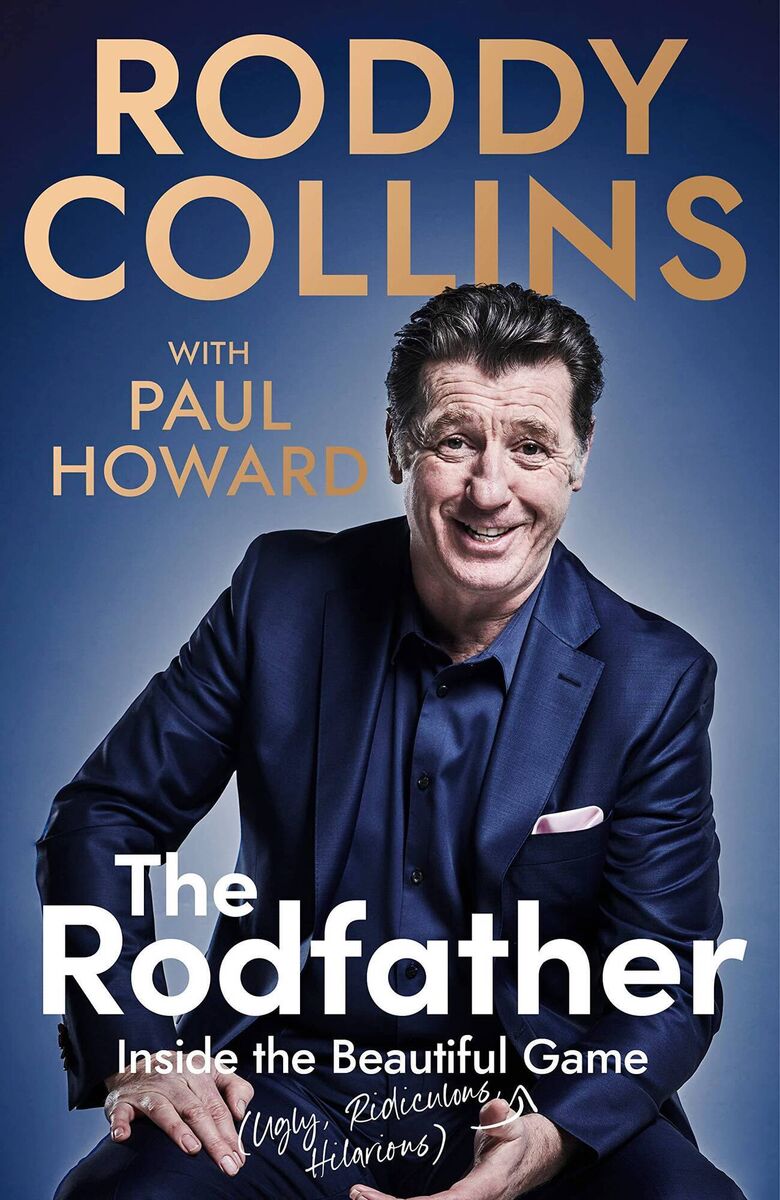
Yet here they are, doing the rounds, having collaborated on one of the best and certainly most rollicking and entertaining Irish sports books of recent years. Because ultimately they had even more in common, most notably a love and remarkable capacity to tell a yarn. Kieran Shannon met up with them to hear them recount more than one.
How did the book come about? Whose idea was it?
It’s a funny one. I had been asked four or five times over the last 20 years, including by someone about 18 months ago, but I had no real interest. I came home from that last meeting, talked to Caroline about it and she said, ‘The only man who could write a book about you and get you is Paul Howard.’ And I went, ‘Paul? Ah stop! He’s a superstar now, he wouldn’t be interested’ and thought no more of it. But then my agent Dave McManus rang and told me another fella wanted to give me a few bob to do a book. I said the only person I’d think about doing a book with would be Paul Howard but he’d hardly be available, but Dave being Dave he made a phone call. So there I was one Monday morning, rambling around, going nowhere, my world basically having ended. Why did I waste my time with football? Why did I do this, why did I do that? And then the bould Paul rang. ‘Howiya, Roddy!’
It was just one of those bizarre coincidences. Michael McLoughlin [of Penguin Ireland, Howard’s primary publisher] had heard Roddy on Second Captains and asked me: Is there a book in Roddy Collins? And I said to him, ‘Would you believe half an hour ago I had Roddy’s agent on the phone.’ Generally I’m not excited about the idea of ghost-writing autobiographies. There are probably only five in the whole world I’d have any interest in. But top of that list would have been Roddy Collins.
Why?
Because he’s such an amazing story. It’s like Forrest Gump in all the different places he goes. It isn’t the classic sports story in that it has a Rocky-like ending. When I wrote his brother Stephen’s book we had that Rocky ending with him beating Chris Eubank: your whole life is building up to this extraordinary moment and achievement. But Roddy has had a life that is full of peaks and troughs. Sometimes within a day of the other. When Roddy was sacked by Carlisle, the following day he was back in Dublin plastering on a building site and the lads were shouting at him, ‘I thought you were going to manage Ireland some day!’
They shouted a lot more and a lot worse than that! ‘You feckin’ wanker, Collins! You feckin’ eejit, you!’
To me that’s a real sports story. That’s a genuine sports story. About a journeyman who lost his heart to football as a kid and spent his entire life chasing a series of dreams.
Roddy, you went to some extraordinary lengths to keep those dreams alive. Tony Cascarino in his book revealed he shaved a year off his passport to make him a more attractive a signing for Marseilles. You shaved off two to make yourself more attractive a signing to an English team! What difference did that make to your career?
Well I was hitting 25 and hadn’t been pulling up any trees and I know when I was a manager myself later on I’d give a two-year-contract to a 23-year-old a bit quicker than I would to a 25-year-old. At 25, it’s ‘Where has he been?’ Whereas at 23, you’d be thinking, ‘Well, he’s broken his leg a couple of times.’ On top of that it was easier to make a 0 into a 2 if you shaved off the middle of the zero and twisted it. And it worked: when I went over on that trial to Mansfield the manager said it was a good age. I got my contract. Mind you when I went to apply for my pension at 35 they told me no, I was only 33! I had forgotten!
On Wikipedia I’m down as 60! And worth €6 million! I’m dying to meet the Wikipedia Roddy Collins!
Well you’d to go extraordinary lengths and an extraordinary number of clubs to keep the dream alive and carve out a career. When you look back on all that instability and insecurity that came from moving from one club to another, is it a life you’d recommend to others? You’ve a son who is playing in the tier just below the football league.
I’ve no regrets. Well, one or two, like the one with Johnny Giles (when Collins walked out of an Irish U18 squad upon learning he was a sub), but only the one or two. Now, would I like my son to follow the same path as me? No. He has an electrical company, he’s not dependent on football, so he’s going to be self-sufficient outside of football. Caroline was the one who suffered the most. Living in flats and hotel rooms, the two of us often broke. But last week we had a meal and we were talking about the book and the journey and I said, ‘Caroline, did I upset you?’ And she said ‘No. I love you and I loved doing it with you.’
The biggest break Roddy got in his life was meeting Caroline.
But she’s not a fool. And there came a time when she said, ‘It’s time for us to go home now and you to act your age.’ It was in Newport when I was 28. We were stone broke. We’d no house because I’d sold it and lost money on it. We’d to live in Caroline’s mother’s. I was there, thinking, ‘What am I after doing with my life?’
So what sustained you? You speak in the book about raising children in hotel rooms, the machismo of the dressing room in those days. Why were you prepared to be and stay in those places?
The challenge of it. To get back from breaking my leg the first time, then the second time. When I went over at 25, people here laughed at me. They’d say to Caroline, ‘He’s too old! He’s not going to get the chance to go back to England!’ But I did and signed a two-and-a-half-year contract which was a huge achievement. And then the challenge to be the best that I could be at that level.
Few players came back from breaking their leg back in those days.
That was probably more of an achievement than if I had signed with a Spurs or Celtic or Arsenal at 18, clubs I had either trialled with or was being linked with before I first broke the leg.
I think Roddy would have been a much less interesting person today if he had actually ‘made it’ in football. If he had become the centre forward at Arsenal and replaced Frank Stapleton and made loads of money he wouldn’t have had the life experiences that he’s had and indeed in football.
It’s only when you’re sitting down with Richie Foran at Carlisle and mention that you played Gaelic with his dad that we learned you played some GAA. How did you find it?
I loved it. Every summer I’d play with O’Connell’s Boys, Paddy Cullen’s old club, to keep me ticking over the offseason. The camaraderie was great. All the lads from the inner city.
Did football dressing rooms approximate that camaraderie?
Ah, no. Coming up as kids, it was great; you still see lads now and there’s that connection. But when it goes up to the paid ranks there’s almost none. I remember sitting in the dressing room in Mansfield beside an experienced pro called Neil Whatmore. Neville Chamberlain – that was his name – was missing and I said, ‘Where’s my pal Neville?’ And Neil pulled me aside and gave me a quiet word. ‘Just to fill you in – you’ve no friends in this game. You meet a lot of acquaintances but you’ve no friends.’ Now he got it wrong – because my pal Nev is coming over for a bit of a do we’re having in Hannon’s Corner at the end of the month. But it was – is – cut-throat. A player would be only down the driveway and he’d be already forgotten about.
The same with a manager. I’ll be honest with you: I’m a centre forward on the bench, I’m hoping the fella in my position gets injured. Not badly, maybe a torn calf that puts him out for six weeks, enough for me to get a place back in the team. That’s just the nature of the business. There’s no real affection for each other.
Though funny, you say at Mansfield it was the fellow strikers, including Neil Whatmore, who were the most welcoming there.
That’s right. They obviously didn’t feel threatened! They must have seen me play!
Paul mentioned you wouldn’t be who you are or where you are if the journey had been smoother. So where are you now? How are you now?
I’m in a great place. Very happy. I have a great wife, brilliant kids and have a bit of health, thank God. And the book is after giving me a new lease of life because I got the chance to let people know the truth about certain things. People have perceptions of me that are miles off the mark.
Such as?
‘Roddy Collins is a wanker, is a wanker!’
In Cork they go one better! ‘Roddy Collins is a horse’s shite!’ Look, in my first five years as a manager there were four Cup finals, three relegation [battle] successes, a league title, one runners-up and two European away wins [with Bohs against Aberdeen and Kaiserslauten. But then as [former newspaper editor] Ger Colleran once said to me, ‘You’ve taken on City Hall, you’re in serious trouble.’ And that derailed me a good bit. But I’m not giving up. I haven’t given up. I’m just after applying for a job in England as an assistant and one of the people [in the front office of the club] is a former player of mine. And he’s read the book.
What are your strengths that you feel have been underplayed or misperceived?
Well I’d believe one of my big strengths is how I’d be tactically astute. But people don’t ever put me in that bracket. I’m categorised as a loud, bombastic motivator. I watch games tactically and how managers react to certain patterns in a game. ‘Right, that’s a problem that’s been going on five, six, eight, ten minutes now and nobody has corrected it.’ I would judge a manager on that – and myself on that.
I remember being a manager at Bangor the same evening Steven was fighting Eubank. I had a problem at halftime and was going to make a change but I said to myself, ‘I’ll give it five minutes.’ I walk out of the dressing room, a BBC reporter grabs me for a few words, the game kicks off, and boom, Linfield score a goal from the problem I had seen at halftime. I learned that day that if you have a problem tactically you cannot afford to wait.
The year we won the league with Bohs we were 4-1 down to Rovers in Santry at halftime and ended up winning 6-4. Only one person, a real football man, has said to me that he noticed that we took a left full off and went with a right full, two centre halves and no left full. No one else spotted it.
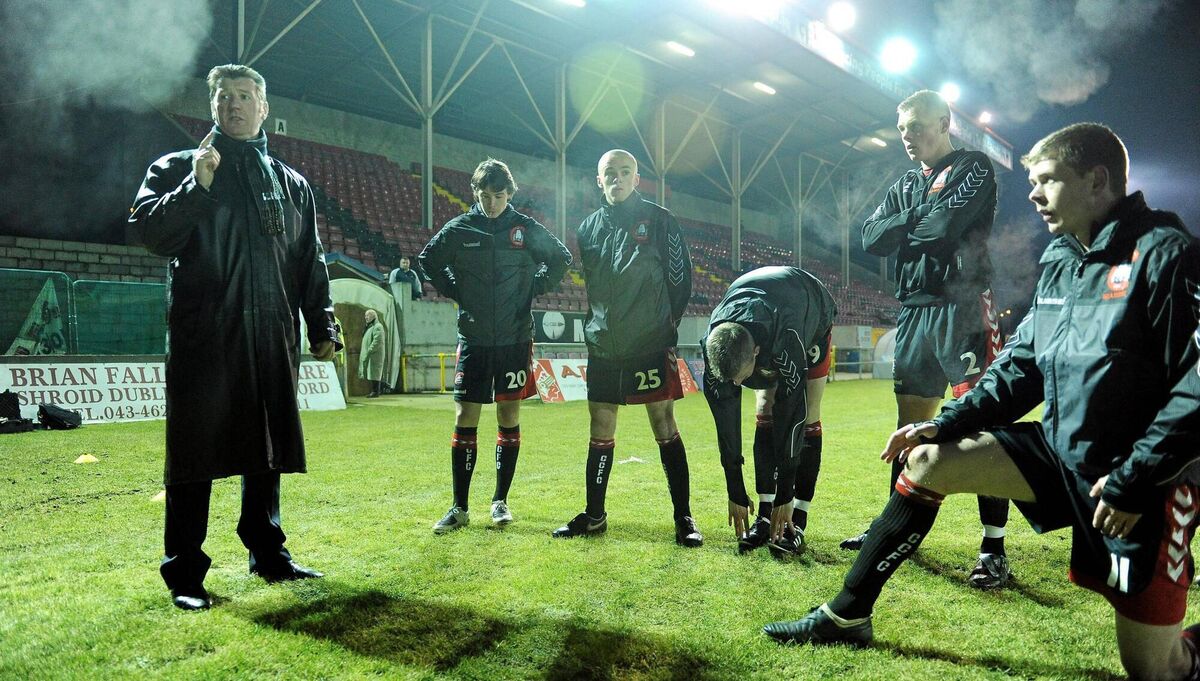
You don’t survive relegation dogfights in England without pulling rabbits out of the hat during games. I used to come up against one manager and seven minutes before halftime I would always switch the formation and gain control of the game. Then I would come out for the second half back to how we started off while he’d have changed his team. That’s tactics. And I love that. It’s like being in a boxing ring. I loved moving people onto a certain punch, drawing people onto a shot, moving round the ring, psychologically making them predictable and dictating their movements.
Well talking about dictating people’s movements and various tactics you’ve used, there’s the time you bought a toy gun, stuck it under your coat and used it as foil to get a business worker to pay you the money they owed you…
When he told me that story it brought me back to my early freelance journalism days when I had similar problems getting paid! I wish I had thought of that one! I’d be a richer man today if I had!
There’s several times in the book where you brush with using violence or even display it. Like the time you retrieve some items that were stolen from your family.
Yeah, the house was burgled shortly after me da passed away. Not long before that he had given me ma a charm bracelet so it obviously had huge sentimental value to her. A leather jacket of his that I had started to wear was also knocked off so I went round to the usual suspects, learned who it was and banjoed him.
You talk about developing a ‘Cabra eye’, street smarts. How it was a tough area. But you also write with great affection about the place.
Ah, Cabra was brilliant. We got up to all kinds of mischief and harmless fun.
Paul, you’ve written extensively about Dublin before, often in satire. How did you find depicting the city and Cabra for this project and what it was like through the 60s, 70s and 80s?
Well, Roddy doesn’t believe this because he thinks I’m a soft southsider but I had quite a similar upbringing to Roddy. I grew up in a council estate in Ballybrack which was similar to Cabra in many ways: it had the same social problems but also a great sense of community where people looked out for one another. So I understand when Roddy talks about his working class childhood because I had one as well. I loved those stories. The bitter and the sweet.
Paul didn’t just listen to me talk about Cabra. We spent a whole day there walking the streets, going round to the school I went to. We stopped in Clarkes Bakery for a roll and one of the local characters walking by shouted at us, ‘Ah, Mountjoy!’ I looked at Paul. ‘You never told me you were in Mountjoy!’ But of course Paul wrote a book The Joy and your man had spent half his life in the place. As he told us that day, ‘See that bank across the road? Three times I cleaned it over!’ A couple of local characters, that was their pastime or occupation if you like: removing money from banks. As kids you’d see them with their flashy cars and think ‘God they’re great’ but when you got older you’d realise there was no future in that carry-on.
It’s an era before drugs that you depict.
I never saw a drug addict when I was growing up as a kid. It would not have been tolerated. I suppose you could say you only had ordinary decent criminals back then. I loved the place. Still do.
Central to the Cabra you knew was your father. But he died when you were 21, as did Caroline’s dad a few months later when she was expecting.
It was something that hit me reading it back again: the proximity of when they both died. It was unbelievable. And horrendous.
I’ve now written autobiographies of two members of this family now and a recurring theme is how much Paschal’s absence looms over both stories. His absence is almost a presence.
And another hero in this book apart from obviously Caroline is Turlough O’Connor because he entered Roddy’s life at a time when he was looking for a father figure. And what a father figure to get. They had this extraordinary relationship. Turlough clearly thought the world of Roddy yet when it came to selling him he had no qualms whatsoever!
Ah, he could be ruthless!
Yet he helped get you a mortgage.
And signed him five times. And got him the Bohs job.
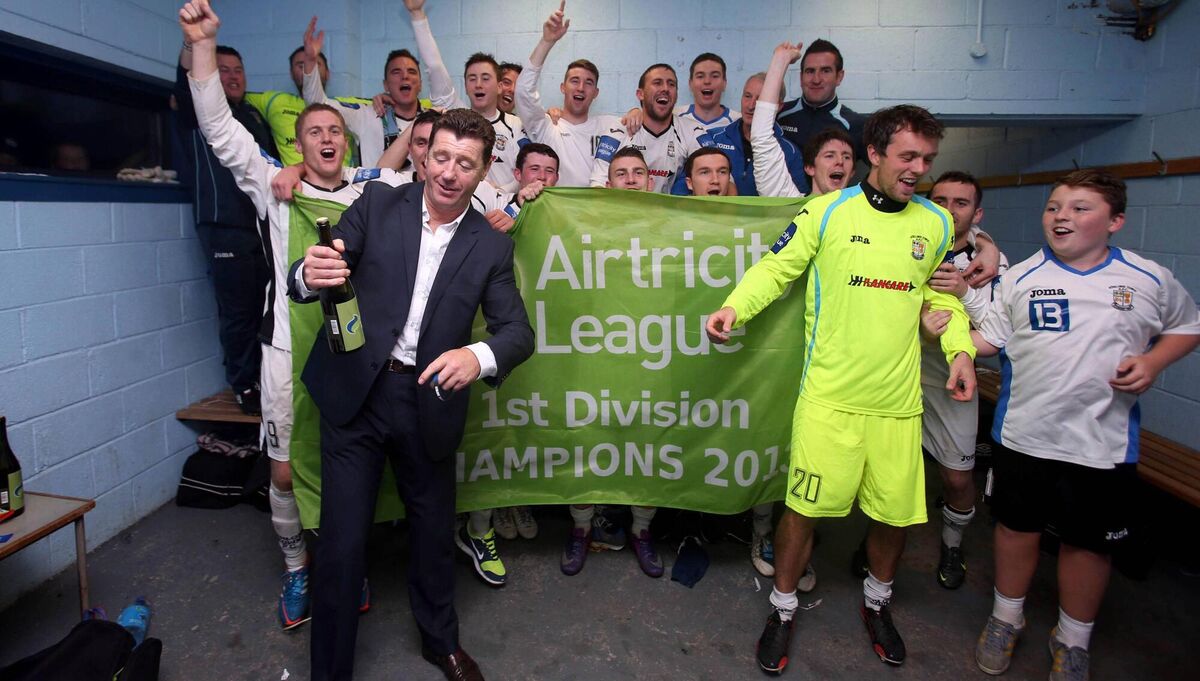
And the one in Athlone when we won the (First Division) league.
I actually feared Turlough, but not in a physical way. His opinion of me would concern me. I remember one night I came in absolutely mouldy and Caroline wasn’t having it so I was thrown out, all my suits were in a bag and I used them as a pillow to sleep in the van outside! The next morning there’s a knock on the van. I’m like, ‘WTF is going on!’ Then Caroline opens the door: ‘Turlough, YOU talk to him!’ I was like, ‘Oh Jesus! Don’t tell on me! Not to Turlough!’ I had so much respect for the man. He created an atmosphere in a dressing room where everyone dug in and there was always a great bit of craic.
Was that something you tried to create too?
I loved with working with players. People. Still do. Every player I signed from outside of Ireland for Bohs I met them at the airport and brought them home for a bit of grub with Caroline and with the kids around the place. You’d find out their manner, personalities. I always say the football dressing room is like a pot of stew – you need all kinds of ingredients.
Dave Hill for instance: the most professional fella I’ve ever dealt with. He’d go have his laces ironed and boots polished – for every training session. Then you’d have the more wayward lads.
I was talking to a player the other day and he said to me, ‘There was this one night we didn’t give it our best and you weren’t happy so you brought us all in on a Sunday morning?’ And I did. Beforehand I bought sausage sandwiches for everyone and then I ran the guts out of them, then we had a pot of tea and the sandwiches. Anyway, there was this one fella who was in the top four in every run but the smell of gargle would knock a horse down. So afterwards I went to a player, ‘Was he drinking last night?’ He confirmed he was so I called this fella over.
‘Were you drinking last night?’ ‘I was.’ ‘How much did you drink?
‘Eight pints.’ I said, ‘With the talent you have, would you not take this more serious?’ He said, ‘That’s me being serious. Normally I’d have 15 pints!’ Look, it’s all a mishmash of personalities. Richie Foran couldn’t do keepie-uppies but could he score a goal, so when we’d be doing exercises with the ball and call ‘Get the ball off the floor’, I’d say, ‘Richie, tie your laces.’ Another fella had a drinking problem so I’d say to him before we’d do runs, ‘You go into the physio for a rub.’ You were always protecting players to get the best out of them.
In In trying to squeeze a win at the weekend, would you make a more sustainable intervention with the fella with the drink problem?
That was my forte. To get and give everyone help. Because when you look at a fella in the eye and you need him to die for you, you want him to be able to look you in the eye and say ‘He never let me down.’ I was their manager, their mentor, their social worker, their fixer. I got fellas out of police stations, paid fines no one knows about and never will. I had great contacts and got them out of financial problems. I even got them suits off Louis Copeland!
There was this overcoat in Louis’s for 12 years – and he couldn’t sell it! But we’d this player come sign for us and he said, ‘I need an overcoat.’ The same fella used to come in dressed like a farmer every day! So I rang Louis, ‘Louis, this could be the day you get rid of that overcoat!’ So your man bought it and thought it was great! He’d looked like a bleedin’ pallbearer! Louis thanks me to this day. He’s never forgotten that overcoat.
So, look, I loved looking after lads and still love meeting up with them and giving them a hug. You see Klopp going around the pitch hugging his players; I was doing that 20 years ago. And I meant it.
Now, I didn’t love every player. There was one player, great talent but an absolute moan, constantly going behind my back. So we used to do a boxing club thing and I’d do a round with each of them. Well, I used to stick him with some heavy right-handers! Sure I couldn’t fine him because he’d have gone to the union!
Paul, you’ve studied a lot of sportspeople and coaches. What do you think made Roddy a good manager but also what made him keep hitting a certain ceiling?
Well the first thing that I noticed when I first met Roddy was that he was a centre-of-the-room kind of guy. I was covering Steven’s fights from when I was 18 and you’d walk into a bar or a hotel or the room where the weigh-in was and Roddy would be centre stage surrounded by people hanging off his every word. And people are still attracted to Roddy that way. He has that charisma and personality which is very absent in sport these days. And I think in football that both helped and hindered Roddy.
There were clubs he was at where a lot of players needed a confessor type of character. That was definitely the case at Bohs. Some managers got a tune out of Paul Byrne but nobody got a tune out of Paul like Roddy did. And that was all about their relationship. There’s a scene in the book where Roddy goes to see him playing for Pat’s and in the middle of the game Paul shouts over to him, ‘Get me the f*** out of here, Roddy!’ I think that’s why Roddy was so good at saving clubs from relegation. The mood is down, players are worried about where they’ll be next year and if they can pay the mortgage. Then Roddy comes in and it’s very hard to be in bad form when Roddy’s around. His good humour is infectious. And he understood human nature, the difficulties a player might have outside of football. Everything he went through himself informed his engagement with players.
But there’s a line early in the book when Roddy walks out of school: he always had a problem with authority. Especially when he felt it wasn’t acting in good faith. And boards of football clubs can be difficult to deal with it.
I’d have been very impatient and very demanding. If I go into a job it’s to win the league. Now, it might take two years, three, ten, but that has to be the ambition. Not every club had that ambition.
There comes a time though where the old line about the definition of insanity kicks in. What way would you go about dealing with boards now?
I’m older now. When I was with Bohs I was a young man who felt I was dealing with old fogies living in the past.
Do you rail against the idea that your own time has passed?
Yeah, I don’t buy into that. The Bohs job came up recently and I was told in no uncertain terms not to bother applying for that very reason. But I’m in for a job in England now with another lad over there. I’d be his assistant; he’s been in the furnace there. I can relate to young people, no problem. I walk around town and have the craic and chat with them. To me football hasn’t changed that much, people within it have. Young players are more opinionated now and so I just let them talk and I listen. And I have ideas on how to play the game, change the game. I know players who would create HAVOC with a system of play I have in mind. So I have the energy, my faculties are still there – if they were ever there in the first place!
In the book it mentions you were in line for a job in China just as Covid was breaking out there. What was the last team you worked with?
Well, professionally, Athlone four or five years ago. But I helped out Achill Rovers last September. I was down in Achill for a month and Tony Grealish, the man over the premises I was renting out, was the club chairman. So I took the team for four weeks training and their games and loved it. Their enthusiasm, the respect they showed. It was brilliant.
That didn’t make the book. I’d say, Paul, there was a lot of good stuff that didn’t.
That was the challenge with this project. It could have been like Winston Churchill’s autobiography which was broken into five books. But the great thing about it was we’d always got on well. We’d hit it off from the first time we met when I was 18, covering Steven’s career, and had no money.
I remember covering Steve’s fight against Reggie Johnson in New Jersey when I was 21. My parents had bought me the plane ticket over as my 21st birthday present but otherwise I was skint. Homeless. I was staying with the family of Joe Egan, the former heavyweight champion, out in Brooklyn but that was a four-hour round-trip from the Meadowlands. So this started the pattern of me sleeping on Roddy’s and Caroline’s floor in hotels. I must have slept in seven or eight of them!
We used to call Paul the Milky Bar Kid because he looked about 12. And I remember one night we were in an hotel after having a bevvy and at about three in the morning when we were about to go to bed, Caroline said, ‘That poor kid is still sitting over there.’ So she went over to him, ‘Paul, get up to bed.’ He said, ‘I’m just going to stay here, I don’t have a room.’ She said, ‘That’s not happening’ and pulled the mattress off our bed, threw it in the corner and we slept on the base of the bed!
Some people will remember that Steve distanced himself in court from the book you did together a couple of years after it came out. That obviously affected your relationship with him. Did it not affect your one with Roddy?
At the time I was definitely hurt by it. But now I kind of understand it. He’d said a lot of complementary things about Barry Hearn in the book so when he was in court for a breach of contract he obviously wanted to distance himself from that. But it never affected my relationship with Roddy or the rest of the family. We stayed on great terms.
And I will also say Steven overall was very good to me over the years. I was a teenager trying to make it as a sportswriter, and in those days the way you did it was to hitch yourself to someone’s wagon. I interviewed Steve for the first time before the Mike McCallum fight and I thought, ‘This guy is the real deal, he’s going somewhere, I hope I can hang onto his coat-tails!’ And I did. He gave me access I never would have before or since to a sportsperson. And that only happened because of his generosity and his family’s.
Do you remember the time you got the wrong water for him in the corner?! You nearly cost us the fight!
That actually happened. There’s a passage in the book about a journalist bringing sparkling water back to the corner for Steven to drink between rounds. Well, that was me! That was the night he won the European middleweight title. In Verbania, Italy.
About 10 years ago I was at a wedding in the very same town. Myself and [his wife] Mary were standing on Lake Maggiore and I said, ‘Mary, I have to ring Roddy.’ And I still had his number on my phone so I rang him. ‘Roddy! You’ll never guess where I am!’ And all the memories came flooding back. Because those were the best days of my life. I have never spoken to Steven since [the court case] but I’d love one day to talk to him [again] because it’s over 25 years ago now and at this remove the memories I have now of those days are only positive ones.
I hadn’t an arse in my trousers yet there I was covering those fights, being in the dressing room before and after each fight. Sure that’s the stuff you dream of as a sportswriter. To go home with blood on your shirt because you’re that close to the ring. We lived through a golden period for sportswriting where that was possible but those days are gone now. The access is roped off. There’s a PR person standing there saying after three questions, ‘Okay, wrap it up now.’ The athletes and coaches are nowhere near as open as they were.
Well we know of one manager who still is.


CONNECT WITH US TODAY



Be the first to know the latest news and updates